

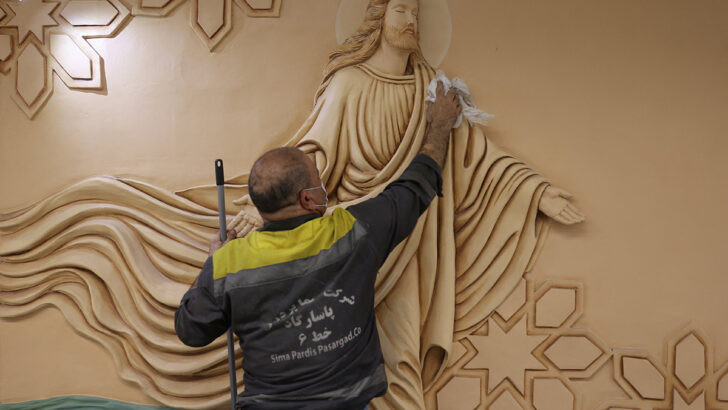
 A worker polishes a relief sculpture of Christ at the ‘Holy Mary’ subway station in Tehran, Iran. Work is one of the places dignity is exercised and revealed. Photo: OSV News/Majid Asgaripour, WANA via Reuters.
 A newsletter I read signs off the same way every time: “To a future of Abundance.” The writer, futurist Peter Diamandis, is one of the leading evangelists for what artificial intelligence is about to do for us, and I read him because he gives confident voice to the optimism our culture now takes for granted.

A recent dispatch promises a feature film generated on demand for the cost of a search query; a patient, brilliant tutor for every child on earth, free: Einstein himself to walk your daughter through relativity. And underneath it all, a question he tosses off almost in passing: when work becomes optional, where do meaning and dignity come from?
Work is not the cost we pay for dignity; it is one of the places our dignity is exercised and revealed”
That question gives away an assumption. It treats work as a burden we will gladly set down once the machines can carry it, and dignity as something we must then source from elsewhere.
Pope Leo XIV’s first encyclical, Magnifica Humanitas: On Safeguarding the Human Person in the Time of Artificial Intelligence, begins from the opposite conviction. Work is not the cost we pay for dignity; it is one of the places our dignity is exercised and revealed. Leo stands in a long line here, back at least to Leo XIII, for whom the primacy of human labour over every mindset fixed on finance or productivity was a first principle.
I enjoy the prospect of rest as much as anyone, and the encyclical is no brief for drudgery. But to frame a future in which work is finally optional as pure liberation is to concede that the human person is, at bottom, a consumer to be satisfied rather than a maker and participant. Leo poses his whole encyclical as one question borrowed from Scripture: “What are we building?” A culture that cannot wait to stop building has already half-answered him.
Unsettles
The second promise unsettles me most: the free, brilliant, infinitely patient tutor. Notice how easily the human teacher drops out of the sentence, as though the one who forms and educates were a mere container for information, now decanted into software.
This mistakes what happens when one person forms another. We are not formed by content delivered on our own optimised terms, but by dwelling with someone, reckoning not only with their thoughts but with how they think. Leo names the danger: the deepest risk of these tools is not that we mistake a machine for a person, but that we “may gradually lose the very desire to form genuine human connections.” A simulated friend has no limits for us to bear with, and so can never become a real friend; the simulated tutor can transmit, but it cannot dwell.
The entertainment promise hides the same trap. A blockbuster generated for my mood and taste sounds like a gift until you notice what it forecloses. Tastes that are only ever flattered never grow. Real culture, like real teaching and real friendship, works on us by exceeding our preferences, handing us what we would not have chosen and would have been poorer for missing.
Incapacity, illness, old age, suffering, vulnerability – ‘tends to be seen primarily as a defect to be corrected, rather than as a reality through which our humanity matures and opens itself to relationship’”
Underneath all three promises runs one confusion about where human grandeur comes from. Diamandis locates it in what we can build, scale and seize. Leo, taking his title from Mary’s Magnificat, insists that the humanity worth safeguarding is not constructed but received, as Mary received it, and then magnified in praise. Everything that looks like a limit, he writes – incapacity, illness, old age, suffering, vulnerability – “tends to be seen primarily as a defect to be corrected, rather than as a reality through which our humanity matures and opens itself to relationship.” Optimise the limit away, and you optimise away the better part of being a person.
Refusing
None of this requires refusing the real goods on offer; the encyclical itself rejects both naive enthusiasm and unfounded fear. But it asks us to keep the question open rather than let a slogan close it.
“To a future of Abundance,” the newsletter promises. It is an alluring word, which is why it deserves scrutiny rather than applause. Abundance of what? At what cost? At whose expense? A future overflowing with frictionless entertainment, optional work and simulated companionship may be abundant in everything except the things that make us human: the labour that forms us, the people who resist our preferences, the limits through which love learns its trade.
Leonard J. DeLorenzo is a professor of the practice in the McGrath Institute for Church Life and concurrent professor in the department of theology at the University of Notre Dame.