

 Mary Kenny
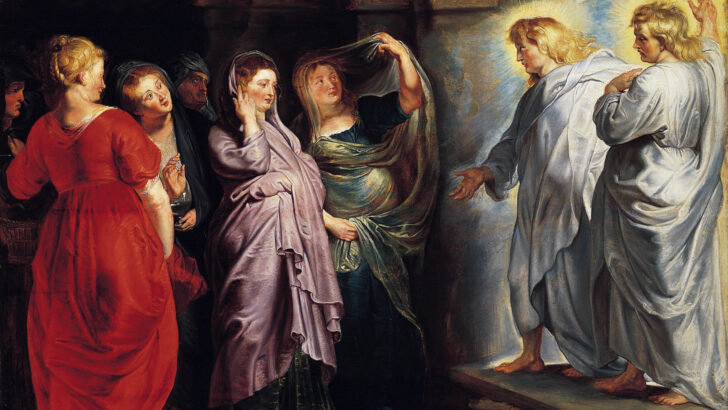 The Holy Women at the Sepulchre by
Peter Paul Rubens. Photo public domain
The Holy Women at the Sepulchre by
Peter Paul Rubens. Photo public domain You’ll have noticed that there’s a current fascination with the ancient world, exemplified by Christopher Nolan’s blockbuster movie of The Odyssey, and the likes of Prof. Mary Beard constantly extolling the glories of Imperial Rome.
Dominance
Books tracing the dominance of pre-Christian Greece and Rome, and their influence on our civilisation flow regularly off the presses. A new scholarly study – ‘Rome’s Age of Revolution’ – by Tim Whitmarsh links the Emperor Augustus, the Roman Empire and the making of Christianity.
This classics’ master argues that Christianity and Imperial Rome had more in common than the popular image of Christians being thrown to the lions supposes. Christianity, he tells us, embraced many of the old Roman structures.
But the question that still remains a puzzle, for Prof. Whitmarsh, is: how did Christianity come to conquer the ancient world and effectively replace the Greco-Roman civilisation?
Plan
Some Christians would simply say this was God’s plan. I’d claim that the means of implementing that plan was crucial.
The classical world was remarkable in what it built, but it was a man’s world, and a world of warriors, brutal and exploitative”
And the answer is – women.
Christianity conquered because it involved women, from the beginning. Mary, the mother of Jesus, Mary Magdalene, Mary and Martha, the sisters of Lazarus, and the early Christian women who lined the route to Calvary, as well as early martyrs like Sts Perpetua and Felicity, were key to the faith’s formation.
The classical world was remarkable in what it built, but it was a man’s world, and a world of warriors, brutal and exploitative of human life.
Values
Women were drawn to Christianity from the outset because it offered so many more female values: compassion, forgiveness, and respect for human life. (In Rome, unwanted infants were exposed and left to die; Christians started rescuing them.)
And that, I suggest, is an answer to the professor’s question of what was the special ingredient Christianity had which other faith systems did not? Christianity recruited half of humanity – women as the first converts and evangelists.
The ideals that shaped Christianity remained and still endure”
Yes, it needs to be admitted that throughout the ages Christian cultures manifested plenty of warrior-like behaviour; brutal wars and repressions occurred in all Christian nations. But the ideals that shaped Christianity remained and still endure.
I don’t have the scholarship to produce a tome along these lines, but somebody, better educated than I, should author a book on the theme How Women Forged the Christian World. It would fit perfectly into the current fashion for western civilisation’s roots.
***
It’s the season of summer weddings, and I note that the trend for adding ‘no children’ to a wedding invitation has come to Ireland. This has been a practice – among some – in GB for a while now.
Those celebrating their nuptials with the ‘no-children’ rule say they just want a smooth experience without kids running amok, or without the responsibility of someone having to mind them.
Yet it obviates the original point of matrimony – which was an aspiration to beget offspring. In every society, weddings have a dynastic element – bringing families on both sides of the aisle together. And how do families start? With kids.
I realise matrimonial fashions and rituals change over the years, and younger people have to do things their way. But when the ‘no kids’ stipulation is issued, shouldn’t someone point out the original point of wedlock?
Incidentally, there’s also a book to be written about the experiences of priests conducting marriages over the years. Some older priests surely have a story or two to tell about weddings they’ve administered…
***
One of the most dispiriting aspects of the late Brenda Fricker’s autobiography (She Died Young – a Life in Fragments) was her description of her mother, Bina.
Brenda depicts Bina as a cruel religious zealot. That’s sad, even allowing for the notion that memoirs are often emotional impressions rather than objective fact. But Brenda claims that Bina beat her “black and blue”, while purporting to be a strong Catholic.
As a consequence, Brenda spurned religious faith; her life was clouded by depression and her outlook, I felt, was nihilistic. Yet she accomplished a great deal as an actress (and she preferred to be called an ‘actress’ rather than ‘actor’) and perhaps her emotional pain brought insight to her many outstanding roles.
Reading Brenda’s story made me reflect on a contrasting point: those of us whose parents were kind and gentle in the practice of their faith were blessed indeed.
But then we never know what demons drive a person like Bina to act in the way Brenda describes.
***
It’s horrible that about 20,000 seafarers are stuck in the Strait of Houmuz during the current conflict. These marine workers are just doing their jobs, mainly transporting goods serving the world economy. They could be fatally hit at any moment. One source of support is the Mission to Seafarers, composed of chaplains and volunteers, who may contact them. What a worthy apostleship.