

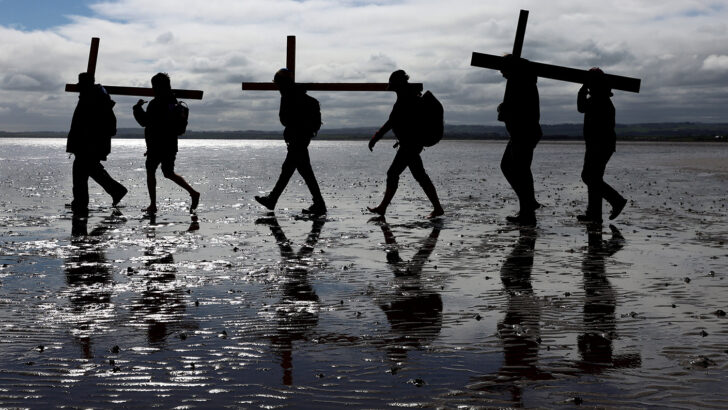
 Pilgrims walk across a tidal causeway while carrying crosses during the final leg of their Good Friday pilgrimage in Berwick-upon-Tweed, Northumberland, England, April 7, 2023. Photo: OSV News /Lee Smith, Reuters.
 Nobody is responsible for everything; responsibility calls for discernment, writes Fr Chris Hayden
***
When we feel overwhelmed by circumstances, we are vulnerable to negative emotions of all sorts. The more of the weight of the world I carry on my shoulders, the more likely I am to feel crushed by sadness and anxiety. To be a responsible citizen does not mean carrying the burdens of nation and world. Nor, of course, does it mean shirking one’s share of those burdens. Responsibility calls for discernment: What can I reasonably do? What tasks can I reasonably take on? Discernment will also ask: What can I reasonably leave undone? What are the limits of my engagement?

In the present cultural moment, we owe it to ourselves, to our loved ones, and to our society, to challenge the practice of piling on anxiety and calling this responsibility. Nobody, to repeat, is responsible for everything; and if we are made to feel responsible for vastly more than we can possibly address, the result will be anxiety and paralysis, rather than responsible action.
Seditious
It is not irresponsible or seditious, nor is it even slightly unpatriotic, to suggest that certain things, even some terribly important things, are beyond my capacity to address. It is not foolhardy, but eminently wise, to resist the globalisation of anxiety and its propagation via the media, both social and ‘legacy’. There will always be fearful issues and threats, but we gain absolutely nothing by adding the paralysing assumption that we are personally responsible.
The burden of personal responsibility is not unlimited, and if we are made to feel as if it is, then we will pay a heavy price of sadness and anxiety”
That said, there are complex issues of social and political morality here. We are sinful creatures living in a sinful world, and we cannot simply wash our hands. But the burden of personal responsibility is not unlimited, and if we are made to feel as if it is, then we will pay a heavy price of sadness and anxiety. And let’s be honest, the burden of personal responsibility is sometimes emphasised to the point where ordinary men and women, and – more sinisterly – ordinary schoolchildren, are made to feel like burdens or even parasites, rather than responsible actors who have a role – a real but limited role – to play in ensuring human flourishing in a healthy world.
Condone
To stress the fact that any given individual is limited in what he or she can do is not to make excuses, or to condone indifference. To establish the limits of our responsibility is not to say, “I can do nothing.” It is to say, “This is what I can and should do, and I will do it.” To have no sense of one’s limits is not to say, “I can do everything.” It is, rather, to be paralysed.
In Christian theology, the practical heresy of quietism would leave everything to God and disregard the need for thoughtful, discerning human action. Like every heresy, this one appeals to a grain of truth: we do, indeed, depend on God for everything; we can do nothing without him. But for Christians, life in this world is a partnership with God and his providence. Quietism loses sight of the partnership and would leave the whole business to God.
We should severely question the bona fides of those who set themselves up as the righteous, knowing purveyors of fear”
The observations I’ve made regarding the limits of our responsibility and our acting, are not a version of quietism. On the contrary, having a realistic sense of where our responsibility begins and ends can spare us a great deal of angst, and the energy and focus we save can be channelled into productive action. Buckling beneath a global anxiety pile-on does not make us productive, and we should severely question the bona fides of those who set themselves up as the righteous, knowing purveyors of fear.
There is no contradiction between trustful faith and effective action in and for the world. There are many high achievers who go about their business with a Novena of Surrender in pocket or purse. Their reserves of mental energy, which have not been unduly depleted by anxiety, are free to be channelled into concrete tasks. Because they have a sense of their limits and their boundaries, they can focus clearly and with a certain intensity on what they set themselves to do. We needn’t, of course, romanticise or idealise! The most fervent and trustful believers will have their off days; days on which they are sad or afraid; days on which they are brought to their knees, both metaphorically and literally; days which the Lord, in His providence, will use to teach them that when all is said and done, salvation is from Him alone.
Notions
So let us, as people of faith and good sense, spot and reject excessive notions of responsibility. Let us prudently limit our sense of responsibility, not so that we may do nothing, but so that we may do something, and do it well. And let us be very sceptical indeed of those who are in the business of placing upon others responsibilities that far exceed anything that human nature allows or God’s providence asks.
This is the fifth instalment in Fr Chris Hayden’s series, ‘Faith in a time of anxiety’.