

 Brendan O’Regan
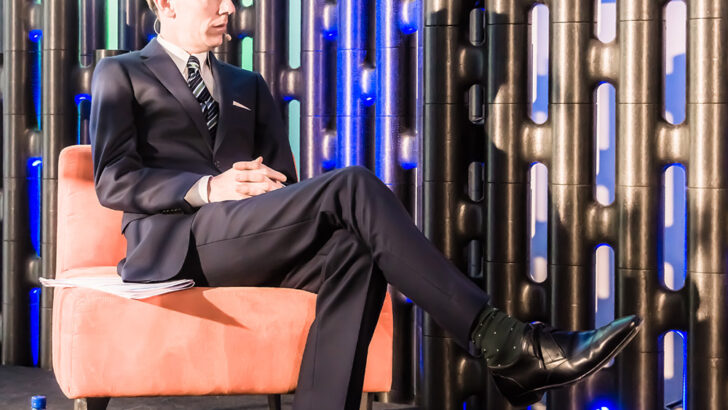 Ryan Tubridy. Photo: Flickr / William Murphy.
 I turned on the radio last Friday morning and heard Ryan Tubridy speaking – what was this, a time warp? It’s a long time since he’s had a morning radio show.
But no, I was indeed in the present moment – he was a guest on Times Radio Breakfast, and what he was saying was an interesting review of the modern media landscape. Traditional TV chat shows were not doing well – perhaps because you could catch up on the highlights online – what he called the “clip economy”. Programmes did well on the basis of their “clipability”, it was like a kind of “Tapas TV”. He lamented the demise of the long-form interviews – the Parkinson approach was referenced. He seemed to like the format of having a leisurely chat with a guest on the couch. Of course, how good that is depends on who the guest is. The Graham Norton Show was mentioned as one where you could catch up on various clips for years to come. I think where that show succeeds is by having several high-profile guests on the couch at the same time – they often spark off each other and seem to be enjoying each other’s company. Tubridy saw the rise of podcasts as evidence that the long-form interview could do well, but then this is audio only – people can do other stuff, like jogging and ironing, while they listen.
Out of curiosity I sampled his own weekend show (Times Radio, Sunday). It differed little from his RTÉ shows – a mixture of light and heavy. He was too chirpy for my liking but was able to be self-deprecating – joking about “monstrous ego” and need for applause! As always, he showed his interest in books and films. Of course, the rise of Andy Burnham to Labour Party leader and Prime Minister was covered. The most interesting segment for me was his discussion of US politics, where he sought to have people from both sides of the political divide. Dr Pippa Malgrem, a former Bush advisor, came across as the more nuanced and reasonable commentator, though it didn’t help that she wouldn’t declare Biden to be the winner of the 2020 election, maintaining the legitimacy was contested. I felt, though mostly respectful, Tubridy was too heavy-handed and interruptive with her on that point. Democrat supporter Bob Weiner was quite combative (though right, I think, in much of his assessment of Trump), which led Malmgrem to say that it was “incredibly difficult to have a measured calm discussion”.
Earlier, Malmgrem said that people were now uneasy about everything presented as facts. She thought people were “disbelieving and non-persuadable”. This is certainly a big social and civic problem in an age of AI fakery, an incredibly useful tool for propagandists. I was conscious of this watching Iran School Bombing – The Search for Truth (Sky News, Sunday). Trigger warnings can be overused, but warnings about ‘distressing’ content was very apt this time. Dominic Waghorn reported from Iran and was obviously affected by the sight of so many graves of children and so many parents mourning. The US government report on the incident has not yet been released, but it seemed to me that the evidence shows it was a US attack, though we saw President Trump initially blaming Iran. Later he said “nobody did that on purpose”, which is probably true, though there seems to have been carelessness, lack of due diligence, a drastic failure of intelligence, or a lack of sufficient “target testing”, as one commentator put it. There was a possible Iranian missile base, likely inactive, in the area.
Whatever the case, it was appalling. We got to see the human side of it – prolific videos of the children before their deaths, videos of lively and colourful school activities, grieving mothers. Waghorn was conscious that the awful Iranian regime was weaponising the tragedy, with huge posters everywhere showing pictures of the children (120 were killed along with 26 teachers), with the Sky team allowed into certain areas only.
It was a stark reminder of the awfulness of war, and regarding it as an accident or collateral damage is just not good enough. Like the US Sandy Hook school massacre, the killing of large numbers of innocent children never seems to have the dramatic and game-changing impact it should have, and so, driven by adults, the war machine trundles on to the next slaughter of innocents.
***
Pilgrimage: The Road Through North Wales
BBC One, Sunday, July 26, 10.30am
Seven celebrities of differing faiths and beliefs experience an emotional journey on a pilgrimage in north Wales, a route linked by churches dedicated to early Celtic Christian saints. (Repeat)
Heartbeat of My Soul
EWTN, Sunday, July 26, 9.45pm
Learn what it takes to become a priest in this revealing visit to St Francis de Sales academy. Seminarians and alumni share their individual stories, their commitment to serving Christ and their hopes for the future.
In the Opinion of the Censor
RTÉ One, Monday, July 27, 9.35pm
Former Film Censor John Kelleher reveals how one hundred years of film censorship in Ireland has reflected the political, social and cultural evolution of the State itself.