

 Renata Steffens
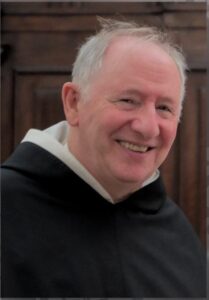
There’s no place like the Basilica of San Clemente in Rome, said Fr Paul Lawlor, a native of Tralee, archaeologist and current Rector of the Basilica. “It’s one of the most beautiful and fascinating churches in the world.”
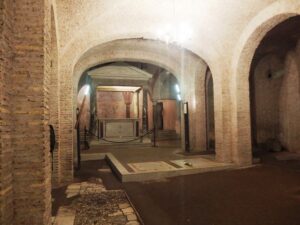
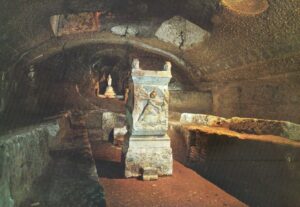
The Basilica of San Clemente is composed today of three layers: The upper 12th century Basilica, the lower 4th century church, and the 1st century Roman buildings. “And in each of these layers, you’ve got extraordinary works of art and memories of the early history of the Church,” the priest explained. “There’s no place where you can go back and walk through the history of Rome, go back to the 1st century, going down staircases that were built in the year 95.”
“We know it from the brick stamps… Christianity in San Clemente goes back to the 1st century. And then, in the 4th century, you’ve got a basilica, and you have the finest collection of medieval paintings, one of the finest in the world. Medieval paintings right up to the 11th century.”
The lower basilica was used for the papal conclave that elected Pope Paschal II in the 4th century, Fr Lawlor explained. “And it was he who decided to build the church at a higher level, the present 12th century basilica.”
Levels
A recurrent question visitors ask when at the Basilica is ‘why three levels?’ “They’re not crypts. They’re not catacombs.” How can you hide a whole building from the road? “It was never hidden”, the Rector answers. “What happened was we were in a steep valley,” he said. In ancient cities, “valleys tend to be filled in because a building is destroyed. They don’t have trucks to take away the rubble. So they build on the old building, and gradually it rises, and the street level also rises within the valley from rubble, from buildings being destroyed.”
/ Palickap.
The 12th century Basilica for centuries “was regarded as one of the oldest churches in the world,” Fr Lawlor explained. “St Jerome, who wrote a book in about the year 384, wrote a chapter on Pope St Clement, and he tells us that Pope St Clement was the third Pope after St Peter… at the end of the chapter, he says, ‘and a church in Rome still preserves the name and memory of Pope St Clement up to our own time.’”
Up to the 19th century, it was believed that the present church, which is now known to be a 12th century building, was the church mentioned in St Jerome’s book. In 1857, archaeologist Fr Joseph Mullooly, a native of Lanesborough, Co. Longford, was the Prior at San Clemente, “and he decided that the present church couldn’t be the one mentioned by St Jerome back in the 4th century. So, he began to excavate underneath the present church, and he discovered the original [4th century] basilica. And going down deeper again, he discovered another layer that goes back to the 1st century.”
Basilica of San Clemente
in Rome. Photo: Wikimedia
Commons / Allie Caulfield.
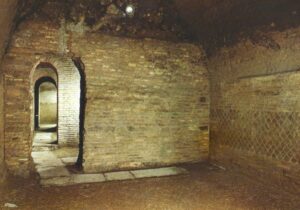
The exciting thing, Fr Lawlor said, is that a new article by the archaeologists at the British School at Rome says that the 1st century level was the house of the Roman Council Titus Flavius Clemens, “who was executed for being a Christian back at the end of the 1st century.” The Rector continued, “Afterwards, this house became a Roman temple and was used up to the 4th century when it was abandoned, and the church was built overhead.”
San Clemente was one of the three houses of the Irish Dominicans in the 1600s, Fr Lawlor explained. “We had three houses. One in Lisbon, one in Leuven, and this house here, San Clemente in Rome.”
At the time, “Irish Dominicans were being executed, and houses already at that stage were destroyed. So the Irish Dominicans looked for a place in Rome where they could study and prepare for what was called the ‘Irish mission’.”
They would prepare for the priesthood in those houses and then come back to Ireland to live in little cottages and say Mass on the mountainside, “and pretend to be clothes merchants going from town to town celebrating Mass for the people during the penal [laws] ages.” Among many of San Clemente’s brilliant alumni are the first bishop of New York in the 1800s, and Fr Thomas Troy, who built Dublin’s Pro Cathedral.
(Rome) / Used with permission of the Irish Dominican Fathers.
Discovery
Fr Lawlor was involved in the discovery of the Sacristy and Baptistry in the lower basilica. “I came here first in 1976. I was involved in excavations, but the person really in charge is a man called [Federico] Guidobaldi.” Prof. Guidobaldi wrote multiple books about the early churches and did his doctorate on San Clemente. “He is probably the finest Christian archaeologist in Rome,” Fr Lawlor said.
The priest moved to Rome as a student in 1976. He “became a sort of assistant” to Prof. Guidobaldi and worked with him over the years.
“I did a degree in Christian archaeology at the Pontifical Institute of Christian Archaeology, and I began teaching at the Angelicum University, the Dominican University in Rome. I taught there for some 15 years, and that was a great experience… I began teaching there in 1985 when there was a very famous student at the Angelicum who is now called ‘Pope Leo’. He wasn’t my student, [as] he was studying canon law. [But] he was a student there when I began teaching at the Angelicum. It was a great period,” Fr Lawlor reminisced.
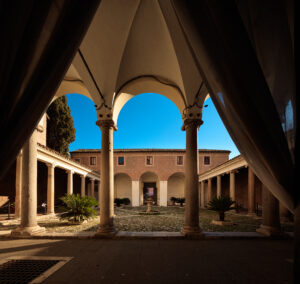
Photo: Basilica di San Clemente
(Rome) / Used with permission of
the Irish Dominican Fathers.
Guidobaldi
He was teaching at the Angelicum and at the same time was “assisting Guidobaldi, this famous archaeologist.” Working with the archaeologist, Fr Lawlor “got to meet some of the great people involved in Christian archaeology.”
The Rector doesn’t consider himself a great archaeologist, but he had some great friends in the field, which culminated in his involvement in the discovery. “The last excavation we did was in the 90s… when really it was to save the frescoes from dampness.
“We began to excavate in the area outside the walls of the church, and in excavating outside the walls of the church, we found the Secretarium, which was the sacristy, from the 6th century. Now this is very important because it’s the earliest one… And then we found the baptistry, which was built in the 6th century, also.”
The baptistry was “certainly” used up to the 11th century, he said, “because we found 11th century frescoes – a beautiful fresco of Our Lady and the child Jesus from the 11th century. This material is still being studied. The excavation went on for quite a period, and the ceramics and materials helped in the dating of the different stages of the baptistry. So a great baptismal font in a monumental area with beautiful marble work all around. This was found in the 90s and excavated right up to the year 2000.”
San Clemente is an extraordinary church full of great wealth and art, the priest said. “[With its] architecture, sculpture, fresco, mosaic. It’s a treasure box, really.”
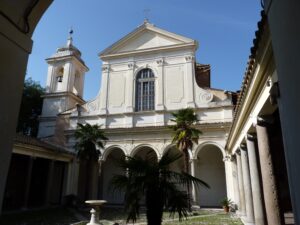
Rome. Photo: Wikimedia Commons / Dudva.
Fr Lawlor said that archaeology and learning the history of the basilica is really important in helping one understand faith and the Catholic Church. “Particularly the finding of the lower church in 1857,” he said. “People were saying that the history of the Church were all fables and legends made up in the Middle Ages,” so when the catacombs were discovered and identified, “they discovered the Christian Church in Rome going back to the year 200.” Which was “a tremendous affirmation of the history of the Church, a real discovery.”
He continued, “The impression in San Clemente is [that] this Church has been a sacred place of prayer and has given people a sense of the transcendence and the presence of God right over those 2,000 years. You can see the continuity of the Church in San Clemente like nowhere else.”
San Clemente “continues to be a place where Dominicans come out and study, have an experience of Rome, of what we call the Catholic Church in the sense of the international Church,” he said. “People ask us sometimes, ‘Is this a museum?’ and I said, ‘No, it’s very much a living church.’”