

 Peter Costello
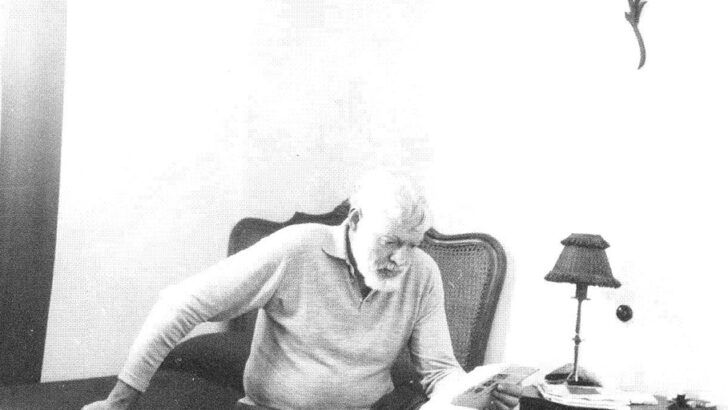 Ernest Hemingway lived his life as a Catholic under the sign of the cross. Photo: Courtesy Fonthill Press.
 Ernest Hemingway: Flawed Genius,
by Aubrey Malone
(Fonthill, £ 25.00 / €29.00).
The film critic of The Irish Catholic, Aubrey Malone is also steeped in the American literature of the 20th century, dominated by such names as F. Scott Fitzgerald, William Faulkner, John Steinbeck and Ernest Hemingway – the latter three authors winning the Nobel Prize for literature – always a controversial procedure.
When Hemingway was awarded the Nobel Prize for literature in 1954, the awards committee of the Swedish Academy singled out the newly published The Old Man and the Sea as the only book of his that they named. This seemed strange to many considering the extent and variety of his life’s work.
The committee had been carried away by the contemporary enthusiasm for that novella – it was initially printed in an issue of Life Magazine that sold over five million copies; the book remained a best seller for years. But it was also Hemingway’s last “real” work of fiction.
Malone remarks that “despite the acres of words that have been written about him, Hemingway continues to elude biographers with his complexity.” His first wife remarked that he was more complex than geometry; hence many of his readers have failed to get the full measure of him.
However, the book had an aspect about it which should not be overlooked; the sufferings of the old man to defeat the marlin he captures resonate with the Christian acceptance of suffering. That links with an aspect of Hemingway’s life that is all too often quite overlooked, the fact that he was a Catholic.
When he took his own life in the summer of 1961 he was buried in a Catholic ceremony at Ketchum, Kansas, where he was then living. Some queried how a suicide, a self murderer in the old parlance, could not receive such rite. But in fact the Catholic Church, like most civil societies, accepted that those who took their own lives did so “whilst the balance of their minds was disturbed”.
But this last sacramental act of remembrance by his family went back in his life to much earlier days. He was raised a Congregationalist – a common enough American experience. However, while serving in the Great War, not as a soldier, but as an ambulance driver on the Italian front against Austria, he was badly wounded by shell and machine gun fire.
He had at that moment of “near death experience” which he later described: “I felt my soul or something come right out of my body, like you’d pull a silk handkerchief out of a pocket by one corner, it flew around and came back and went in again and I wasn’t dead anymore.” An Italian priest carried him from the field and gave him the last rites as a Catholic.
After this event Hemingway remained a Catholic – of a kind. His first marriage failed. When marrying his second wife Pauline Pfeiffer he went through a more formal process of conversion, as she was a Catholic. He thought of himself as a Catholic for the rest of his life, which rather ran against his public life – or publicity life perhaps one might say.
So he was not a “cradle Catholic” nor a “nominal Catholic” – he was what might be called a “persistent” Catholic, with a special devotion to the Virgin. When he won the Nobel Prize in 1954, he presented the gold medal ex voto to the shrine of Our Lady of Charity at El Cobre, the patron saint of Cuba where he then lived.
Aubrey Malone, like other biographers, has so much to cram into his very readable pages, that he has little space for the theme in Hemingway’s existence. There are colour pictures in this book that evoke Hemingway the writer and Hemingway at leisure. But he was also a man with a tortured mind, given to fits of depression. A small monochrome photograph shows him brooding while sitting on the edge of his bed, on the wall above him a rustic wooden cross.
Perhaps we have not by any means heard the last of Ernest Hemingway the Catholic. He didn’t care to advertise himself as a “Catholic novelist” as Graham Greene did, as he could never set the world a “good example”; nevertheless that is what he was.
For myself, I find the later Hemingway unattractive; the macho mode pales after a time. But the early Hemingway, especially those stories drawn from his own youth, and the first two novels are a different matter. Rereading them in the light of the author’s shadowy faith gives them a previously unnoticed depth.