

 Peter Costello
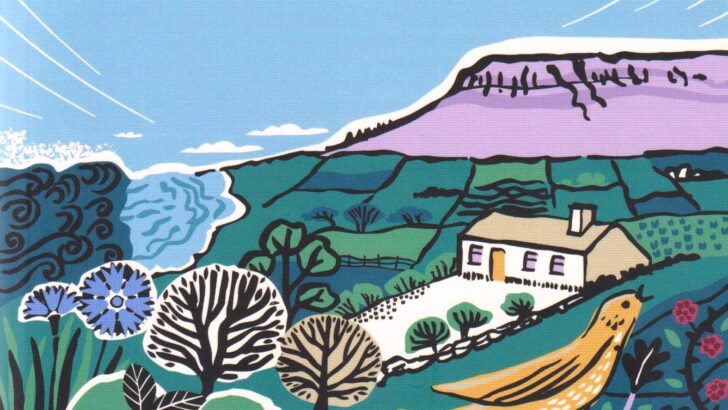 The Doyle landing holding in sight of Ben Bulben. Photo: drawing by Paula McGloin.
 Salt Wind and Rising Water: Planting a Wood on Ireland’s Wild Atlantic Coast,
by John S. Doyle
(Merrion Press, €18.99 / £16.99)
I suspect that since the invention of cities there have ever been those who longed to fly from the crowded streets to the flowing streams of the countryside. From the Epic of Gilgamesh down to Yeats’ Lake Isle of Innisfree, that idyll of a bee-loud glade has haunted the imagination of urbanites.
Some of them, from Thoreau onwards, have done something about it. Of course, the sage of Walden Pond had not really moved far from Concord village, certainly not as far as John S. Doyle, his wife and family went from Dublin.
From streets of Dublin broad and narrow the former editor of In Dublin Magazine, that watch word of city culture, uprooted and fled to Sligo. The idea was not for wattle and daub and bee hives, but on that windy western shore in sight of Ben Bulben, to plant a forest and cultivate a garden.
Planting trees in Ireland has been the aim of progressive minded people since the middle of the 19th century. What Coilte plants, those massed ranks of pine trees do not, in the minds of the ecologically minded, constitute a forest. A forest has to be like North California or Epping forest, great boled deciduous trees.
John Doyle says he writes from memory, but a memory supported to some extent by diaries, notes, photos and other people. The scheme, or daft idea, goes back to 1992. Starting out admittedly with a piece of poor wet land, larger than he thought it was when he began the process of buying it, land no one else wanted.
They had a sketch plan, which is reproduced in the book, which has been achieved. The cottage on the land was restored and later joined by a shed, which in the pictures look like a miniature Dutch barn.
They had the advice of experts, of course, the suggestions of friends and family, and the freely offered opinions of locals and visitors. The narrative flows along with its ups and downs, but mostly ups, for that sketch plan has been achieved, the screening wood thrives, the garden grows what they want it to grow, and now over thirty years – a whole generation – their scheme is a success. Of course, once achieved, it has now to be repaired and maintained.
This is a warm and free flowing story like the streams invoked above. Among their plantings in the garden were plants from family and friends, especially from his sisters.
These provide, we can see, a special kind of continuity for the place. And though the Doyle children seem to have their lives in Dublin, they have also a foothold in the great wild west of Ireland, to go back to when they want to.
This is a lovely book about what sheer drive can achieve and bring to completion, humane and enlivening about people and land, and well worth reading.
The glade was certainly created and can now be walked through, by couples holding hands; but the bees were not such a success. After great trouble the Doyle’s obtained a set of hives, and a swarm of the right kind of bees, the small black Irish bee. But the wild west is not called wild for nothing.
A storm from the Atlantic overthrew and broke open the hives; the bees decamped, and could not be tempted back. John Doyle has not had the heart to try again. But in most other ways the move to the west was a great success, what he calls in one place “a fortunate existence”.