

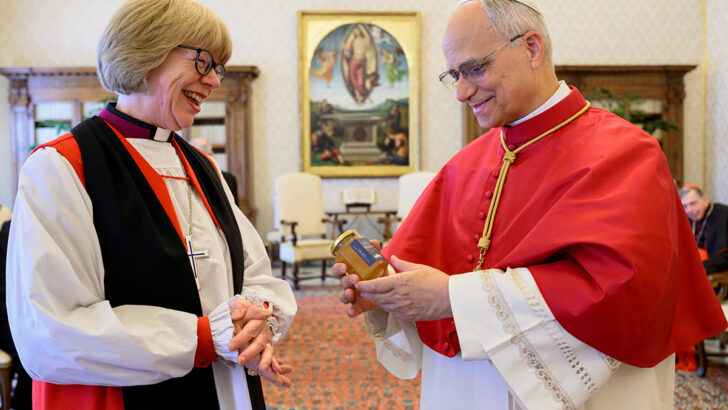
 Pope Leo XIV receives a gift from Anglican Archbishop Sarah Mullally of Canterbury during their meeting at the Vatican on April 27, 2026. Photo: OSV News / Simone Risoluti, Vatican Media.
 Recently, Pope Leo welcomed the new female Archbishop of Canterbury to the Vatican. The optics of the meeting bring the Catholic Church’s male-only priesthood into focus though it can never really be said to be out of focus among progressive Catholics.

It is difficult to make a case for the theological rationale behind the Church’s and indeed Christ’s stance without first addressing some misconceptions around equality.
It can seem plainly sexist compared to the way other professions have opened doors to women. Many women excel in the study of theology. Women serve effectively on pastoral councils and Church bodies. Men and women alike share in the same baptism that calls all to serve Christ to the fullness of their gifts. So, their exclusion looks a lot like sexism if you look at the issue through the equality lens.
However, participation in priestly ministry isn’t primarily about the ability to fulfil a function because the role of a priest isn’t primarily a matter of function but symbol and profound theological significance. If it were just about competence, then it could be said that Jesus succumbed to in-cultured sexist bias, which would be, as theologian Peter Kreeft observed, “a denial of the incarnation”. As God incarnate, everything Jesus did was fully intentional and he never hesitated to confront manmade conventions around, like ritual washing or Sabbath observance, and he scandalised Jewish elders by assuming the divine prerogative of forgiving sins, making himself as they well understood, “equal to God”. Would God incarnate be blind to unjust discrimination? If not, would he feel socially pressured to turn a blind eye?
Prominent
Women were prominent in his life as the Gospel record reveals. The first person to come to know who he was and publicly proclaim him in St John’s Gospel was not only a woman but a marginalised and stigmatised woman, the Samaritan woman he met at the well. In a gesture reminiscent of Peter leaving his nets by the shore to follow Jesus, she left her jug to rush into the nearby town to announce the Messiah. Could anything have been more subversive of Jewish propriety?
A point often lost is that most of the women through history who, distinguished themselves in public roles did so within the institutions of the Church”
The Resurrection was first proclaimed to a woman by angels on the first Easter morning. The supreme model of discipleship is not Peter or Paul but the immaculately conceived mother of our Saviour, Mary, “our tainted nature’s solitary boast” in the words of Protestant, English poet, William Wordsworth. She is the very image of the Church, as fruitful mother who brings Christ to the world by bearing him through the Gospel, lived and proclaimed, and timelessly brought forth in the Eucharist.
A point often lost is that most of the women through history who distinguished themselves in public roles did so within the institutions of the Church. The Fifth Report On Women And Leadership from the Synod on Synodality lists their names from biblical characters to inspirational women of our own time.
It’s a list that stretches from familiar biblical names to Hildegard of Bingen and Bridget of Sweden in the 10th and 12th centuries, to Catherine of Siena and Teresa of Avila in the 14th and 16th, to Elizabeth Seton, the first American saint, in the 18th, ending with more familiar recent foundresses of religious orders and social activists like Dorothy Day. The Church was a place where women flourished not as outlier individuals but as leaders and members of dynamic movements and communities. They were not stymied in their pursuit of either personal sanctity or proclaiming the gospel in word and deed because they were women.
Blurred
In our time, gender distinction is blurred. The post-faith equality project stretches to a belief that identity, including gender identity, is something we can shape for ourselves. For the first time in its history, the Church’s adherence to biblical precedence and church tradition demands robust defending. Not just for outsiders like the Archbishop of Canterbury, Sarah Mullaly, who implied male-only ordination is an “injustice” but for many of its own members too.
Understanding why the priesthood has a masculine character is not internalising sexism. It can’t be separated from how we understand Christ’s relationship with his Church and with each one of us, personally and communally, in the Eucharist.
Like the sexual union between male and female, Jesus encounters us in a way that bridges the vast separateness between God and humankind by creating new life in us”
Jesus, co-eternal with the Father, became the incarnate Son, God made flesh in a male body. Male and female is not a hierarchical distinction. The identity of each is most explicitly expressed and realised in encounter with the other. Jesus expressed his relationship with his Church in spousal imagery. He speaks of himself as bridegroom, directly and in parable. Other images support this expression of extrinsic, life-begetting power. In his conversation with the woman at the well, he offers “the spring of living water that wells up to eternal life” (John 4). He says he is the vine through whom the branches bear fruit. Like the sexual union between male and female, Jesus encounters us in a way that bridges the vast separateness between God and humankind by creating new life in us. It’s the life of divine grace, a pattern of the Trinity, born of love that spills out in love of others, our brothers and sisters in Christ. It is transcendence becoming immanent, the Word made flesh again and again through human history.
Incarnation
The pattern is present at the Incarnation, the encounter between the angel Gabriel and Mary that first brought Christ into the world through the power of the Holy Spirit. Mary is an image of the Church continuing to bring Christ to the world through the Eucharist and her priests who preside ‘in persona Christi’.
Thomas Aquinas said that “God speaks in things as well as words”. Nobody would presume to change ‘things’ like water, bread and wine. Nor would anyone presume to replace images like the vine, the spring, the grains of wheat and mustard or the good shepherd, all of which pulse with older scriptural associations and theological significance. There is no reason to think the masculine character of the priesthood instituted by Christ, in continuity with as well as breaking from the Old Testament priestly traditions of the Levites and Melchisadech, should be any less settled.
(It is perhaps unsurprising that the issue that is polarising opinion in the Catholic Church and in Christian denominations is also convulsing secular society in the west too. The battle lines of course have advanced much further in the secular world. It’s the same war however with the same ever-progressing objectives of equality, which is something that may or may not be lost on the promoters of female ordination.)