

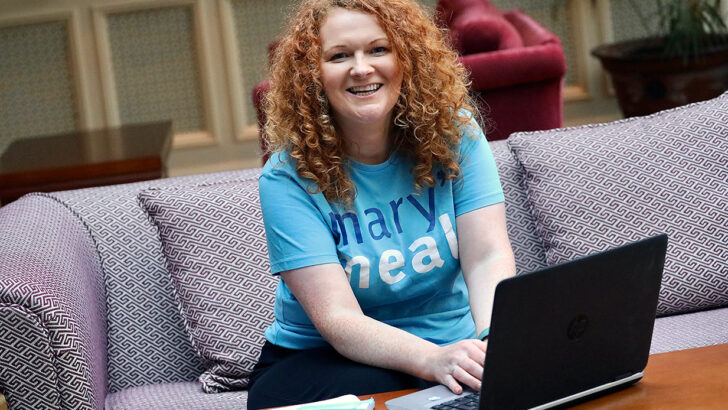
 Patricia Friel.
 “Love for others, and especially for the poor, is made concrete by promoting justice,” wrote the late Pope St John Paul II in Centesimus Annus. For the charity Mary’s Meals, this means feeding over three million school children across sixteen of the world’s poorest countries every day. By providing meals to children, the organisation also encourages access to education and hope for families trapped in cycles of extreme poverty.

Patricia Friel has volunteered for Mary’s Meals Ireland since 2013, before becoming the Executive Director in 2020. “Mary’s Meals is the simple solution to world hunger. We believe that every child should have enough food to eat and should be able to go to school,” says Ms Friel. Relying heavily on the work of volunteers, Mary’s Meals fights one of the largest social injustices worldwide.
Impact
Ms Friel said the impact of their work becomes most visible when visiting the communities supported by the charity. Recalling a visit to Zambia in 2019, she said, “I was worried about mosquitoes, I was worried about where I was going to sleep, but once I visited the schools and saw the children, all those worries went away.”
She described speaking to children in an overcrowded classroom when one young boy asked whether the visitors had come to announce that the school meals would stop. “My heart sank,” she said. “All the time I was speaking, they were thinking that we were there to take the food away.” She reassured the children that, as long as they kept attending school, local volunteers would continue to help prepare the meals. “A big smile came across his face,” she recalled. “Then he put his hand up again and asked if we could put more sugar in it. The children are the same throughout the world, no matter where they are – they want to run, they want to play, they want to go to school, and they all love a little bit of sugar.”
Also in Zambia, Ms Friel recalled meeting community elders and delegations of parents. “This lady catches my hand, and she says, ‘thank you for feeding my child’”, she recalled. Ms Friel explained that the lady mistook her for Mary’s Meals’ Mary, thinking it was one person and not a whole organisation with volunteers “who give so generously.” Ms Friel said that experiences such as these highlight the severe realities of poverty faced by many families supported by the organisation.
It isn’t that there is a lack of food, it’s absolute poverty that people just don’t have the money to pay for it”
“I really don’t think we can comprehend the poverty those small children live in,” she said. Recalling a later visit to Malawi in 2023, she described seeing large amounts of food available in markets while families remained unable to afford it. “There were mountains of mangoes,” she said. “It isn’t that there is a lack of food, it’s absolute poverty that people just don’t have the money to pay for it.”
She explained that for many parents, the charity provides reassurance that their children will receive at least one nutritious meal each day while also gaining an education. “A mother knows that by sending her child to school, she is going to learn how to read, she is going to learn how to write, and most importantly, she is going to get food,” Ms Friel said.
Central to the work of Mary’s Meals is its large network of volunteers, which Ms Friel described as “the life and blood” of the organisation. In Malawi alone, approximately 86,000 volunteers help prepare and serve meals each day, many of whom are mothers and grandmothers preparing food for children within their own communities. “It’s a community-owned solution,” she said.
“Without the volunteers, we could not feed one child for €22 a year.” Ms Friel explained that to keep the cost low, food is purchased locally and in bulk. This also allows for the meals to remain fresh and to have “every vitamin and mineral that the children need.” Many volunteers travel to countries where the charity works, each paying for their own expenses to ensure that all funds raised go directly to feeding the children in need.
Volunteers
Ms Friel stressed that volunteers remain central to every aspect of the organisation’s work. “It’s not about us coming in from the western world and saying, ‘We’ll feed your children,’” she said. “The communities build the kitchens, they provide the volunteers, and they feed their own children.”
According to Ms Friel, the importance of these volunteers became particularly evident during the Covid-19 pandemic, when schools closed across many of the countries where Mary’s Meals operates. Rather than allowing families to go without support, volunteers continued delivering food directly to homes and local communities.
It is not right that they have all that they have here, yet there’s children on the other side of the world that have literally nothing”
“They came back to us and said, ‘We can bring the food, we know where the families are — we are the families,’” she recalled The organisation has increasingly turned to Youth Ambassadors to help carry the mission forward. According to the Executive Director, young people often respond strongly to the inequality faced by children living in extreme poverty. “It is not right that they have all that they have here, yet there’s children on the other side of the world that have literally nothing,” she said. “I think young people really feel that. They’ve brought great heart and joy to our mission, and a different perspective as well.”
For Ms Friel and others who work with Mary’s Meals, their work is not simply about distributing food but restoring dignity to families and communities facing the devastating consequences of hunger and poverty. “It’s one of our core values where we respect the dignity of every human life,” she explained.
Generosity
The organisation depends on the generosity of people choosing to make sacrifices through volunteer work, fundraising, prayer and spreading awareness of their work. “We can all do our small bit,” she said. “We could all feed one child. We could all tell the story of Mary’s Meals and hope somebody else will do the same.”
One of the main goals of the UN is to end world hunger by 2030. Despite this, 150 million more people faced hunger in 2021 than in the previous year, and 8% of the world’s population is expected to still face hunger by 2030 (UN 2021). Along with this, “there are 78 million children who will not go to school tomorrow because of hunger and poverty” Ms Friel said and continued, “there’s not much we can do about that, but we could all feed one child.”
The charity continues to welcome new volunteers and Youth Ambassadors. Through the Mary’s Meals Ireland website, supporters can register to become a Youth Ambassador, donate to the charity and create fundraising projects to support its work. “We are so grateful to all the wonderful volunteers and supporters” Ms Friel said, as their work makes the mission of the charity possible.