

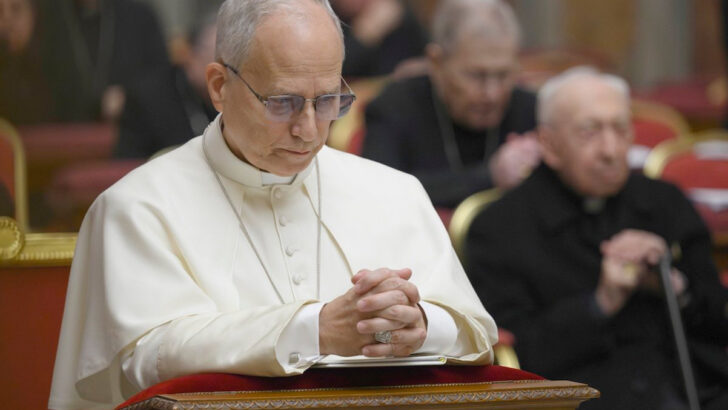
 Pope Leo XIV prays at a Lenten retreat. Photo: OSV News /Simone Risoluti, Vatican Media.
 You could be as wealthy as a king – yet miserable – if you have no friends. Or you could be as poor as dirt – yet happy – because you’re surrounded by loved ones.
And what personal relationship could be more important than the relationship with God?
The saints gave witness to this reality. Even St Maximilian Kolbe, the Claretian Martyrs of Barbastro, and the Carmelite nuns of Compiegne sang hymns of joy on their way to martyrdom, these friends of God faced suffering with joy.
But friendship takes time and needs to be strengthened by conversation. Couples who have strong marriages will tell you about the importance of getting away for a long weekend to spend time alone in conversation.
Retreats are a time away from our normal activities to spend time getting reacquainted with God, to examine the priorities of life and to make concrete and practical resolutions for improvement.
Before Our Lord began his public ministry, he spent 40 days in the desert praying and fasting as a way to prepare for the important work ahead (see Lk 4:1-13).
During his three years of public ministry, Jesus would sometimes invite his disciples to “come away by yourselves to a deserted place and rest a while” (Mk 6:31).
When Jesus entered forcefully into the life of St Paul, he directed him to rise and go into the city, where he would be told what to do. For three days St Paul neither ate nor drank, preparing himself to receive the spiritual direction of Ananias (see Acts 9:1-9).
Down through the centuries, the Holy Spirit has raised up great saints and founders for the reform and service of the Church. What they shared in common was a profound spiritual experience while on retreat.
These saints were seeking solitude in order to listen to God.
For the good of the Church, lay people are also encouraged to get away for a few days each year to rekindle their relationship with Christ.
Retreats
There are many types of retreats. Retreats may last two days or 40 days; they may be organised for men or for women, or for couples together.
They may follow a traditional format with a priest-preacher as the retreat master, offering several spiritual conferences or meditations daily.
They may be directed or undirected. You might make a retreat with a large group in a hotel, or by yourself in a Trappist monastery. In general, however, prudent pastoral experience suggests the following elements are most helpful for making a good retreat: silence, the holy Eucharist, confession, spiritual reading and closeness to the Blessed Mother.
First, silence. Look for a retreat setting that fosters an atmosphere of silence. When you go away for a weekend retreat, you’re going away to be with God and to deepen your friendship with him. When you go on retreat, turn off your cell phone and unplug yourself from all cyber-communication.
Second, the holy Eucharist. Since the holy Eucharist is the body, blood, soul and divinity of Christ, it’s most helpful for a retreatant to attend Mass and receive holy Communion daily while on retreat.
Third, confession. A retreat is all about seeking, finding and loving Christ.
For true and lasting spiritual progress, it’s essential that a person make a deep and searching examination of conscience, express heartfelt contrition, and confess his or her sins to a priest.
Pride
Fourth, spiritual reading. Pride of place is to be accorded to the New Testament. The soul benefits greatly by reading and thinking about the words and actions of our blessed Savior.
Fifth, closeness to the Blessed Mother. After Our Lord ascended into heaven, the apostles gathered around Our Lady and accompanied her in prayer. After 10 days, on Pentecost, the Holy Spirit infused grace in each one in the Upper Room, and the Church was born.
During your retreat, take time to pray the rosary daily and meditate deeply upon each mystery. As your retreat draws to a close, be sure to make a few – no more than three – practical and generous resolutions to improve in prayer, service and sacrifice.
Finally, beware of PRS, also known as ‘Post-Retreat Syndrome.’ This is the tendency to fail in one or more of your resolutions soon after your return. With God’s grace, you will make progress.
Fr Francis J. Hoffman, also known as ‘Fr Rocky’, is CEO of Relevant Radio (relevantradio.com).