

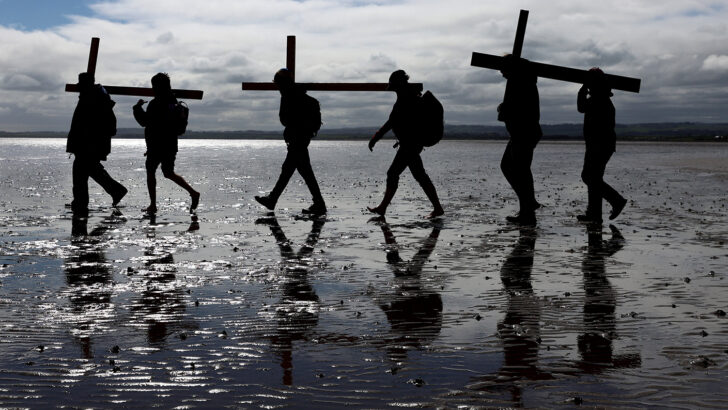
 Pilgrims walk across a tidal causeway while carrying crosses during the final leg of their Good Friday pilgrimage in Berwick-upon-Tweed, Northumberland, England. Photo: OSV News /Lee Smith, Reuters.
 Whoever finds his life will lose it; whoever loses his life will find it
The Gospel
Matt 10:37 [Jesus said:] “Whoever loves father or mother more than me is not worthy of me, and whoever loves son or daughter more than me is not worthy of me.
Matt 10:38 And whoever does not take up his cross and follow me is not worthy of me.
Matt 10:39 Whoever finds his life will lose it, and whoever loses his life because of me will find it.
Matt 10:40 “Whoever receives you receives me, and whoever receives me receives the one who sent me.
Matt 10:41 Whoever receives a prophet in the name of a prophet will receive a prophet’s reward. Whoever receives a righteous person in the name of a righteous person will receive a righteous person’s reward.
Matt 10:42 And whoever gives only a cup of cold water to one of these little ones in the name of a disciple, I tell you the truth, he will never lose his reward.”
Initial observations
The first part of our Gospel for this Sunday may cause surprise and possibly unease. Even taking account of robust Semitic language, the message is stark: faith above family, or more gently, the family of the faith about our natural family. The Hebrew Bible would never set up such a chasm between faith and family! Hence it is no surprise that the first reading corresponds with the second part of the Gospel about how to receive a prophet.
Kind of writing
The Mission Discourse unfolds in several moments.
10:1-4 Authority for mission
10:5-16 Core instructions
10:17-25 Future opposition
10:26-33 Fearlessness
10:34-39 The cost of discipleship
10:40-11:1 The rewards of discipleship
Mt 10:37-39 offers three parallel sayings. The link words are father, mother, son, daughter. The theme is Jesus’ challenge to family loyalty. Matthew’s version is a little more stark because he omits a link passage which we find in Luke 14:25-26a.
The first part of the text is shared with Luke 14:25-27 and Luke 17:33, with significant differences. Both go back to the Sayings Source (Q), which may have looked like this (following the Lucan order):
Q Lk 14:26 The one who does not hate father and mother cannot be my disciple; and the one who does not hate son and daughter cannot be my disciple.
Q Lk 14:27 The one who does not take one’s cross and follow after me cannot be my disciple.
Q Lk 17:33 The one who finds one’s life will lose it, and the one who loses one’s life will find it.
Some of the second part of the text is also taken from Q: Lk 10:16.
Q Lk 10:16 Whoever takes you in takes me in, and whoever takes me in takes in the one who sent me.
Verses 37-38 share a refrain, “is not worthy of me.” Verses 39-41 offer three sayings in the form of couplets. The little word “reward” helps to stitch v. 42 into the sequence.
Old Testament background
Put no trust in a friend, have no confidence in a loved one; guard the doors of your mouth from her who lies in your embrace; for the son treats the father with contempt, the daughter rises up against her mother, the daughter-in-law against her mother-in-law; your enemies are members of your own household. (Mic 7:5–6)
Like cold water to a thirsty soul, so is good news from a far country. (Prov 25:25)
New Testament foreground
Then Jesus told his disciples, “If any want to become my followers, let them deny themselves and take up their cross and follow me. For those who want to save their life will lose it, and those who lose their life for my sake will find it. For what will it profit them if they gain the whole world but forfeit their life? Or what will they give in return for their life? (Matt 16:24–26)
At that time the disciples came to Jesus and asked, “Who is the greatest in the kingdom of heaven?” He called a child, whom he put among them, and said, “Truly I tell you, unless you change and become like children, you will never enter the kingdom of heaven. Whoever becomes humble like this child is the greatest in the kingdom of heaven. Whoever welcomes one such child in my name welcomes me. (Matt 18:1–5)
While he was still speaking to the crowds, his mother and his brothers were standing outside, wanting to speak to him. Someone told him, “Look, your mother and your brothers are standing outside, wanting to speak to you.” But to the one who had told him this, Jesus replied, “Who is my mother, and who are my brothers?” And pointing to his disciples, he said, “Here are my mother and my brothers! For whoever does the will of my Father in heaven is my brother and sister and mother.” (Matt 12:46–50)
Very truly, I tell you, whoever receives one whom I send receives me; and whoever receives me receives him who sent me.” (John 13:20)
St Paul
I have been crucified with Christ, and it is no longer I who live, but Christ lives in me. So the life I now live in the body, I live because of the faithfulness of the Son of God, who loved me and gave himself for me. (Gal 2:19–20)
But may I never boast except in the cross of our Lord Jesus Christ, through which the world has been crucified to me, and I to the world. (Gal 6:14)
More than that, I now regard all things as liabilities compared to the far greater value of knowing Christ Jesus my Lord, for whom I have suffered the loss of all things—indeed, I regard them as dung!–that I may gain Christ, and be found in him, not because I have my own righteousness derived from the law, but because I have the righteousness that comes by way of Christ’s faithfulness–a righteousness from God that is in fact based on Christ’s faithfulness. My aim is to know him, to experience the power of his resurrection, to share in his sufferings, and to be like him in his death, and so, somehow, to attain to the resurrection from the dead. (Phil 3:8–11)
Brief commentary
Verse 37 In contrast with the Q and Lucan forms, Matthew avoids the word “hate.” He has a greater emphasis on love (5:43-47; 22:34-40). The word hate has quite negative connotations in his Gospel (5:43; 6:24; 10:22; 24:9-10) and, evidently, he cannot bring himself to use it constructively. Consistent with his editorial approach, Matthew simplifies the layout of family members. “More than me” is also typical of Matthew. Cf. Mt 10:24.
The contrast with Q Lk 14:26 may shed light. Matthew has intensified and personalised the master-discipleship relationship. No longer, then, “cannot” but rather “is not worthy of me,” surely a significant adjustment. This also picks up the personal relationship already implied in “more than me.”
Verse 38 Matthew explicitly links this saying with the previous one by adding the simple word “and.” For the third time—that is, emphatically—we hear “is not worthy of me.” In this Gospel, Jesus does not begin to speak of his crucifixion until 16:21-23, so the reference to the cross is chronologically awkward. In any case, it is hard to imagine metaphorical use of “cross” before Jesus’ own crucifixion. In Matthew’s context, the threat of actual martyrdom seems real and so the metaphor is rather more than a way of saying something. Matthew likes the word “to follow” and the statistical occurrence is important: 25-18-17-19.
Verse 39 The contrast with Luke sheds light once more. Luke reads: Whoever seeks to preserve his life will lose it, but whoever loses his life will keep it. (Luke 17:33). Matthew opens with “whoever finds” (a participle); he strengthens and improves the contrast by inserting “finds” instead of “seeks to preserve”; finally, he disturbs the balance by inserting “for my sake”, underlining again the relationship with Jesus. The word for life—psyche—has a range of meanings: life (in contrast to death); the whole person; the principle by which one is in contact with God. The last two meanings are at play here.
Verse 40 Here, it seems Matthew has conflated sayings preserved elsewhere in Mark and Luke. There are subtle differences and, as often, Matthew is just that little bit clearer.
The overall effect in Matthew’s version is to give greater authority and responsibility to the disciples, as representatives of Jesus and of the Father who sent him. This may reflect emerging church order in Matthew’s community in Antioch.
Verse 41 This verse is unique to Matthew. It may also reflect an early church order in Matthew’s community: apostles, prophets, righteous persons and the little ones. The vocabulary reflects the interests of Matthew: prophet, righteous, little ones, receive, reward.
Verse 42 The teaching here is taken from Mark 9:41. Matthew’s editing of Mark is again illuminating.
Even though there is an emerging hierarchy, the little ones—the ordinary church members—are not to be neglected. All the “levels” share the same context of mission, including witness, persecution, flight and, when needed, fraternal hospitality.
Pointers for prayer
- Jesus never wanted suffering for anyone but he knew that if anyone was going to follow in his footsteps promoting love and respect for every person, they would meet with opposition. Fidelity has its price, but also rewards. Would you agree?
- The passage is a call to both radical and practical discipleship. When have you found that in order to achieve a certain objective you had to make it a priority, and then take the practical steps necessary to reach your goal? What were the benefits to you when you did this?
- ‘Hate’ (in the Lucan version) is prophetic exaggeration for the uncompromising loyalty Jesus seeks in disciples. There may be times when people make demands in conflict with fidelity to another relationship. This can be painful. When have you found that being clear about your priorities helped you in that situation?
Prayer
All-powerful God, your incarnate Word commands our obedience and offers us true life.
Make our ears attentive to the voice of your Son and our hearts generous in answering his call, that we may take up the cross with trust in his promises. Through Christ our Lord. Amen.
“Whoever welcomes one such child in my name welcomes me, and whoever welcomes me welcomes not me but the one who sent me.”
(Mark 9:37)
“Whoever welcomes this child in my name welcomes me, and whoever welcomes me welcomes the one who sent me; for the least among all of you is the greatest.”
(Luke 9:48)
Mark 9:41 For truly I tell you, whoever gives you a cup of water to drink because you bear the name of Christ will by no means lose the reward.
Matthew 10:42 And whoever gives only a cup of cold water to one of these little ones in the name of a disciple, I tell you the truth, he will never lose his reward.
Thought for the day
We do have the saying, “goodness is its own reward” and that, no doubt, is true. We don’t do good to be rewarded but simply because it is good. At the same time, goodness leads to goodness and kindness inspires kindness. This can be true at the most mundane level: if I am courteous and obliging, say, as a driver, perhaps others on the road will be inspired to be obliging and courteous in their turn. It is even more true at a higher level. Generosity of spirit inspires the same in others.
Prayer
Help us, Lord, to be kind and generous in our dealings with others today following the example of Jesus. Amen.
If we died with Christ, we believe that we will also live with him
The first reading
Rom 6:1 What shall we say then? Are we to remain in sin so that grace may increase?
Rom 6:2 Absolutely not! How can we who died to sin still live in it?
Rom 6:3 Or do you not know that as many as were baptised into Christ Jesus were baptised into his death?
Rom 6:4 Therefore we have been buried with him through baptism into death, in order that just as Christ was raised from the dead through the glory of the Father, so we too may live a new life.
Rom 6:5 For if we have become united with him in the likeness of his death, we will certainly also be united in the likeness of his resurrection.
Rom 6:6 We know that our old man was crucified with him so that the body of sin would no longer dominate us, so that we would no longer be enslaved to sin.
Rom 6:7 (For someone who has died has been freed from sin.)
Rom 6:8 Now if we died with Christ, we believe that we will also live with him.
Rom 6:9 We know that since Christ has been raised from the dead, he is never going to die again; death no longer has mastery over him.
Rom 6:10 For the death he died, he died to sin once for all, but the life he lives, he lives to God.
Rom 6:11 So you too consider yourselves dead to sin, but alive to God in Christ Jesus.
Initial observations
Last week, we read from Romans 5, where Paul compares and contrasts Adam and Christ. His overall purpose in that comparison is overwhelmingly positive, convinced as he is of the astonishing gift of grace in Christ. In our passage he continue his constructive account of the Christian calling.
Context in the community
The context here remains that of conflict between Christ believers of Jewish and Gentile origin. Paul goal in Romans 1-4 was to show their equal “success” in sinning and their equal need of faith and grace in Christ. His purpose in Romans 5-8 is to explore that extraordinary grace. In Paul’s mind, the riches bestowed on us in Christ should make it clear that distinctions of ritual practices etc. are utterly irrelevant (“there is now no distinction”).
Kind of writing
Romans 5-8 is a large, coherent argument. The layout may be contemplated in the box below. As often, it is concentric and the various “wings” of the argument go together. The linear sequence is just as important: faith, salvation, baptism, Christian living, prayer (Abba, Father), the Holy Spirit and unshakeable hope in Christ (following the arrow). With so much to sustain and keep them in communion, Roman house churches should set aside the issues dividing them. There’s surely something in that for us today as well.
Related passages
Is Christ divided? Paul wasn’t crucified for you, was he? Or were you in fact baptised in the name of Paul? I thank God that I did not baptise any of you except Crispus and Gaius, so that no one can say that you were baptised in my name! (I also baptised the household of Stephanus. Otherwise, I do not remember whether I baptised anyone else.) For Christ did not send me to baptise, but to preach the gospel—and not with clever speech, so that the cross of Christ would not become useless. (1 Cor 1:13–17)
For in one Spirit we were all baptised into one body. Whether Jews or Greeks or slaves or free, we were all made to drink of the one Spirit. (1 Cor 12:13)
For all of you who were baptised into Christ have clothed yourselves with Christ. (Gal 3:27)
Brief commentary
Verse 3 “In Christ” is a favourite phrase of Paul’s, indicating two things: belonging to the social body of Christ, the church, and living in a new way, which shapes everything we do.
Verse 4 Full immersion suggests both death and life. Even more, Jesus’ own journey through death into resurrection is represented and becomes part of the biography—the story—of the baptised.
Verse 5 Cross and resurrection cannot be separated (unlike in traditional western theology). Our hope of future resurrection is grounded in our living now the same self-giving love of Jesus himself.
Verse 6 My “old self” is how I used to be, living a natural life, apart from God, with a “this worldly” focus. In baptism, this old self has been put to death.
Verses 8-9 Paul draws out the consequences of our aligning ourselves with Christ. Resurrection includes not simply surviving death but victory over death.
Verses 10-11 Using a familiar apocalyptic expression (“he lives towards God” cf. 4 Macc 7:19 and 16:25), Paul points out that this also how the person-in-Christ should live. NB. Gal 2:19.
Pointers for prayer
- When I consider my old self (perhaps no so old!), what comes to mind? Have I really been radically renewed?
- How do I live now, dead to sin but alive “towards God” in Christ Jesus?
- What does it mean to mean today, at this point in my life, to be baptised in Christ?
Prayer
God, giver of every grace, you give us new life in Christ and in his body the church. Help us to be truly alive in Christ by living every day the grace of faith and the gift of baptism. Amen.
At this season, in due time, you shall embrace a son
The second reading
2 Kgs 4:8 One day Elisha was passing through Shunem, where a wealthy woman lived, who urged him to have a meal. So whenever he passed that way, he would stop there for a meal.
2 Kgs 4:9 She said to her husband, “Look, I am sure that this man who regularly passes our way is a holy man of God.
2 Kgs 4:10 Let us make a small roof chamber with walls, and put there for him a bed, a table, a chair, and a lamp, so that he can stay there whenever he comes to us.”
2 Kgs 4:11 One day when he came there, he went up to the chamber and lay down there.
2 Kgs 4:12 He said to his servant Gehazi, “Call the Shunammite woman.” When he had called her, she stood before him.
2 Kgs 4:13 He said to him, “Say to her, Since you have taken all this trouble for us, what may be done for you? Would you have a word spoken on your behalf to the king or to the commander of the army?” She answered, “I live among my own people.”
2 Kgs 4:14 He said, “What then may be done for her?” Gehazi answered, “Well, she has no son, and her husband is old.”
2 Kgs 4:15 He said, “Call her.” When he had called her, she stood at the door.
2 Kgs 4:16 He said, “At this season, in due time, you shall embrace a son.” She replied, “No, my lord, O man of God; do not deceive your servant.”
2 Kgs 4:17 The woman conceived and bore a son at that season, in due time, as Elisha had declared to her.
Initial observations
Our reading is chosen because of the evident link with the Gospel teaching of receiving a prophet and a prophet’s reward.
Origin of the reading
The first and second books of the Kings (originally a single work in Hebrew), tell the story of Israel from the time of king Solomon until the destruction of Judah under the Babylonians.
1 Kgs 1:1-11:43 The reign of Solomon
1Kgs 12:1-2 Kgs 17:41 The divided kingdom
2 Kgs 18:1-25:30 The end of Judah
In may ways, the book of the Kings offer a rattling good tale, with memorable scenes and events. At the same time, there are passages which are tedious, horribly violent, ethically challenging or just peculiar. How do we treat all of that as inspired Scripture? The grand historical overview—only apparently a general history—is in reality a theological interpretation of the past designed to influence the present (at the time of writing). Politics, warfare, economy etc. are all viewed in such a way a to furnish both understanding and a message or warning.
Kind of writing
Elisha is presented in the Bible as a 9th century BC prophet and wonder worker (1 Kgs 19:16–21; 2 Kgs 2:1–10:27; 13:14–21). He was the successor of Elijah, and like Elijah, he operates nationally (dealing with kings and the poor) and internationally (Moab, Edom and Syria). There are some fifteen episodes of Elijah, very often showing him coming to the help of the poor.
For example, Elisha makes water from a spring usable by throwing salt into it; he tells a widow to use her last bit of oil to fill jar after jar with oil until she can pay her debts and save her sons from becoming debt slaves; he turns a toxic stew edible by throwing in some flour; he feeds one hundred men with only twenty barley rolls, with leftovers; he recovers a borrowed ax head from the Jordan River by throwing in a stick after it.
While the tales are presented as taking place during the reign of Joram as king of the northern state (perhaps form 849-842 or from 852 to 841). The stories seem to reflect later conditions, however.
Like Elisha, Jesus responded to the needs of unfortunate women (Mark 7:24–30; 5:24–34); like Elisha, Jesus raised the dead (Mark 5:21–24; 35–43; Luke 7:11–17); and like Elisha, Jesus fed the hungry (Mark 6:30–44).
In 2 Kings 4:1-44, we have a portrait of Elisha’s ministry and life:
- vv. 1-7 Miracle of the oil
- vv. 8-37 The rich woman of Shunem
- 8-17 The gift of a son
- 18-37 Death and resurrection
- vv. 38-44 Feeding the hungry
- 38-41 Death in the pot
- 42-44 Feeding many with little
Related readings
When Elijah was enveloped in the whirlwind, Elisha was filled with his spirit. He performed twice as many signs, and marvels with every utterance of his mouth. Never in his lifetime did he tremble before any ruler, nor could anyone intimidate him at all. (Sir 48:12)
There were also many lepers in Israel in the time of the prophet Elisha, and none of them was cleansed except Naaman the Syrian.” (Luke 4:27)
Brief commentary
Verse 8 Shunem is identified with the modern village of Sulah, overlooking the plain of Jezreel from the north. “A woman of substance” literally: she has disposable income. Her offer of hospitality is not strictly necessary because the distance to Carmel is not great.
Verses 9-10 She takes the initiative and proposes a purpose-built walled chamber (contrast Ahaziah’s room in 2 Kings 1:2). The detailed planning is an indication of the woman’s care and concern, respect and regard for the man of God.
Verses 11-12 This is the first mention of Elisha’s servant, Gehazi, a prominent and eventually a tragic figure (2 Kgs 4:12, 14, 25, 27, 29, 31, 36; 5:20–21, 23, 25; 8:4–5).
Verse 13 It seems to be implied that the woman has a case or a grievance of some kind before the king as chief magistrate. Would she like Elisha to put in a good word for her? All this is spoken not by Elisha but by Gehazi. Her response is confident and solid (in contrast with her later appearance in 8:1-6). Thus, she also avoids an impolite direct request.
Verse 14 Elisha and his servant are alone again. The servant steps in and explains the situation of childlessness. The pressure is twofold: no son and an elderly husband, for whom time is running out, presumably.
Verses 15-16 Discreetly, the woman does not enter the room but stays by the door. Elisha is a regular visitor and upon his return in the spring, she will have a child, a tremendous boon. The woman does not wish to be deceived, perhaps after years of false hopes. Strangely, v. 17 is omitted by the lectionary.
Pointers for prayer
- What is your experience of one kindness leading to another?
Prayer
Lord, may the goodness we have received be reflected in the good do to others. Amen.
***
Hearers of the Word: The Liturgy
2 Kings 4:8-11,13-16; Psalm, 89 (88); Romans 6:3-4,8-11; Matthew 10:37-42
Readings 1 and 3
Our readings belong well together, because Jesus is often portrayed in the Gospel with the traits of Elijah and Elisha. It is all part of the Old Testament background to the Gospels.
The responsorial Psalm
It is perhaps the tone of Psalm 89 (88) which counts, a tone captured in the exultant words first words (= the response): I will sing for ever of your love, O Lord.
Sunday introductions
First reading
2 Kings 4:8-11,13-16
Today we hear a somewhat legendary story of the prophet Elisha. There is a good teaching: goodness leads to goodness and kindness leads to kindness.
Second reading
Romans 6:3-4, 8-11
We have all be baptised, usually as children. What does it mean to be baptised? St Paul’s teaching is enriching, deep and life-giving.
Gospel
Matthew 10:37-42
There are two parts to today’s Gospel. The second part, about hospitality and kindness, has already been anticipated by the Elisha story. The first part, however, is startling and unexpected.
Weekday introductions Monday 29 June
Sts Peter and Paul, apostles
Acts 12:1-11
This symbolic tale reminds us that whatever the appearances, God protects his followers.
2 Timothy 4:6-8, 17-18
Not really by Paul, this is a good reflection back on life as the apostle. He is shown as an old man, full of faith.
Matthew 16:13-16
Peter did attain a special role in the early Church, initially at Antioch in Syria. This present story is unique to Matthew and often thought to be a post-Easter commissioning account.
Tuesday 30 June
First Martyrs of the See of Rome
Amos 3:1-8, 4:11-12
Severely, Amos reminds us that everything has its cause and purpose.
Matthew 8:23-27
The storm and the boat symbolise the experience of the church. The prayer of the disciples could easily be ours today.
Wednesday 1 July
St Oliver Plunkett, bishop and martyr
Readings for the day
Amos 5:14-15, 21-24
When worship is elaborate, there is always the risk of an enormous gap between what we pray and how we live. Amos exposes such hypocrisy is no uncertain terms.
Matthew 8:28-34
This tales is both serious and humorous. It is serious because it deals with the forces of evil. It is somewhat comical because the demons request a stay of execution in (unclean) pigs and that’s exactly what it turns out to be!
Readings for the memorial
Ezekiel 34:11-16
Both readings are chosen to reflect the ministry and martyrdom of St Oliver. Our first reading from Ezekiel portrays God as the ideal shepherd. The context of Ezekiel, this was in contrast with the behaviour of the human shepherds of the people.)
John 10:11-16
In this reading, the shepherd is Jesus himself. His example of being willing to lay down his life was followed to the letter by St Oliver Plunkett.
Thursday 2 July
Amos 7:10-17
Amos disturbed the powers that be and in response they tried to silence the prophet. The higher clergy collaborate with the king to get at him, but Amos never falters. The silencing of prophets might perhaps have a special resonance for us at this time.
Matthew 9:1-8
The question is a good one: it is apparently much easier to say your sins are forgiven because the effects are unseen!
Friday 3 July
St Thomas, apostle
Ephesians 2:19-22
This short reading is rich in resonance: it presents the Christian life as a home coming (something most of us have experienced), a being built into a house of God.
John 20:24-29
It is interesting that this story survives in popular memory as “doubting Thomas.” And yet, the central point is his tremendous faith and confession: my Lord and my God.
Saturday 4 July
St Elizabeth of Portugal
Amos 9:11-15
Prophets can seem predominantly negative and certainly Amos had negative things to say. But even these are expressions of God’s faithfulness. In today passage, it is that very faithfulness of God which is the focus: in spite of everything, God will restore his people.
Matthew 9:14-17
The real focus of this little dispute is the sheer novelty of the proclamation of Jesus, a novelty marked by a break in religious practice. Apart from the forty days in the desert, it seems Jesus did not fast and this scandalised some. But old practices were not adequate to celebrate the radically new teaching of Jesus.