

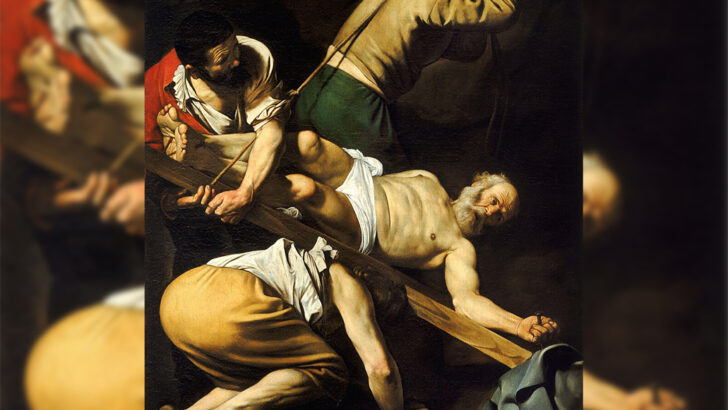
 Crucifixion of St Peter (c. 1601), Caravaggio. Photo: Public domain.
 In St Peter’s Square in Rome, the great colonnades of Bernini begin at either side of the Basilica and wrap around most of the square’s perimeter. In the mind of the architects, the body of the basilica was designed to symbolise the body of Christ, the dome symbolised Christ the head of the Church and the two colonnades symbolise the arms of God, enfolding the whole world in His saving embrace. In front of St Peter’s Basilica, there are two imposing statues of St Peter and St Paul. They are the two pillars of the Apostolic Church who were martyred for the same faith in Christ and whose joint feast we celebrate on June 29.
Tradition
Each time I am present for a General Audience on Wednesday mornings or at a liturgy with the Holy Father in the Square, it always strikes me how the original dream of the architects has become a reality as people from all over the world gather to celebrate the same faith in the same Lord whom Peter and Paul believed in and loved onto death.
Christian tradition has always considered St Peter and St Paul to be inseparable. By keeping together the lives of Peter and Paul, the Church is bringing something important to our attention: namely the need to hold together what Peter and Paul represent in the Christian life, namely the necessity of both structure and spirit.
Without this stability and leadership, the family of the Church would fall apart and descend into chaos”
First, we take the example of St Peter. He was uneducated, worked with his hands, was impetuous and fearful. Despite this and despite his denial of the Lord three times, Peter was chosen by Jesus to be the foundation of his Church: “You are Peter and on this rock I will build my Church” (Matt. 16:18). Despite his weakness, Peter’s faith in the Lord would be the rock on which the Church would be built. After he had received the Holy Spirit at Pentecost, Peter was changed into a man of courage and leadership. Later he would die in Rome in the circus of Nero, sentenced to death by crucifixion. Peter was the first leader of the Church, the first pope and represents order, structure, unity and stability. His role in the early Church is like that of his successor Pope Leo XIV in modern times. He takes the lead, sets the tone and inspires the rest of us. Without this stability and leadership, the family of the Church would fall apart and descend into chaos.
Mission
Yet we all know that this focus on order and structure is not enough and here is where the figure of St Paul becomes important. Paul was educated, zealous for the Jewish faith and was prepared to kill for it. Yet despite his dark past, Paul was also called by Jesus to be a witness to his mercy to the ends of the earth. For Paul, what was important was not structure or the law but the spirit, mission, evangelisation and the great movement of the Church beyond itself to preach the Good News. Paul was a fearless missionary who founded Churches in Corinth, Ephesus, Galatia and finally in Rome where he was beheaded. Here was a man who was so driven by the love of Christ that he would say “the life I now live in the flesh I live by faith in the Son of God who loved me and gave himself for me’”(Gal. 2:20).
It is this love for the Lord and their faith in him that unites them and unites us”
This was the love that moved Paul to travel, to take risks and to give his entire life in service of others. This too is the spirit of the Gospel that continues in the Church without which it could not survive. Structure must be accompanied by creativity; maintenance must be accompanied by mission and continuity accompanied by newness. In this sense Peter and Paul represent what is needed to keep the Church alive and healthy.
This is true for every vibrant parish and diocese. We all need structure and stability. This is the spirit of Peter. But we also need the spirit of Paul. Every healthy parish and diocese must not go stale but must discern challenges synodally, adapt itself to take risks, to reach out and to go beyond itself. It is about what the late Pope Francis called an effort to “to recover the original freshness of the Gospel”. Whenever we make that effort “new avenues arise and new paths of creativity open up” (The Joy of the Gospel, 11).
On the feast of Peter and Paul, we thank God for the example of their lives as people of faith. Both were very different but both were united by a powerful bond: their deep love for Jesus Christ for whom they gave their lives in martyrdom. It is this love for the Lord and their faith in him that unites them and unites us to them. May our parishes and dioceses be filled with the spirit of both Peter and Paul: on one hand strong, reliable and courageous in faith like Peter. Yet on the other hand bold proclaimers of the Good News, leaving our comfort zones and taking the risk of reaching out to new people and in new ways.