

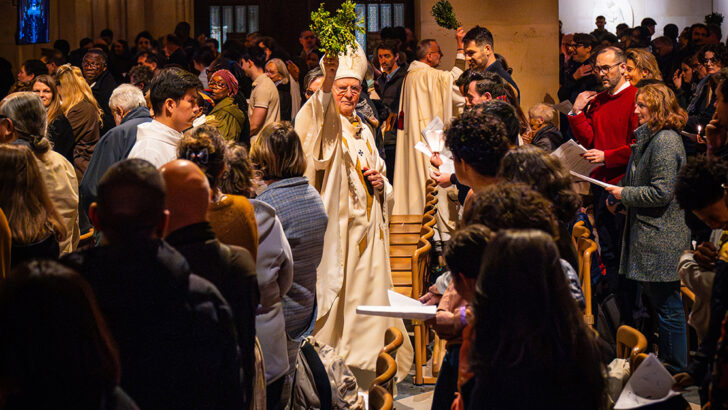
 Paris Archbishop Laurent Ulrich blesses the congregation with holy water as he celebrates the Easter Vigil Mass at Notre Dame Cathedral in Paris on April 4, 2026. Photo: OSV News /Liam Hoarau, courtesy Archdiocese of Paris.
 Over twenty thousand adults and adolescents were baptised into the Catholic Church in France at Easter this year. The island of Ireland has roughly one tenth of France’s population, so an equivalent number here would be two thousand. I smiled when I read that the influx in France represents a ‘major challenge’ to the French Church. May the Lord bless the Irish Church with an abundance of such challenges!
But what’s behind this encouraging challenge? Why are so many people choosing to be baptised? Some of the commentary on the recent influx in France mentions things like the desire for the spiritual, the thirst for God, the search for meaning. All true, undoubtedly, but certainly not the full story.
Decision
The decision to be baptised is something more than the end-point of a personal, spiritual quest. As a decision to enter into the Catholic Church, it is a statement that a person has, in a somewhat metaphorical but very real sense, found their home. That decision quite obviously includes a spiritual aspect; indeed, the spiritual aspect will more than likely be uppermost. But the decision for baptism incorporates a choice to belong to an institution, a visible structure, with practices, disciplines and traditions.
I’ve heard it suggested that when adults choose to be baptised into the Catholic Church, they do so in spite of the institutional reality. I think that this is an unhelpful observation, which communicates more about those who would make it, than it does about converts to Catholicism. I find it hard to imagine converts making a distinction between faith and institution as they stand by the baptismal font and profess their baptismal faith in “the holy Catholic Church and the communion of saints.” It’s not that every convert will have a profound grasp of ecclesiology or of institutional matters, or that they will experience some kind of specific, institutionally-oriented ecstasy as the water is poured. What is at issue is that converts, in choosing the Catholic faith, choose the Catholic Church, and in choosing the Catholic Church, they choose to belong to an institution. The absolute least one can say is that they are not put off by the prospect of that belonging!
Challenges
Whatever challenges new Catholics may experience, their entrance into the Church presents a significant challenge to the Church as an institution, and it would be a pity to deflect that challenge by focussing too exclusively on the ‘spiritual’ aspects of the journey of new converts. A memory from my seminary days may help to clarify the challenge I have in mind.
I was ordained in 1991, and in the years of our formation, I (and, I think, my peers) had imbibed something of the anti-institutional sentiment that was – and to some extent remains – part of the spirit of the times. In a course on ecclesiology (the theological discipline that deals with the understanding of Church) we studied various ‘models’ of the Church, including mystical communion, sacrament of God, herald of the Gospel, servant of humanity, community of disciples, and institution. When it came to considering the Church as institution, we were left feeling rather cold. The other ‘models’ resonated with us, but the idea of the Church as institution conjured up notions of harshness, coldness and remoteness.
After thirty-five years of priestly ministry, though, I can say that most of my day-to-day priesthood has been lived within the nuts-and-bolts reality of institution. But – and this is a crucial point – even the apparently finer and more satisfying projects of proclamation, service and outreach are worked out in the context of the Church as an institution. Institution is inescapable; it cannot be circumvented. Institutions grow and crystallise wherever people organise anything. Yes, institutions are imperfect and often downright sinful, but that is largely because the people making them up are imperfect and often downright sinful.
Adulthood
Those who choose to join the Church in adulthood are not, to repeat, doing so despite the institution. If we drive a wedge between the spiritual aspect of their journey and the institutional membership they have chosen, if we rattle off the nostrum that they have found their way into the Church despite the institution, then we risk giving the institution something of a free pass. Our new members challenge us to work for the best and most humane institutional structures, structures that are fit for purpose; and the purpose, of course, is to serve the good of the faithful.
In this life, one choice we cannot make is the choice of a perfect institution, so let’s work with what we have, mindful that, imperfect though it may be, the Church’s institutional face has not proven an unsurmountable obstacle to a large number of converts.