

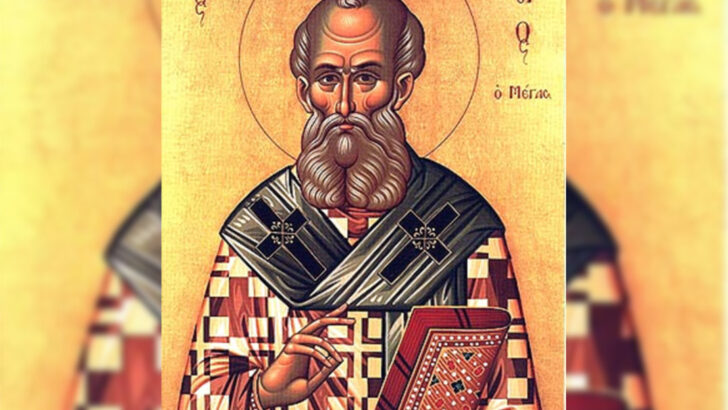
 An icon of St Athanasius of Alexandria. Photo: Wikimedia Commons / Public Domain.
 In the early Church, after the Resurrection and Ascension of Jesus, and having reflected at length on his parables, miracles, suffering and death, the focus of the debate about him moved from what Jesus did to who Jesus was. This conversation was not without pain and controversy. Positions on Jesus’ identity moved between two extreme positions – on one hand were those who argued that Jesus was so obviously divine that his humanity was a mere appearance of being human but that he lacked a human nature like ours. On the other hand, many saw Jesus as being so human that he was reduced to a creature albeit a special and holy one, a kind of super-saint. This latter position was adapted by a man named Arius and the Arian heresy called after him. His views on Jesus that reduced his divine identity were strongly opposed by a bishop called Athanasius (c.296-373) who came from the Egyptian city of Alexandria. This issue of the identity of Jesus was causing divisions in the Church and so the Council of Nicaea was called in 325 AD. It was thanks to the insights and teaching of Athanasius that the Council concluded that Jesus was indeed divine and “consubstantial with the Father” as we profess in the Creed today. A famous adage from Athanasius was hugely influential in this conclusion of Nicaea where Athanasius insisted that “He (Jesus) became human so that we might become divine”.
Warning
This introduction is not just an interesting glance back at history. Rather it is warning for all Christians today to avoid the two extremes of making Jesus so divine that he is removed from human experience or so human that we forget his divine origin and identity. There were times in the history of the Church when we over-emphasised Jesus’ divinity at the expense of his humanity. Then there were times when we understated Jesus’ divinity, leaving him merely human.
Here I suggest that in these times of religious pluralism and diversity, coupled with a loss of transcendence and an increasingly materialist view of the universe, the greater risk of reducing Jesus’ divinity, is more pressing. What this error looks like is that while Jesus of Nazareth was one of the greatest leaders and figures of history, he was one among many human beings who lived, made an impact and died. We remember him and his legacy in history but nothing more.
Without him we might all have drifted into a vague admiration of Jesus but nothing more. This is not Christianity”
Even within the Church, Jesus can be presented only as an archetype or model to be imitated in charity and virtuous living. The position held by many is that he was a moral teacher who showed us an example of how to be kind, merciful and just. Jesus certainly did show us how to be kind, merciful and just, but he did far more. As God he became human like us and became the Saviour we needed to save us from sin, death and every form of dysfunction. If Jesus was only human and merely an external example to be copied, he could not do this as God. But by the power of his Holy Spirit, the saving power of God through Jesus has been offered to us through faith, his Word and the sacraments of the Church. And by the power of that same Spirit, Jesus penetrates our humanity, uniting himself to our nature in order to conform it to the nature that God intended. It is because of this that we can dare to speak of the divine indwelling as we find in St John’s Gospel where Jesus invites us to “make your home in me as I make mine in you” (John 15:4). It is why we can understand why Jesus promises us a share in his own immortality through union with him in the Eucharist.
All of these insights that have been distilled through the Church for centuries, began with St Athanasius who defended the divinity of Jesus while holding onto the fullness of his humanity. He did so at great expense to himself as he was exiled and persecuted several times. Without him we might all have drifted into a vague admiration of Jesus but nothing more. This is not Christianity. For this reason, we owe St Athanasius a debt of gratitude. On his feast day that we celebrate on May 2, we thank God for raising up this champion of the orthodox faith whose teaching counters modern forms of Arianism that reduce the identity of Jesus Christ to just another model to be imitated but not to be worshipped.
An cúigú Domhnach den Cháisc
An t-Ath Seán MacCárthaigh
Tá an Saosúr Turasóireachta againn go láidir anois le teacht na Cásca, tá an slua cuartóirí le feiscint ar fuaid na háíte.
Nuair a bhios féin ag taisteal trí Americeá agus áiteanna eile, bhí aon ráiteas amháin comónta ionta go léir – an cuimhne is láidre a bhí ag daoine ansúd de Éire ab ea ní amháin na radharcanna áileachta iontacha, ach an fáilte a fuaireadar ann.
An cinneáltacht, an flathúileacht, an dea humor agus an gáirb ‘shin iad na rudaí go gcuimhníodar orthu.
Mar a dubhairt an scríobhnóír Maya Angelou “Bfhéidir ná cuinhneofá ar gach a ndubhairt duine leat ach cuimhneóigh tú ar conas a mhothaís ina dteannta.”
A cháirde, ceann des na rudaí is mó luach againn orthu ná go nglactar linn, agus ar an dtaobh eile, an mothúchán gránna sin nuair a diúltaítear sinn.
Feiceannmíd an dá cheann inár saol laethiúil. Feiceannmíd an glaca i roghnú foireann peile, an áít sin ar foireann scoile in iarrtas ar phost in agallaimh ag fáil fostaíóchta leanúnach.
Ach bfhéidir leis go bhfuaireamar an litir ag diúltú post dúinn, gur briseadh as post.
Sin nár deineadh an ath-nuachtaint ar chonradh linn.
I gcomhluadar clainne, nó ionad oibre, nó scoile, is féidir bullaíocht do bheith ann.
Tá alán gortú ag dul le bheith diúltaithe, geartha amach, curtha i leataoibh, daoine ag déanamh beag beann ort – an mothúchán aonarúil sin, an t-uaigneas, an gortú sin atá i bhfolach.
Ar an dtaobh eile den scéal, cloiseannmíd faoi an glaca páirte an cuireadh chun pósta, an iarrtas ar chúrsa nó post a faightear, nó mar a dubhart cheanna, an fáilte roim stróinséar. Tá áthas ag baint le bheith glacaithe leis.
Do dhiúltaigh muintir a bhaile féin Íosa Críost ach sínnean Críost cuireadh Fáilteach uile dhomhanda chun cách. Deir Críost go bhfuil áit ann do chácha ghlacann le siúd ar dtúis agus a chuireann a muinín is a mbeatha ann.
Cuireann an Soiscéal inniu soiscéal a cloistear ag sochraidí go minic cuireann sé iad siúd go dtugamar grá dhóibh agus atá anois sna Flaithis, i gcuimhne dhúinn. Agus tá an cuireadh sin sinnte chughainne leis inniu.
Le breaca an lae inné do shiubhalaigh alán againn. Cuireann an soiscéal I gcuimhne dhúinn an siubhal sin – amach ón ndorchacht chun an tsolais ó dhorchadais an diúltaichais chun solas an ghlacaithe.
I bhfocalaibh an Pápa Benedict XVI “Is sinn uile toradh smaoineamh Dé. Tá gach duine ann de bharr a thoill. Tá grá ann do gach duine. Tá gá le gach duine againn.” Alleluia.