

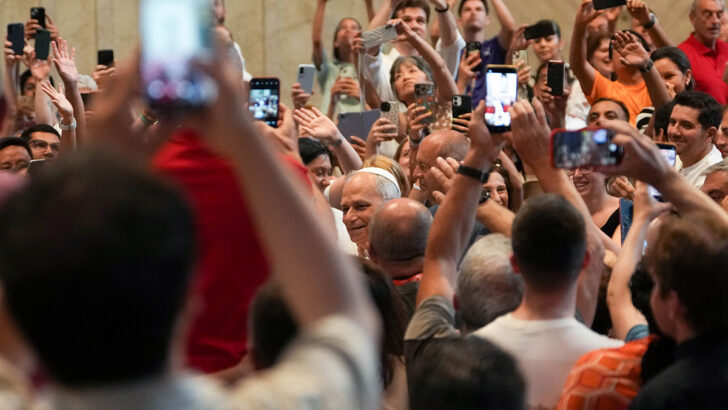
 Pope Leo greets people as they hold up cellphones to take photos and videos. Photo: OSV News / Lola Gomez.
Never before in human history has falsehood travelled so fast, so far, and so convincingly. In today’s digital world, powered by rapidly advancing artificial intelligence (AI), misinformation and disinformation can be generated and disseminated within seconds, often indistinguishable from the truth.

This poses a profound crisis. Truth lies at the very heart of the Christian faith. When it is blurred, diluted or manipulated, grave consequences ensue: confusion, division and a gradual erosion of trust.
A world flooded with falsehood
AI systems today can generate highly realistic text, images, audio and video. While these technologies have brought great benefits to education, healthcare and economics, they also enable the creation of fabricated speeches, videos, distorted narratives, and deceptive ‘deep fakes’.
Digital platforms, driven by engagement-based algorithms, tend to amplify content that provokes strong emotional reactions such as fear, anger and outrage. Misinformation often spreads more rapidly than verified truth. The result is a growing erosion of trust, as confidence in media, institutions and even personal relationships weakens, and the notion of objective truth is called into question.
When technology shapes perception
AI-driven misinformation is seldom presented as outright falsehood but as half-truths, selective framing or emotionally charged narratives that shape perception. Through repeated exposure, these influence how individuals interpret reality, what they consider credible, what they value, and how they judge moral questions, drawing many into echo chambers where existing beliefs are reinforced and opposing views dismissed.
For Christians, this situation poses a serious risk. Our faith calls us to actively seek truth. Yet when our worldview is shaped more by algorithmic feeds than by Gospel precepts, our moral compass becomes disoriented.
The impact on faith and the Church
Misinformation does not spare the Church. Misleading interpretations of Church teachings can circulate widely, and statements attributed to Church leaders may be taken out of context or fabricated. The result is fragmentation: the faithful risk being drawn into ideological debates instead of the unity the Church calls for, with trust overtaken by suspicion and dialogue shaped by confrontation.
Such division reflects a wider pattern. Falsehoods breed division, and AI-driven systems often amplify polarising content, fostering an “us versus them” mentality. Within the Church, this can fracture families, groups and generations; on a global scale, it inflames tensions across cultures, religions and nations.
This stands in stark contrast to the Christian call to unity. As St Paul exhorts: “Let no evil talk come out of your mouths, but only what is useful for building up” (Eph. 4:29). A society that loses its commitment to truth risks losing its moral foundation: without truth, trust is diminished and genuine community begins to erode.
A moral and spiritual crisis
The spread of misinformation is not simply a technological issue – it is a moral one. It calls each of us to seek truth, to uphold it, and to communicate it responsibly.
The Eighth Commandment obliges us to bear witness to the truth and avoid falsehood. In the digital age, this responsibility extends to what we read, view and share. Passing on unverified information, even unintentionally, could contribute to the spread of deception.
The Catechism of the Catholic Church teaches that “Truth or truthfulness is the virtue which consists in showing oneself true in deeds and truthful in words, and in guarding against duplicity, dissimulation, and hypocrisy” (CCC 2468).
Pope Francis has repeatedly warned about the dangers of misinformation and manipulation in the digital age. In his message for the 2025 World Day of Social Communications, he cautioned that modern communication could “use false or artfully distorted information,” generating “fear and despair, prejudice and resentment … even hatred.”
Echoing this concern, Pope Leo XIV has emphasised that technological progress must always be guided by moral truth. He warns that when human beings surrender discernment to machines, they risk losing their moral bearings.
The Christian response
Faced with this challenge, Christians are called to respond with wisdom and courage.
First, deepen our foundations in faith. A well-formed conscience is the best defence against deception. This requires a solid grounding in the Scriptures and the teachings of the Church. As St Paul reminds us, “Do not be conformed to this world, but be transformed by the renewal of your mind” (Rom 12:2).
Second, rediscover Catholic social teaching. Principles such as human dignity, the common good, solidarity, and subsidiarity provide a moral framework for evaluating both technology and society.
Third, develop critical thinking skills. The exhortation of St Paul remains strikingly relevant today: “Test everything; hold fast to what is good.” (1 Thes. 5:21). Catholics must learn to be sceptical, question sources, identify biases, verify information, contextualise the message, and resist the impulse to share content without verification.
Fourth, embrace ethical responsibility. As Christians, we have a duty to uphold truth in our daily lives. Before sharing information, we must ask: Is it true? Is it necessary? Is it kind? Does it build up or tear down?
Fifth, build communities of dialogue. In our highly polarised world, we must remember that the Church must be a place of encountering Christ and the truth. Honest, respectful conversations within parishes and communities could help to counter division, build unity and foster understanding.
Evangelisation in a digital age
Given the challenge of AI, Pope Leo has emphasised that we must reflect on the authenticity of our witness, “on our ability to listen and speak, and on our capacity to understand and to be understood. We have a duty to work together to develop a way of thinking, to develop a language, of our time, that gives voice to love.”
The greater danger today is not only that people are misinformed, but that they become malformed”
He added, “It is not simply a matter of generating content but of creating an encounter of hearts. This will entail seeking out those who suffer, those who need to know the Lord, so that they may heal their wounds, get back on their feet, and find meaning in their lives” (Jubilee of Digital Missionaries and Catholic Influencers, July 29, 2025).
In a world where machines can fabricate reality, authenticity becomes a powerful witness. Integrity, honesty and clarity stand out as signs of credibility. The greater danger is not only misinformation, but the gradual weakening of our capacity for judgement.
In the face of confusion and falsehood, the Christian mission remains clear: to seek the truth, to live the truth, and to bear witness to the truth.