

 Peter Costello
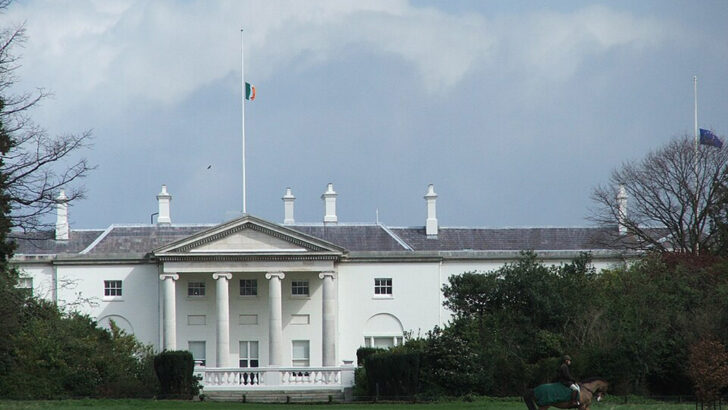 The Aras. Photo: Wiki Common
 Ireland Bunreacht na hÉireann/The Constitution of Ireland
(Government Publications Office, available both in printed form and as an online resource; Address: Jonathan Swift Street, Trim, Co. Meath, C15 NX36; website: https://www.gov.ie/opw/)
It might behove us all in the present campaign for the office of President of Ireland to actually look at the 1937 constitution and read for ourselves what the framers of that document which was eventually accepted by the people of Ireland had in mind.

Under the Free State Constitution, the Head of State was the King of Great Britain. That was considered quite unseemly by de Valera and his associates when they set to work on the new constitution. The significant power of the constitution was invested in the elected government in the Dáil. The role of the King and the office of Lord Lieutenant was removed. But there was no desire to make the office of President one of actual power. Real power reposed in the people and their elected representatives.
The new office of President was seen as an office for someone of maturity. If the term was for seven years, fourteen years if re-elected, it was clearly not intended for someone in the full flight of a career.
Purpose
What was in the mind of the framers was clearly illustrated by the person of the first President, Douglas Hyde, an Anglican of recognised achievement, whose work for Ireland in cultural and scholarly roles was well recognised by all. Note well: he was a mature cultural figure.
He was in office from June 25, 1938 to June 1945. He was followed by Sean T. O’Kelly, who was in office from June 1945 to June 1959. He was followed by de Valera himself from 1959 to June 1973. These three illustrated in a direct way what the role needed. But after the demise of Erskine Childers, another Anglican, the role began to change with the resignation of Cearbhall Ó Dalaigh.
The more recent presidents are perhaps most familiar; but really none of them, except Michael D. Higgins, seemed to fill the role as intended. Indeed, many were disappointed that Mrs Robinson was prepared to resign the highest post Ireland had to offer for a post with the United Nations.
That person whoever they are must be a person of calm and settled outlook, conscious of their own achievement willing to serve as head of State”
But as the office of President has become competitive, sought for by people clearly not of the kind envisaged by the Constitution.
Surely though a mature nation like Ireland claims to be today, can find a person of past achievement, a cultured person experienced in public life, but with facets that appeal across the social spectrum. They do not indeed need to be a politician, a judge, or a lawyer, but that person whoever they are must be a person of calm and settled outlook, conscious of their own achievement willing to serve as head of State in a calm and settled way.
Such a person may not emerge from this election. But next time we will all take time to reflect on what the position calls for in terms of the Constitution. It would be a good thing indeed if more of us were actually better informed all round about the Constitution we live under and not confuse ourselves with what they do in other countries. A little bit of reading never did anyone any harm.