

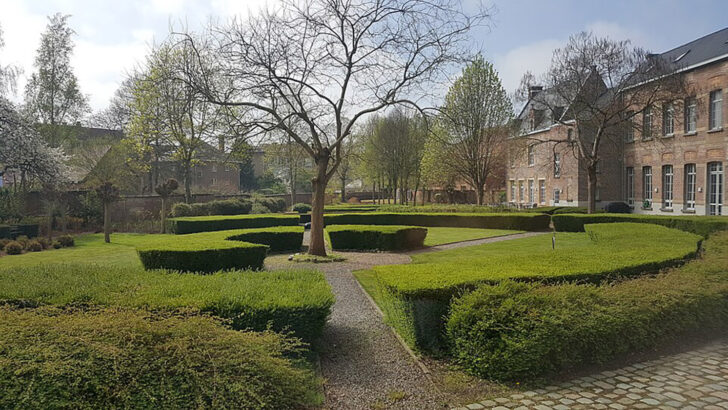
 The quiet acres of the Irish College in Leuven, Belgium. Photo: courtesy Irish College.
 Memorialising Émigré Dignity: The Cultural Heritage of St Anthony’s College, Leuven,
Edited by Francis M. O’Donnell
(Irish College, Leuven, €20.00)
The Franciscan Irish College of St Anthony of Padua was founded by the rulers of the Spanish Netherlands, Archduke Albert and Infante Isabella, in May 1617. From the outset the main aim of the college was to train and ordain Franciscan priests for the hazardous Irish mission.

It soon became a centre of learning with some of the friars lecturing and teaching in the University of Leuven. The friars were committed to promoting the integral Irish tradition of culture and learning.
To this end they dispatched Bro. Michael O’Clery OFM, to collect and copy the ancient records of his native land. He spent fifteen years on the project and with others he compiled the invaluable Annals of the Kingdom of Ireland (now known as the Annals of the Four Masters). The friars at the Irish College also had a key role in the preservation of the Irish language. They published the first books printed in Irish.
Burials
All the articles in this collection are linked in one way or another with the college. None more so that that of Francis M. O’Donnell. He provides a comprehensive account of the soldiers, scholars, friars and friends who lie buried in the college and its precincts.
He first lists the five buried in the College chapel and their location therein. Next, he names the ten persons buried in the neighbouring corridor. Finally, he describes eleven persons who are buried elsewhere in the college courtyard, including Bro. Michael O’Clery.
Francis has a keen interest in the members of his own clan. Thus, he provides informative notes on the O’Donnells buried in the College and its precincts.
A few days after entering Leuven in January 1793 the French took possession of St Anthony’s College”
First and foremost, there were those who were among the ninety-nine who travelled by ship on the Flight of the Earls: Captain Donal Oge O’Donnell (1585-1620), Nuala O’Donnell (1565-1630), Margaret O’Donnell (1608-1662), Hugh O’Donnell (1605-1625) and Rose O’Doherty (1590-1660). Rose O’Doherty was the wife of Owen Roe O’Neill, Commander-in-chief of the Catholic Army in Ulster.
In his contribution the distinguished Eurocrat, Bernard Snoy et d’Oppuers, records how his family assisted the Irish Franciscan friars in Leuven during the French Revolutionary period. In 1792 the French troops invaded what was at that time the Austrian Low Countries (today’s Belgium).
A few days after entering Leuven in January 1793 the French took possession of St Anthony’s College and ordered the Guardian to surrender the title deeds and all monies belonging to the college. By October 1, 1795, the anti-clerical and anti-religious laws enacted in France since the beginning of the French Revolution were imposed across Belgium.
The Irish friars were driven from their college. Philippe-Ghislain (1744-1825) came to their assistance. He had a castle and a farm between Mechlin and Leuven and the friars were accommodated there from 1795 to 1880. Thus, representatives of his family were much cherished guests at the formal re-opening of the college in 1927.
Queens
Katherine Simms, in her essay, writes about the role of queens in later medieval Ireland; it seems they flourished particularly during the sixteenth century. She regrets that there is little evidence as to what these formidable Irish women really looked like.
One of the most notorious and flamboyant of them was Gráinne Ní Mhaille or Granuaile in tradition known as ‘the pirate queen’. The O’Malley family, who held lands along the west coast and islands of Co Mayo, had been hereditary naval commanders for the Ó Conchobhair kings of Connaught. Gráinne brought a naval fleet of ships to her successive husbands’ and commanded them in defence of her own and her husbands’ strongholds.
It is fitting to give the last word to the erudite Fr Canice Mooney OFM. He wrote: “is there any other similar plot of ground inside Ireland or outside it that can boast the mortal remains of such an illustrious company of Irish soldiers and scholars”.
Francis O’Donnell’s monograph verifies this claim and also provides an insight into the global influence of the Irish Franciscan College at Leuven.
This book can be ordered online from the Genealogical Society of Ireland: https://familyhistory.ie/product/memorialising-emigre-dignity-the-cultural-heritage-of-st-anthonys-college-leuven-plus-postage-packaging/