

 Peter Costello
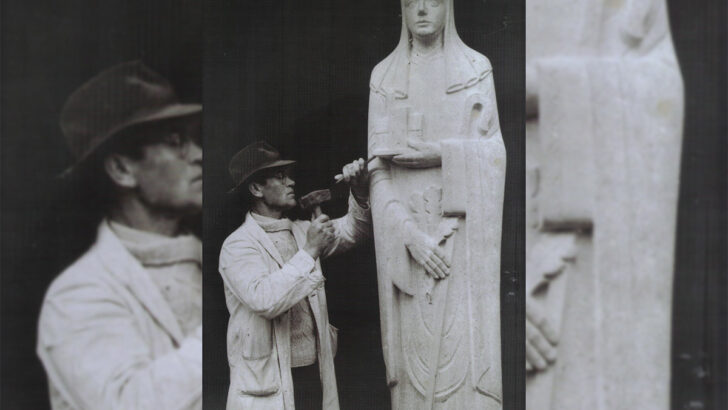 Séamus Murphy at work on his statue of St Brighid for the
church in San Francisco. Photo: Gandon Editions
Séamus Murphy at work on his statue of St Brighid for the
church in San Francisco. Photo: Gandon Editions Séamus Murphy (1907-1975) Sculptor, a centenary album
Edited by Peter Murray assisted by Clare Hennessy
(Gandon Editions / Crawford Art Gallery, Cork, €39.00 + postage)
This book was sent to us for review after some discussion with the editors at the publishers about titles that would be of interest to our readers. This account of the life and work of one of Ireland’s most interesting modern artists certainly contains much of interest as it is a revelation of the life’s work of an important artist.

Effect
One can see the effect of his work in the huge bust of Michael Collins in the foyer of Dublin’s Hugh Lane Gallery which has for every visitor a powerful dynamic presence.
Murphy was in time a contemporary of Eric Gill and Jacob Epstein, but his work, while similar in some aspects, has a very different character.
You’ve drawn a superb and valuable picture of life you know and one that is going to last a long time”
Séamus Murphy gave us an account of his own way of life in a book – Stone Mad – he published back in 1950, in a very different and now vanished Ireland. It was an account of his life as a ‘stoney’, having gone to work in a mason’s yard at the age of 14, a boy small for his age.
A stoney was the term for those workers in stone who did so much work not just for graveyard memorials, but also public buildings and private houses, in the days before everything came readymade in concrete. Look around any of the older parts of our cities, towns, and villages, and the work of the stoneys still stand out.
That book was recognised by his fellow Cork artist and writer Robert Gibbings as one with a set of life histories along with Ó Crohan’s Island Man and O’Sullivan’s Twenty Years A Growing, which became immediate Irish classics.
In a letter to Séamus Murphy, he told him that “You’ve drawn a superb and valuable picture of life you know and one that is going to last a long time whatever may happen to the craft.” That was true in 1950 and is still true today. A casual opening at any page immediately rivets the reader to the human warmth of the book.
That comment put the finger on a point of great relevance to the career and achievement of Séamus Murphy. He was not a trained artist in the usual way. He was an apprenticed stone mason, following an ancient and lasting craft.
Achievements
All the pieces illustrated in this book, which the editors admit is very far from being a complete catalogue, have a quality which the ancient Greeks would perhaps have called autochthonous, sprung from the earth, as they seem to arise not from calculation but from a natural process. The photographs show Murphy at work carving out a form inherent to his mind in the block of stone under his chisel.
Some of his achievements stand out. In 1948 he was commissioned to provide a set of statues of the twelve apostles for St Brighid’s Church in San Francisco. As a young man while on a brief stay in France Murphy had visited Chartres and been overwhelmed, not so much by the great rose window, but by the carvings of the saints and others on the facade.
These echoed in his mind when he set about his Apostles. The figure of St Thomas Didymus, the ‘Doubting Thomas’ of pious legend, was said by gossip to have been modelled on de Valera – though the image itself does not support this notion.
Among the illustrations are photos of Nancy McCarthy, and other figures of Cork cultural scene”
A few years earlier he had also been commissioned by the local magnate who was paying for the Church of the Annunciation at Blackpool in Cork, which he worked on with the architect Eddie O’Flynn. Every detail, down to the smallest, passed under Murphy’s hand.
The project was a pre-eminent success. But strangely enough it did not lead to many further church commissions. Murphy had done a head of Archbishop McQuaid of Dublin. His Grace did not care for it; he said it looked nothing like him. His influence alone, it is suggested here, was enough to exclude Séamus Murphy from many further church projects.
Not that he lacked for work. This book illustrates not only his statues and busts and memorials, but also much of his work as a lettering mason on gravestones and memorials. The powerful simplicity of his style is well illustrated by the headstone for Seán Ó Riada and his wife Ruth, now in the graveyard at Cúil Aodha, Co. Cork.
And there are others too: a stone for Peig Sayers, Tomas Ó Crohan, and the Tailor and his wife Ansty. The later couple were famously the subject of a book by Eric Cross which was inadvertently the cause of controversy. But among the illustrations are photos of Nancy McCarthy, and other figures of Cork cultural scene in the 1940s, such as Frank O’Connor and Sean O’Faolain, even the American Ken Ripley.
Not that Murphy had not travelled. He had, and his time in Paris is recounted in detail. But his heart was in Cork, and the stones of Cork. A remarkable instance was his statue of St Gobnait, at Ballyvourney, Co. Cork. This is shown in several stages, ending with its present situation, as a tree surrounded shrine, beloved of the local people.
Gandon Editions, Oysterhaven, Kinsale, Co. Cork, www.gandoneditions.com, can be reached at gandonedtion@gmail.com.