

 Aubrey Malone
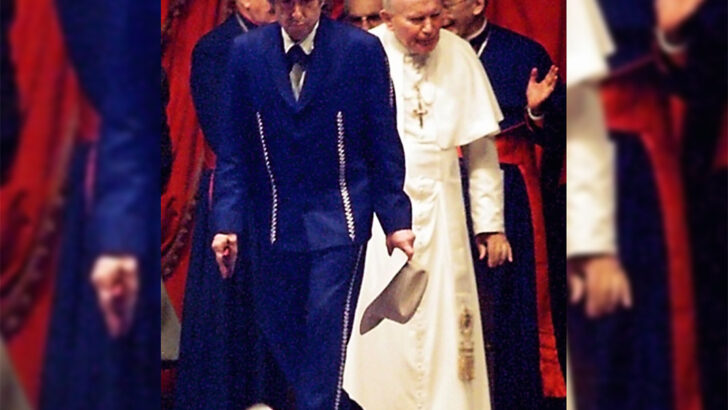 St John Paul II with Bob Dylan in 1997
 After the Flood: Inside Bob Dylan’s Memory Palace,
by Robert Polito
(W.W. Norton, £15.00 / €29.99)
Bob Dylan has reinvented himself more often than any artist inside or outside music. Morphing from the folk-rock avatar of the sixties counterculture to a born-again Christian in the late seventies, he went from singing anti-religious anthems like ‘With God On Our Side to performing for Pope John Paul II at the 23rd Italian Eucharistic Congress in Bologna in 1997.

He rocked the pillars of the temple with his iconoclastic early anthems. Dubbed ‘Judas’ when he went electric in Newport in 1965, three years later he produced the semi-religious album John Wesley Harding, which included the track ‘I Dreamed I Saw St Augustine.’ In 1971 he celebrated his 30th birthday by going to the Wailing Wall in Jerusalem to explore his Jewish heritage.
His conversion to Christianity was said to have started the night someone threw a crucifix on stage during one of his concerts in San Diego in 1978. He saw it as significant.
“Jesus put his hand on me,” he said three years later, “It was a physical thing. I felt my whole body tremble.” He read the Bible ardently at this time and also released three brilliant spiritual albums, ‘Slow Train Coming’, ‘Saved’ and ‘Shot of Love’. They all had a ‘Gotta Serve Somebody’ zeitgeist. His conversion was influenced by his then-girlfriend Mary Alice Artes, an evangelical African-American actress. She’s the ‘Precious Angel’ and the ‘Covenant Woman’ of the two songs with those titles.
Biography
I first saw him live in London in 1981. It was shortly after he’d gone through his born-again phase. He performed a lot of gospel numbers that night but the next time I saw him in concert, in Slane in 1984, his set list had changed dramatically. That’s Bob Dylan, the man who famously said, “He who’s not busy being born is busy dying.”
Robert Polito’s new biography of him is one of the best I’ve read. That’s saying something. I’ve trawled my way through at least twenty of them over the past half-century. Polito’s frames of reference go way beyond the usual Dylanography, even bringing in people like Marcel Proust, Al Jolson, Charlotte Brontë, and James Joyce.
Since then, he’s cut innumerable albums, almost died (in 1997), become a DJ, and even started a whiskey brand”
Dylan won the Nobel Prize for Literature in 2016, the first time it was awarded to a songwriter. It was an acknowledgement, says Polito, of the fact that his lyrics, which are often richly poetical, can stand up without the addition of that nasal roar he’s made his own ever since he first trod the streets of Greenwich Village in 1961.
Since then, he’s cut innumerable albums, almost died (in 1997), become a DJ, and even started a whiskey brand. In his concerts, he persists in warbling versions of the old classics that are often indecipherable. (“Even to himself,” Tommy Tiernan jokes).
Polito references Dylan bootlegs. I own about fifty of these, courtesy of a Canadian dealer who informed me he has a recording of practically every concert Dylan did in his life. Considering he’s been averaging about 100 a year since he started his career nearly 70 years ago, that must result in a tally of many thousands.
Some of them are brilliant and some terrible. That’s what you have to expect with someone as prolific as this man. It’s been many years now since he’s stopped caring what we think of him. Did he ever? At a concert in 3Arena a few months ago he barely acknowledged us in the audience. I think he might have muttered “Thank you” after one of his songs. From Bob, that’s practically a novel.
Layers
Polito, a poet, focuses on the second part of his life, using a lapidary style of writing that’s compulsive. The book is both amusing and enlightening. In its later pages, he writes about Dylan being inflicted with “balance issues” and vertigo. These he apparently contracted during Covid. They could be responsible for the fact that he hasn’t stood up at his concerts for many years now, preferring to do them from being a keyboard. I believe he’s also crippled with arthritis.
Polito draws on Dylan’s vast Oklahoma archives to craft a unique portrait of him in the winter of his life. At one point he quotes him saying, “You’re hoping to croak before senility sets in. You don’t want to be ancient or decrepit, no thank you.” He’s 84 now and still writing.
People like Polito write erudite books about him, like this one”
He is also still being elusive. No matter how many layers of the onion we peel away, there are always going to be a few more left tantalisingly underneath. That’s the way he likes it and the way we like it. He remains a permanent enigma, the Jokerman of his song of that name, where he wrote, “I was born with a snake in both of my fists while a hurricane was blowing.”
People like Polito write erudite books about him, like this one, which are limned with insight. He tries his best to divine his essence but after a certain point we have to accept the fact that we’re really just scratching the surface with this chameleon. He’s probably laughing up his sleeve at all the Politos just like Joyce was, knowing he’ll keep them in hermeneutic theses till kingdom come.
It’s Bob Dylan’s world. The rest of us just live in it.