

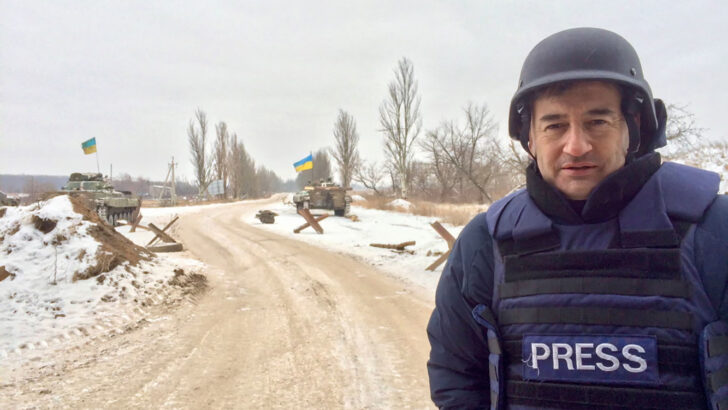
 Fergal reporting from the war zone in Ukraine. Photo: BBC/Fergal Keane.
The Madness: A Memoir of War, Fear and Post Traumatic Stress Disorder,
by Fergal Keane
(William Collins, £10.99)
Fergal Keane was born in London on January 6, 1961. His father, Eamon, was a professional actor, and his mother also “trod the boards”. He is a nephew of John B. Keane, the playwright. In his early years, he attended a number of the best-known schools in Dublin, and he writes scathingly about how they were conducted, in particular, their extensive use of physical punishment to impose discipline. However, he spent most of his formative years in the Presentation College in Cork, where he occasionally exhibited signs of his later brilliance.

Fergal begins his memoir with a comprehensive account of the fear, terror and panic he endured as he grew to manhood. Next, through the lens of Hannah Purtill, his grandmother, he traces the course of the Black & Tan war in North Kerry. Atrocities were committed by combatants from both sides of the conflict. Hannah was a member of Cumann na mBan and took an active part in the struggle against the crown forces.
Depression
Fergal muses that the bouts of depression she endured in her later years were caused by memories of those “cruel times”. He also suggests that the well-known errant behaviour of some of the local leading participants in the War of Independence also had its origin in those times.
On graduating from Patrician College, Cork, Fergal signed on as a reporter in the Limerick Leader. Thereafter, he continued working as a journalist in the Irish Press and RTÉ. Then, in 1989, he secured an appointment at the prestigious BBC, and during the next thirty-seven years he became one of their best-known journalists.
Most people would associate Fergal with the anti-apartheid campaign in South Africa. No sooner had Fergal joined the BBC than they had him cover that ‘developing story’”
He did the BBC proud with his accurate and balanced reporting from many of the “trouble spots” across the world. In return, the BBC and his colleagues at the corporation did him proud, fully supporting him when he was coping with nervous breakdowns and sojourns at psychiatric institutions. He provides a brutally honest account of the twenty-eight days he spent at one of those institutions, as he attempted to deal with his addiction to alcohol.
Most people would associate Fergal with the anti-apartheid campaign in South Africa. No sooner had Fergal joined the BBC than they had him cover that “developing story”. Each week, we saw him on our TV screens interviewing people in the South African townships.
Fergal covered every aspect of the anti-apartheid campaign. He was not an uninvolved observer. He fervently hated the apartheid ideology and everything it stood for. Then, before the fall of the apartheid regime, he assisted one of the leading anti-apartheid campaigners, who was in mortal danger, to escape from South Africa.
Fergal, it seems, was most impacted by the horrors he witnessed during the Rwandan genocide when the majority of Hutus set about eliminating the minority Tutsis. The debt of bitterness and hatred between former neighbours shocked him to the core. He exhibited remarkable courage in ensuring that his evidence led to the arraignment before the courts of some of those who were chiefly responsible for the genocide.
Retired
Until he retired in 2026, Fergal continued to attend and report on scenes throughout the world of man’s inhumanity to man. Despite his super-busy life as a reporter, he was a prolific author. He was also a noted historian, publishing important studies on Ireland and Britain. The list of awards and honours he received for his work, including an OBE from Queen Elizabeth II, is remarkable.
This book, his latest publication, on war, fear and PTSD, is essentially a lesson that if one goes to the edge too often, there is a serious price to be paid in terms of one’s health and well-being.