

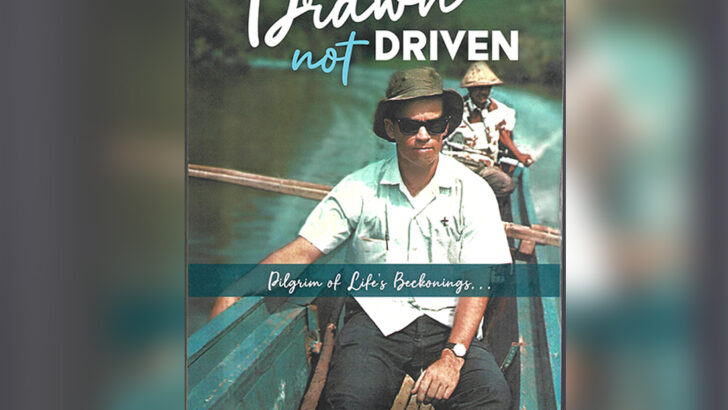
Drawn not Driven: Pilgrim of Life’s Beckonings,
by Warren Ford
(Red Feather Publishing, 2025).
This is a fascinating autobiography, a wide ranging account of an Australian .

The author, Warren Ford, was born in Western Australia on 23 January 1942. He attended the elementary convent school of St Aloysius conducted by the Mercy Sisters at Toodyay and the Christian Brothers Highschool at Highgate.
He was an active member of the Young Australian League (YAL). This was set up by the Labour Prime Minister, John Curtin, to encourage young Australians to love and have pride in their country. To this end it promoted gatherings and concerts across Australia. But Warren’s main hobby and activity in his teens was playing the drums which he did in several bands.
When Warren was attending Highgate Highschool, missionaries occasionally addressed the students seeking vocations. Warren was impressed by one of them who recorded his experiences in China. Not long after he ended his education Warren received a letter from that missionary’s society inviting him to join the Columbans and dedicate his life to the missions.
Warren recalls baptising people by the dozen. On one occasion he married twenty couples in the one ceremony”
Known as the Maynooth Mission to China when first established in 1916, by 1921 it had become known as the Missionary Society of St Columban or the Columbans. Warren accepted the invitation and after studies at the Columban seminaries, first at Melbourne and later in Sydney, he was ordained in 1967.
The Columbans set out to evangelise the nations of the Orient. Thus Warren was not surprised when his first missionary assignment was to the Philippines. After a stint at a language school learning Cebuano, the local language, he joined a fellow Columban at Dinas on Mindanao Island. There he and his colleague provided a 24/7 service for their parishioners.
Warren recalls baptising people by the dozen. On one occasion he married twenty couples in the one ceremony. They visited the sick and the dying and dutifully attended civic ceremonies. He also describes the basic living conditions in the area and his frugal life-style and that of his colleague.
Warren completed three more missionary assignments: Pagadian 1971-1975, Dimataling 1976-1980, and Pagadian 1981-1984. As the years went by the Philippines was becoming more and more dangerous for missionaries. There were more and more murderous clashes between Christian and Muslim communities and opposition to the military dictatorship of Ferdinand Marcos was becoming widespread.
Then there was the Federation of Free Farmers (FFF). The relationship between the landlords and the landless tenant farmers was akin to slavery, thus the Columbans co-organised the FFF to make that relationship more equitable.
At the same time the militant opposition to the government – centred on the Communists – were striving for the same end with the slogan ‘the Land for the People’. As the authorities sometimes were not able or willing to distinguish between the two, missionaries were as much in danger of being shot by a trigger-happy soldier as by a terrorist or communist.
Laicisation
Warren requested and received laicisation in 1982 and married Evan Guillena in 1984. She had earlier worked with him in the Philippines. Thereafter he was employed on engineering, mining and infra structure projects in various countries in Asia not least because of his experience in the Philippines.
Following his retirement he and his wife Evan busied themselves in working for and with under-privileged families and children. He revelled in family celebration. There were trips around the world. He was particularly impressed by the great cities of Western Europe.
Warren enjoyed his extended family. At the age of eighty he sat down to write his memoir, which is dedicated to them. It includes a lovely eulogy to his mother. His father had an addiction to gambling, was totally irresponsible and left Warren’s mother to raise him and his brother and sister on her own.
Throughout, this memoirs exudes brusque Australian friendliness, While directed to Warren’s extended family, I feel it deserves a much wider readership. It has, of course, a special interest for all those who admire the missionary efforts of Irish people, not just in past centuries, but around the world today.