

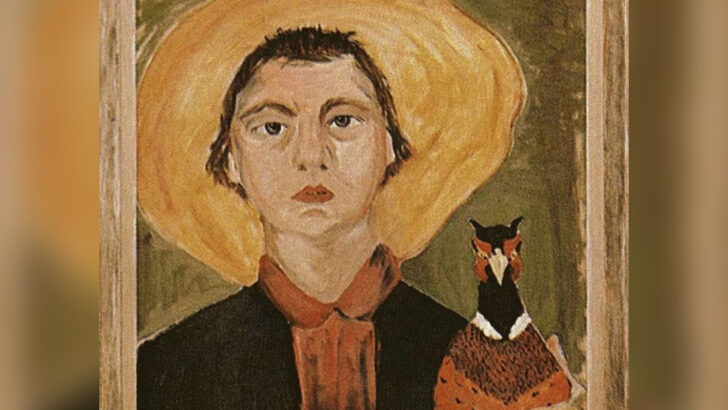
 A painted self portrait by
Flannery O’Connor
A painted self portrait by
Flannery O’Connor No One Was Paying Any Attention to the Sky: Flannery O’Connor and Modernity,
by Damian Ference
(Wiseblood books, US$11.00 / €9.50)
Flannery O’Connor was a remarkable writer, who was born and passed her short life in the state of Georgia, a region beset by its “Southern Gothic” heritage, a history of slavery and passionate division, from which her own particular vision. with its Catholic undercurrents, springs. Her own religion gave her a distanced view of the peculiar culture around her.
For the hundredth anniversary of the birth of Flannery O’Connor, which fell on March 25 this year, I wrote about her enduring legacy, inspired by a conversation with Fr Damian Ference – the Vicar for Evangelisation of the Diocese of Cleveland, a Flannery O’Connor scholar and author of Understanding the Hillbilly Thomist (Word on Fire, US€25.00 / €21.50).
Anyone familiar with that book, his podcast appearances, or even just a casual conversation with him, knows what an insightful and passionate reader he is. It’s fair to say he filled my mind with new thoughts.
That earlier book, Fr Ference made clear, grew out of his doctoral work exploring how the philosophy of St Thomas Aquinas, whom O’Connor greatly admired, shaped the structure and substance of her fiction.
Fruitful
In our conversation, he made it clear that his doctoral dissertation had been fruitful and to expect a new monograph in the coming months, the shorter yet no less insightful No One Was Paying Any Attention to the Sky: Flannery O’Connor and Modernity , just published by Wiseblood Books.
This book, he made clear, expands on a single chapter of his dissertation, encouraged by an advisor who urged him to dive deeper into the philosophical undercurrents both of O’Connor’s overall world view as well as those which formed her understanding of ‘modernity’.
In particular, it focuses on some key thinkers who influenced her views on modernity: Romano Guardini, Étienne Gilson, and to a lesser extent, Gabriel Marcel.
Fr Ference opens with literary critic Caroline Gordon’s remark that “Flannery O’Connor’s picture of the modern world is literally terrifying.” He argues that the ‘terrifying’ picture O’Connor presents is not careless or excessive, but actually a direct response to the spiritual and philosophical assumptions of modernity.
Drawing on Guardini’s existential Augustinianism and Gilson’s Thomist realism, Fr Ference identifies the four main points which O’Connor critiques throughout her work, those inherent in the modern conception: the self as the centre of existence; a disregard for mystery; a distrust of the concrete; the subordination of reason to emotion or will
The meaning of a story has to be embodied in it, has to be made concrete in it. A story is a way to say something that can’t be said any other way”
In exploring these themes through such thinkers as Descartes, Comte, and Spinoza, Fr Ference presents O’Connor as a “provincial writer”, yet one who was fully engaged in the intellectual debates of the time, responding in the way she knew how – through her fictions. Her reading habits, including reviews of philosophy books for her diocesan newspaper, speak to her seriousness and rigorousness.
One of the book’s unexpected gifts, especially for “wannabe creatives” like myself, is how clearly it conveys O’Connor’s understanding of artistic creation. Her stories are never vehicles for arguments, stories made purely for ideological ends. In fact, she warns against any fiction that separates the idea from the embodiment.
“The meaning of a story has to be embodied in it, has to be made concrete in it. A story is a way to say something that can’t be said any other way.”
Or as she says more pointedly: “Fiction is an art that calls for the strictest attention to the real—whether the writer is writing a naturalistic story or a fantasy.”
Grounding
This is where Fr Ference’s philosophical grounding shines. By drawing on Gilson and Guardini, he helps show how O’Connor resists the modern temptation toward disembodied idealism.
For her, the Incarnation is central. Mystery must pass through flesh. Her stories deal not in abstraction but in blood and barns and brutal grace. She deals with a reality where the waters of baptism are not merely a rite of passage but have the power to drown the dirty soul.
To the hard of hearing you shout, and for the almost-blind you draw large and startling figures”
For O’Connor, these tendencies of modernity are not just shifts in culture but are signs of a fundamental metaphysical misunderstanding. Modernity rejects reality as it has been revealed to us through the scriptures and creation: patterned, participatory, and sacramental. Where Christianity sees creation as intelligible and grace-filled, modern thought isolates the self, reduces mystery to mechanism, and treats the body as separate from the soul.
O’Connor’s fiction is her reply. “Reality is something to which we must be returned at considerable cost,” she writes. The cost, in her stories, is often suffering, violence, and strangeness, all of which open a path toward grace which we often tend to take for granted.
As she writes elsewhere, “To the hard of hearing you shout, and for the almost-blind you draw large and startling figures.”
Culminates
The book culminates in a close reading of Wise Blood, O’Connor’s first novel. Fr Ference interprets the book as modernity’s spiritual excesses allowed to run to their conclusions.
What No One Was Paying Any Attention to the Sky ultimately shows is that in an age obsessed with the self, allergic to mystery, and suspicious of anything concrete or inherited, O’Connor’s fiction still matters now more than ever. Her stories are unsettling because they aim to wake us up.