

 Peter Costello
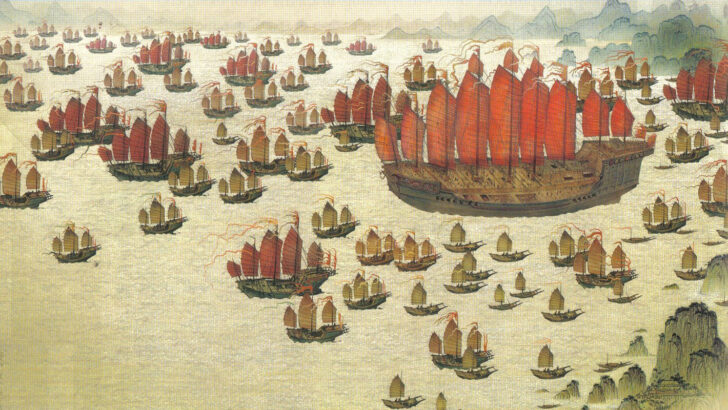 An imaginative reconstruction of a great Chinese fleet sent out in the years after 1405 to impress Chinese power on the countries of the Eastern world and
the Indian Ocean.
An imaginative reconstruction of a great Chinese fleet sent out in the years after 1405 to impress Chinese power on the countries of the Eastern world and
the Indian Ocean. Driven by the Monsoons: Through the Indian Ocean and the Seas of China,
by Barry Cunliffe
(Oxford University Press, £30.00 / € 42.00)
Barry Cunliffe, now Emeritus Professor of Archaeology at Oxford University, is one of the most distinguished archaeologists of his generation. He is known not just as an excavator, but also as one of those rare persons who manages to stand well above the pits and cuttings of national sites and their results, to see a wider international context both in space and time.

Indeed, the phrase the longue durée occurs early in this book, which runs from the obscure antiquity of Homo erectus (otherwise Peking Man) in the remotest reaches of prehistoric China to the recent announcement of the current Chinese leader Xi Jinping’s “Belt and Road Initiative”, which hopes to create a new presence for his empire across the world today.
Along the way Cunliffe manages to allude to every important culture in South Asia and the Far East from the earliest times, including those you will recall from early learning of the Bible at school to places and peoples only recently recovered by archaeologists from the tangled jungles of forgetfulness.
Turing these pages is in itself almost an entire education given the vast range of material and insights that Cunliffe utilises. The essential point is that history, whether the actors wish it or not, is driven by the forces of geography far more than by social matters. The brute facts of the natural world are more formative than many allow.
Hope
I had a vague hope that he might have interesting things to say about the initial spread of Christianity across central Asia to China by Nestorian priests from Assyria — the first people to utter the name of Jesus in the Celestial Empire.
This book is so rich in information that what is said has often to be restricted to get everything in”
Cunliffe has written in an earlier book about these movements on land along the culture back and forth along the Silk Road; but here he deals with the trade routes at sea that (as some think) carried St Thomas to India in Apostolic times.
He does indeed allude to the Nestorians settling later in India, but only briefly, for this book is so rich in information that what is said has often to be restricted to get everything in.
(This, however, is more than made up by the lists of sources and further reading at the end which will help make this book of long time value in many libraries.)
Monsoons
The monsoons that are central to the book are the seasonal winds that blow across the Arabian Sea between southern Arabia and the coast of Kerala in India. But he goes beyond India and discusses the China seas that carried Chinese embassies to peripheral states of Indo-China to India, and to Arabia and to distant South Africa. Giraffes were brought as gifts from Arab rulers to China, a remarkable thing to think of.
But again the routes through the China seas led to Japan, to Malaysia, and beyond that to the island chains of the Pacific.
Here it is explained just how it is that the tourist-ridden island of Bali is a Hindu island in the middle of a Muslim state; later Hindus became the ubiquitous accountants and shopkeepers of the British Empire from Trinidad to Fiji by way of Uganda. But also just how with the pots, pans and spices came ideas and inventions (gunpowder and rockets from China for example), the thoughts of Confucius, the notions of Lao Tzu, and the beliefs of Shakyamuni spread out, fell back and spread again.
This period is dealt with in a chapter entitled ‘Of Treasure Fleets and Gunboats’ – which says it all about empires”
We are so used to thinking of the world from a Eurocentric point of view. Western explorers went nowhere where there were not others before them. That is not forgotten here. But in this setting of history the Portuguese and the Spanish, and after them the French and British, not to speak of other empires the Japanese, the Americans, Germans, and Italians simply plugged themselves into a system of contacts and trade that went back more centuries than could be remembered.
But this period is dealt with in a chapter entitled “Of Treasure Fleets and Gunboats” – which says it all about empires. On that point, those who use the terms ‘empire’ and ‘colonial’ only to refer to the activities of Europeans imposing themselves on the world in recent centuries, are wrong.
Slavery
We see here that this has been the way of all empires, all races, all times of history. Slavery, all too often seen – even by our own Trinity College – as a matter of American history in the last few centuries has always been a force in history; even here in Celtic Ireland.
But by 1602 the world had been encircled, a global pattern of trade had come into existence – much earlier indeed than those who carelessly speak of it as modern, realise.
The activities of the present administration in North America show that an idea of history limited to the last three generations is to know nothing of the real world”
Cunliffe’s final brief summary of his theme is called “Riding the Monsoon: Retrospect and Prospect.” Careful readers will have learned a great deal from this book, not just about East Asia and the Pacific, but those more familiar regions of the world in Greece, the Middle East and Persia.
But that prospect he alludes to is one to think about. The Americas as a whole do not feature in this book – can Cunliffe have a book about them in preparation? The activities of the present administration in North America show that an idea of history limited to the last three generations is to know nothing of the real world. Persia, Afghanistan, India, Japan, China, all take on new aspects in the light of this book.
Important
I suspect that this book will come to be seen as one of the most interesting, indeed most important books of 2025. Certainly it is one which Xi Jinping himself might read with pleasure, if he reads Western modern books.
This book is printed in full colour, which gives a dimension of splendour to the whole thing, for the illustrations have been selected and prepared with great care.
A special word must be said about the maps, which for once are really wonderful, well drawn, informative and adjusted to the needs of historical exposition in a singular way. In them the global view of the book comes alive. Yet I cannot find the cartographer’s name anywhere among the credits. I emailed OUP to ask who the map makers were. But answer came there none.