

 David Quinn
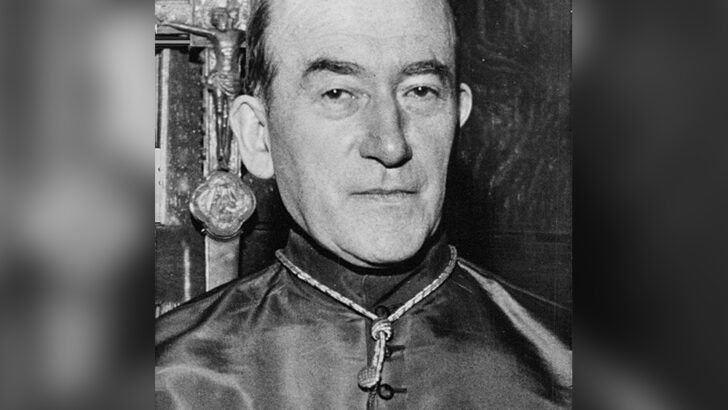 Archbishop John Charles McQuaid. Photo: Wikimedia Commons.
 Official Ireland has its heroes and villains. The heroes and villains of the first few decades after independence in 1922 are easily categorised. The heroes are the ones who propelled Ireland forward into the modern age. They are people like Noel Browne, Sean Lemass, TK Whitaker and Gay Bryne.
The villains are the ones who ‘held us back’, and the two who loom largest in this regard are Eamon de Valera and John Charles McQuaid. How many books, how many documentaries, have been made lamenting these two men, men we see in literal black and white, but also in moral black and white?
The division of the major Irish figures of the 20th century into these black and white moral categories is more cartoon than history. If you go looking deep enough, you can find the nuances in various books and articles. But for the general public, the message is clear: McQuaid and de Valera were harmful to Ireland, and we would have been better off without them.
If only Michael Collins had lived, we are sometimes led to believe, perhaps he could have seen Dev off the political stage and Ireland would have opened up to the rest of the world much sooner than it did. And if only someone else had become Archbishop of Dublin in 1940, someone less conservative than McQuaid, less controlling, less severe, less energetic, then perhaps we’d have experienced a less authoritarian Church?
RTÉ
True to form, RTÉ recently aired a two-part discussion about Archbishop McQuaid called The Fearsome Ruler of Catholic Ireland. The presenters were historians Diarmuid Ferriter and Caitriona Crowe, who are the co-hosts of a history podcast for RTÉ called What Were We Like.
The title immediately cast McQuaid in a negative light and the opening music was sinister, as befits a man who is cast as one of Ireland’s villains.
In fairness to Ferriter, he at least tried to bring a bit of balance to the discussion. Crowe was less fair-minded, in my opinion. But overall, the series would have confirmed the anti-McQuaid prejudice of those who pay attention to these sorts of things.
I am not a historian, and I am not going to pretend to be an expert on either McQuaid or de Valera, but you don’t have to be an historian to know that a black and white presentation of historical subjects almost always does an injustice to whatever is under consideration.
The modern, liberal presentation of history, which is by far and away the dominant one, is far too inclined to caricature those found guilty of keeping Ireland parochial and Catholic.
But we can see these things differently. Even if Collins had lived, and become Taoiseach, he would have faced the same economic and political conditions as de Valera. During the Great Depression of the 1930s would he really have opened up the Irish economy to the rest of the world when most countries were drawing up the economic drawbridge? It seems unlikely.
I don’t think our economic fate would have been so different under a Collins. Too many things were outside our very limited control”
Perhaps he would not have fought an economic war with Britain which Dev did. But who can say? Maybe public opinion would have forced him into this stance.
Then World War II came and the economy remained in terrible condition for years afterwards. If Dev was not around, perhaps we’d have opened our economy to the world a little sooner, but again, who can really say?
Either way, I don’t think our economic fate would have been so different under a Collins. Too many things were outside our very limited control.
Would we have been less Catholic? Again, doubtful. We were a Catholic people, and we wanted a strong Church and a political system that was responsive to Catholic values. No politician was going to defy that, even if they wanted to. We might have ended up with a somewhat different Constitution than the 1937 one, but it would not have been radically different.
Dev wanted John Charles McQuaid to become archbishop of Dublin in 1940. They knew and respected each other. So perhaps a Michael Collins would have lobbied the Vatican for a different archbishop. But what you should note here is the influence the State was having on the Church, not the other way around.
Personally, I believe that Archbishop McQuaid would be much better judged had he been a prelate in a somewhat earlier era. It just so happened that he lasted through to 1970, when Ireland was changing and a growing number of people, especially the ones that mattered, didn’t want the bishops to have as much influence anymore and McQuaid fought back hard against that.
If he had been archbishop of Dublin from say, 1930 until 1950, he might barely be spoken about today.
Credit
But credit should be given where it is due. He cannot be viewed only through liberal, secular eyes. He was extremely devoted to the poor of Dublin and was personally generous. (Ferriter does acknowledge some of this).
He presided over the founding of several hospitals in Dublin (albeit by religious orders), and many parishes. He cared very much about the fate of Irish emigrants.
He also cared that Ireland should remain Catholic. But why wouldn’t he? He was a sincere Catholic believer who genuinely believed that Irish people were better off under the guidance of the Church. He believed the rising, secular, liberal tide would lead them astray and he fought that tooth and nail. It was a losing battle, of course. But liberals don’t forgive or forget their opponents easily.
One interesting vignette from the two podcasts about McQuaid revealed more than might have been intended. In 1962, as RTÉ was still finding its feet, a member of the Knights of St Columbanus wrote to McQuaid about the 16 producers then working at the station. Of the 16, he said, only two were practicing Catholics. That is remarkable, given the level of Mass attendance at the time.
Of the rest, several were very much on the left, politically speaking, and at least one was very anti-clerical. In other words, those 16 producers were not representative of Irish public opinion at the time. It turns out Archbishop McQuaid was right to be suspicious of the station.
The censorious side of McQuaid is still alive and well in modern Ireland”
Today, we imagine that we have banished censorious, controlling individuals like John Charles McQuaid from our midst. But have we really, or have we simply replaced him with secular equivalents? Would you really say that people today are allowed to freely speak their minds on whatever they like without fear of personal or career consequences? Would you really say that the likes of RTÉ is happy to hear criticism of say, transgender ideology, or does it prefer to keep such criticisms off the airwaves? I think we know the answer to that.
In other words, we have changed less than we think. The censorious side of McQuaid is still alive and well in modern Ireland and ironically it is often to be found in his most strident, secular critics.