

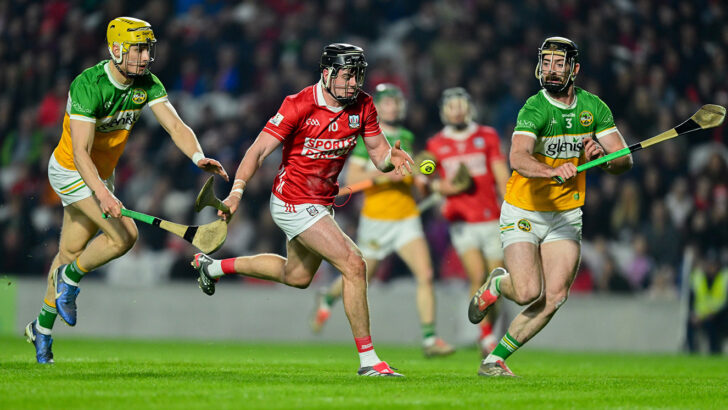
 Darragh Fitzgibbon of Cork in action against Donal Shirley, left, and Ben Conneely of Offaly during the Allianz Hurling League Division 1A match between Cork and Offaly at SuperValu Páirc Ui Chaoimh in Cork, March 21, 2026. Photo: Tyler Miller / Sportsfile.
 Just five games remain in this year’s intercounty hurling championship as the All-Ireland quarter-finals bring the curtain down on provincial campaigns that, in truth, never really caught fire.
The Munster and Leinster finals were far from the classics many had anticipated, with Limerick and Galway emerging victorious to secure direct passage to the All-Ireland semi-finals. The 2018 All-Ireland final pairing will now await one of Cork, Clare, Dublin or Offaly in the final four.
It has been a disappointing summer for hurling in truth. While there have been flashes of quality, the championship has struggled to generate the drama and intensity that has become synonymous with it in recent seasons. Ironically, the game that should have provided hurling’s defining moment of the summer so far instead became consumed by controversy and frustration.
The latest chapter in the modern rivalry between Cork and Limerick promised another classic. Instead, dreadful weather, a stop-start contest and a contentious finish ensured that much of the post-match discussion centred on referee James Owens rather than the action itself.
The Wexford official became the focal point following his decision to sound the final whistle while the ball remained in flight, well beyond the allotted five minutes of additional time. Both sets of supporters voiced frustration at various stages of the contest, while Cork manager Ben O’Connor was left feeling that several crucial decisions had gone against his side.
Calls
There is little doubt that some calls will continue to be debated. Kyle Hayes was penalised for a challenge on Brian Hayes that resulted in a Cork penalty, while a similar incident involving Shane O’Brien and Niall O’Leary at the other end went unpunished. Marginal decisions are inevitable in games played at such intensity, but consistency remains the standard supporters expect.
Spectators were left frustrated by the constant stop-start nature of the decider, with a whistle-happy Owens seemingly pulling for every infringement. In many ways, it highlighted just how impossible a task refereeing has become at the highest level of hurling.
With the clock well beyond the allotted five minutes of added time, Cork were awarded a free deep inside the Limerick half”
Ironically, when the same official took charge of Cork and Limerick’s round-robin meeting at Páirc Uí Chaoimh earlier in the championship, there were nine minutes on the clock before he awarded his first free. In the aftermath of that game, Owens was criticised for allowing too much physicality and failing to punish a number of obvious fouls. This time, the criticism centred on the exact opposite approach.
The greatest source of contention arrived with the final act of the game. With the clock well beyond the allotted five minutes of added time, Cork were awarded a free deep inside the Limerick half. Rather than driving the ball directly towards goal, the Rebels opted to play it short and work a shooting opportunity. Before that chance could materialise, Owens sounded the final whistle while the sliotar was still in flight, bringing the game to an abrupt end.
Controversy
The decision sparked immediate outrage among Cork players and supporters, many of whom felt their side had been denied one final attack. Others pointed to the fact that the allotted time had already elapsed and that Cork had chosen not to use what was almost certainly their last possession to strike for goal immediately.
Yet for all the controversy, Cork’s problems ran deeper than officiating. The Rebels managed just 1-6 from play across almost seventy-eight minutes of championship hurling. Brian Hayes’ goal in the thirty-eighth minute proved to be their final score from play, while their last point from open play arrived before the half-hour mark. In terms of shooting, Limerick, by contrast, registered forty-two shots to Cork’s twenty-three and gradually tightened their grip to surge in front as the contest came down the stretch.
Focusing too heavily on the refereeing performance risks overlooking the more important lessons from the defeat”
Those numbers are difficult to ignore. The scenes at the final whistle mirrored those of twelve months earlier when a sea of red flooded the Gaelic Grounds as Cork ended Limerick’s quest for a seventh successive Munster title. This time it was green smoke and jerseys celebrating after John Kiely’s men once again demonstrated the resilience that has defined their era.
Even in the closing stages, the numbers tell an interesting story. Of the seven minutes and forty seconds played beyond normal time, the ball was in play for almost six. During that period Cork were awarded two frees, while the Treaty men found the scores that ultimately decided the contest.
That is not to suggest Cork have no grounds for frustration. Supporters are entitled to question decisions, and managers are entitled to defend their players. But focusing too heavily on the refereeing performance risks overlooking the more important lessons from the defeat.
Reputations
O’Connor has earned a reputation as a straight-talking manager since succeeding Pat Ryan, yet he will know his side left opportunities behind them. The same applies to some of the criticism aimed at goalkeeper Patrick Collins, particularly for the game’s bizarre ending.
The Ballinhassig man has often found himself in the firing line after big defeats, yet had Cork emerged victorious, he would likely have been among the leading contenders for man of the match. His shot-stopping and bravery under pressure kept Limerick to a single goal despite sustained periods of dominance.
Earlier this year Alan Connolly boldly declared that the Rebels intended to win the league, Munster and the All-Ireland. Such confidence is admirable, but speaking publicly as he did inevitably brings increased scrutiny when setbacks occur, with O’Connor’s men having already failed to meet their first two objectives.
With the championship entering its decisive phase, there remains every possibility that these great rivals could collide once more”
Ultimately, Cork’s defeat was not decided by one whistle, one free or one controversial moment. It was decided over seventy minutes in which Limerick found the crucial scores at the key moments, just before half-time, and right as the game came down the stretch, digging deep to secure a first-ever Munster final victory over the Rebels on Leeside.
Yet, while Limerick have won the first two major battles of the summer, the war itself remains far from settled. With the championship entering its decisive phase, there remains every possibility that these great rivals could collide once more on the biggest stage of all beneath the Hogan Stand in five weeks’ time.
The Rebels now face a golden opportunity to get their championship back on track when they take on a resurgent Offaly side in Sunday’s All-Ireland quarter-final at Semple Stadium.
The travelling Cork support will almost certainly ensure a bumper attendance in Thurles for a fixture that carries echoes of the 2023 All-Ireland Under-20 final. The core of this Offaly side is built around that talented group that fell short against Cork on that occasion before returning a year later to secure the county’s first-ever Under-20 All-Ireland title.
Obstacles
Many within the Faithful County believe their side is already ahead of schedule. Few would have predicted that Johnny Kelly’s young charges would be among the final six teams standing at this stage of the season. Yet their performances throughout the campaign suggest they will not be overawed by the occasion.
An additional month of championship hurling and the opportunity to test themselves against one of the premier teams in the country represents another invaluable step in Offaly’s development. Having risen from Christy Ring Cup winners in 2021 to All-Ireland quarter-finalists just five years later, their progress has been one of the most encouraging stories in the game.
However, Cork will arrive in Thurles hell bent on a response to the disappointment of the Munster final. A place in the last four and a meeting with Galway awaits the winners, while the Rebels remain determined to end a twenty-one-year wait for Liam McCarthy success. The return of skipper Darragh Fitzgibbon will provide a significant boost, although Tommy O’Connell and Tim O’Mahony remain injury concerns heading into the weekend.
There is a growing sense that 2026 could represent a final push for some of the county’s greatest servants”
With firmer ground conditions and a dry ball expected, Cork’s pedigree, running game and attacking firepower should make them massive favourites. Yet as Dublin demonstrated when they stunned Limerick twelve months ago, the emotional toll of losing a provincial final can linger longer than expected. Meanwhile, Offaly will embrace their underdog status and arrive believing another shock is possible, with absolutely nothing to lose in a game many are already treating as a formality.
In the other quarter-final, Clare take on beaten Leinster finalists Dublin in a contest that could prove far closer than many expect despite the Munster men being hot-tipped to get back to Croke Park. Brian Lohan’s men remain serious dark horses for Liam McCarthy and are not unlike Tipperary twelve months ago: a team that many have quietly written off but one that possesses more than enough talent and experience to go all the way.
The Banner have been rejuvenated by the integration of youth into an ageing squad. While Clare remain heavily reliant on the golden generation that delivered All-Ireland success in 2013, there is a growing sense that 2026 could represent a final push for some of the county’s greatest servants. Tony Kelly, David Fitzgerald, Shane O’Donnell and the evergreen John Conlon remain central figures, but they are now being complemented by a new wave of talent.
Momentum
Defensively, Clare looked vulnerable at times during the Munster Championship, conceding a combined 6-51 to Waterford and Limerick in their opening two games. However, the return of Conlon following last year’s nightmare injury has brought greater stability, while younger players such as Diarmuid Stritch and Seán Rynne have injected much-needed energy into the side.
The Banner will also draw confidence from its recent Under-20 All-Ireland triumph. Clare’s emphatic ten-point victory over Galway secured only their fifth title at the grade and provided further evidence that a promising generation is waiting in the wings. If momentum is one of sport’s most powerful forces, then Clare have plenty of it behind them.
Hurlers have attracted growing support and have earned the right to be considered genuine provincial contenders”
Dublin, meanwhile, arrive in Thurles seeking a response after a disappointing Leinster final defeat to Galway. Having topped the round-robin standings with impressive victories over both Galway and Kilkenny, expectations were high that Niall Ó Ceallacháin’s men could end their thirteen-year wait for the Bob O’Keeffe Cup.
Instead, Galway produced a dominant display in front of more than 46,000 spectators to claim their first provincial crown since 2018. The Tribesmen were excellent, but Dublin will be disappointed by the amount of time and space they afforded their opponents in what was a surprisingly one-sided final.
There is no doubt that hurling in the capital is enjoying a resurgence. With Dublin football enduring a difficult period, the hurlers have attracted growing support and have earned the right to be considered genuine provincial contenders. Yet consistency remains the challenge. The same side that defeated Galway and Kilkenny during the round robin failed to reproduce those levels when silverware was on the line.
Predictions
The loss of Chris Crummey and Liam Rushe through injury further complicates matters. While Clare’s defence has shown vulnerabilities, their attacking firepower and championship experience are on a par with the very best in the country and should give them the edge over a Dublin side still looking for stability at the very top table.
Cork should have enough quality to overcome Offaly, while Clare will fancy their chances against Dublin”
What many are predicting to be a Galway, Cork, Clare and Limerick final four would provide the championship with the blockbuster semi-finals it desperately needs after an underwhelming summer. Neither Dublin nor Offaly will roll over, but the challenge posed by Munster opposition is a different proposition entirely.
Cork should have enough quality to overcome Offaly, while Clare will fancy their chances against Dublin. If the Banner can get close to full strength, the 2024 All-Ireland champions remain capable of beating anyone left in the championship.