

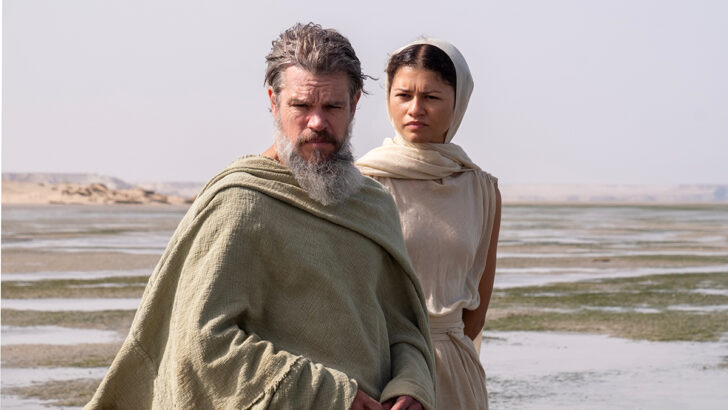
 Matt Damon portrays Odysseus and Zendaya as Athena in a scene from the movie, The Odyssey. Photo: OSV News /Melinda Sue Gordon, Universal.
 With the release of Christopher Nolan’s new interpretation of The Odyssey (which, at the time of writing, I have yet to see) Homer’s great story has once again captured the public imagination.

Anyone who knows me knows of my deep-seated love for Greek mythology. Ever since I was a child, I have been obsessed with these stories of heroes, monsters and gods. That love eventually grew further afield into a fascination with myth of all kinds, and it has probably also given me a greater appreciation for some of the strangeness found in the Bible.
But no story has captured my imagination more than the timeless tale of one man trying to return home after years of struggle, wandering and loss. I speak, of course, of The Odyssey.
As a child, I had a picture-book version which really sparked my imagination. The Cyclops, Circe, the Sirens, Scylla and Charybdis – these images stayed with me. Since then, I have read Homer’s poem a number of times, and each reading has been richer than the last.
This time, I was struck especially by the Christological parallels in the story of Odysseus.
Here we have the tale of a king returning home to reclaim his kingdom, not at the height of power, but disguised as a beggar. He enters his own house unrecognised and suffers verbal and physical abuse at the hands of wicked and boastful men. These men have violated xenia, the sacred Greek duty of hospitality, something dear to the gods. They consume his goods, dishonour his household and attempt to take his wife.
Endures
Still, Odysseus endures. And in enduring, he discovers who has remained loyal to him.
His old nurse recognises him by a scar. Penelope finally recognises him through the secret of their marriage bed, rooted in the living trunk of an olive tree. The hidden king is revealed through his wound and through the sign of a covenant which cannot be moved.
However, Odysseus is not Christ. He is frequently deceitful, morally compromised and capable of terrible violence. Homer was not secretly writing a Gospel centuries before the birth of Jesus. I mean, Dante in The Inferno condemns the hero to the eighth circle of hell. But the pattern is hard for the Christian imagination to ignore: the absent king, the kingdom occupied by the faithless, the ruler who returns in humility, the wound by which he is known, and the final restoration of a disordered house.
Some will argue that this is simply reading Christian ideas back into a pagan story. But the Church Fathers took pagan literature far more seriously than that objection allows. The classics formed the backbone of higher education in their world, and educated Christians were deeply familiar with Homer, the poets and the philosophers. The question was not simply whether they should read these works, but how they should read them as Christians.
St Basil argues that pagan literature can help to train our spiritual perception”
One answer came from St Justin Martyr, who spoke of the “seeds of the Word” scattered throughout human culture. Wherever something true had been seen, however dimly, it ultimately belonged to Christ, the eternal Logos.
But it is in St Basil the Great’s Address to Young Men on the Right Use of Greek Literature where we hear the argument fully. Sacred Scripture remains the highest guide because it leads us towards eternal life. But St Basil argues that pagan literature can help to train our spiritual perception.
“Into the life eternal the Holy Scriptures lead us but so long as our immaturity forbids our understanding their deep thought, we exercise our spiritual perceptions upon profane writings… in which we perceive the truth as it were in shadows and in mirrors.”
His famous image is that of the bee. Bees do not land indiscriminately on every flower, nor do they carry everything away. They take what is useful for making honey and leave the rest behind.
Fullness
In some sense, St Basil is asking: if we cannot learn to see these things in pagan literature, where they appear only in shadows and reflections, how are we supposed to recognise them when they are given to us in their fullness? These works train the eye. They teach us to recognise the shape of courage, fidelity, justice and virtue, so that when we encounter their perfection in Scripture, we have eyes to see.
But jumping from one great work of epic poetry to another, the image which most clearly illuminates St Basil’s argument for me is found in Dante’s Divine Comedy.
Virgil cannot bring him to the end of the journey. He can guide Dante through Hell and up the mountain of Purgatory, but he cannot enter Paradise”
Dante begins his journey under the guidance of Virgil, the great pagan poet. Virgil teaches him how to move through the strange landscape before him. He tells Dante where to look and where not to linger. He corrects him when his pity becomes confused. He explains the vices and virtues embodied by the souls they encounter and repeatedly gives him courage to continue. In doing this, Virgil doesn’t just give Dante information but gives him “eyes to see”.
Still, Virgil cannot bring him to the end of the journey. He can guide Dante through Hell and up the mountain of Purgatory, but he cannot enter Paradise. When Dante is finally ready to encounter Beatrice, “the ancient flame” awakens within him, and he turns towards to tell the guide who has brought him so far and in looking back finds his guide no longer with him.
The pagan poet had completed the work that was his to perform. He had prepared Dante to recognise in its fullness that beauty, goodness and truth of which pagan wisdom could offer only partial glimpses. But Virgil could only bring him to the threshold. To enter into the fullness of what he had learned to see, Dante still needed grace.
This, I think, is what St Basil is saying. Pagan literature may bring us to the threshold, but it cannot carry us across it. It is not Scripture, and it cannot save us. There are things within it which are false, disordered or morally dangerous. But read with discernment, it can train our sight.
Areopagus
St Paul does something similar at the Areopagus. Speaking to the Athenians beside an altar dedicated to an unknown god, he quotes their own pagan poets: “In him we live and move and have our being.” He takes words spoken within a pagan setting and draws them towards their fulfilment in the true God.
Maybe this is also the right Christian use of The Odyssey. We do not need to force Christ into every scene or pretend that everything in Homer is good. But we can allow the poem to educate our longing: for justice, fidelity, hospitality, restoration and, above all, home.
Homer cannot carry us across the threshold. He cannot lead us all the way home. But, like Virgil, he may train our eyes to recognise the road home.