

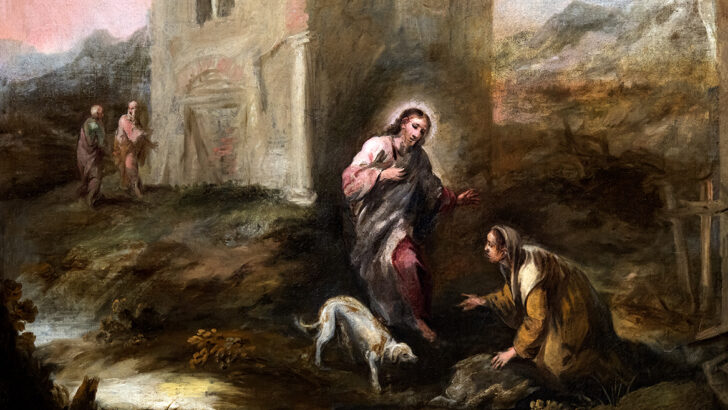
 ‘Christ and the woman of Canaan’ by Francisco Antolínez y Sarabia, circa before 1674. Photo: Wikimedia Commons / Public Domain.
 “Woman, great is your faith! Let it be done for you as you wish”
Matt 15:21 Jesus left that place and went away to the district of Tyre and Sidon.
Matt 15:22 Just then a Canaanite woman from that region came out and started shouting, “Have mercy on me, Lord, Son of David; my daughter is tormented by a demon.”
Matt 15:23 But he did not answer her at all. And his disciples came and urged him, saying, “Send her away, for she keeps shouting after us.”
Matt 15:24 He answered, “I was sent only to the lost sheep of the house of Israel.”
Matt 15:25 But she came and knelt before him, saying, “Lord, help me.”
Matt 15:26 He answered, “It is not fair to take the children’s food and throw it to the dogs.”
Matt 15:27 She said, “Yes, Lord, yet even the dogs eat the crumbs that fall from their masters’ table.”
Matt 15:28 Then Jesus answered her, “Woman, great is your faith! Let it be done for you as you wish.” And her daughter was healed instantly.
Initial observations
This extremely interesting story is found also in Mark 7:24-30, but not in Luke. (Luke may omit it because he writes for a Gentile community and for him openness to the Gentiles is no longer an issue.) Both versions are striking and the differences between them shed a great deal of light on the “project” of each gospel writer. Here’s is Mark’s version:
From there Jesus set out and went away to the region of Tyre. He entered a house and did not want anyone to know he was there. Yet he could not escape notice, but a woman whose little daughter had an unclean spirit immediately heard about him, and she came and bowed down at his feet. Now the woman was a Gentile, of Syrophoenician origin. She begged him to cast the demon out of her daughter. He said to her, “Let the children be fed first, for it is not fair to take the children’s food and throw it to the dogs.” But she answered him, “Sir, even the dogs under the table eat the children’s crumbs.” Then he said to her, “For saying that, you may go—the demon has left your daughter.” So she went home, found the child lying on the bed, and the demon gone. (Mark 7:24–30)
In Mark, Jesus seems to go alone and for no purpose. He enters a house, apparently because he did not want to be recognised in an area where he has never been. The child is a little daughter. The woman is extremely respectful. Only then are we told she was a Gentile (lit. a Greek), a Syrophoenician. Using a parabolic saying, Jesus implies that his message is for the children and not the outsiders (“dogs”). Her witty response gains her her request—i.e. her faith is implicitly recognised. Jesus exorcises the child and the cure is fully reported in v.30.
Matthew has fundamentally the same story, but with significant adjustments. Jesus goes to Tyre and Sidon, this time with his disciples. He does not go indoors and is not afraid to be recognised. We are told immediately that the woman is a Canaanite. Matthew supplies the woman’s words, which are rich in meaning (“Lord”, “son of David”). Jesus ignores her. The disciples intervene, but only to confirm Jesus’ apparent rebuff. V.24 is special to Matthew. Eventually, the woman changes her tone and posture, begging for help (“Lord”). Jesus’ reply is shorter, perhaps in the light of v. 24. The woman agrees with what Jesus has said and only then goes on, in the same parabolic vein, to make her request. Her faith is explicitly acknowledged and the cure is proclaimed. The confirmation is reported is as few words as possible.
Both accounts are strange. Jesus seems to make this journey for no purpose, has a chance encounter and returns. In Mark, there is indoor / outdoor symbolism, suggesting insiders / outsiders. Matthew makes the purpose and problem very clear in v. 24. In both accounts, a foreign woman causes Jesus to open his preaching to non-Israelites. The story is never resumed again. The comments below will bring out further details.
Kind of writing
There are two stories here and two levels. The motivating story concerns a sick child and mother’s plea. Without this the second story—a theological argument using the significant image of bread, children and dogs—would not exist. The discussion is the point of the story in both versions, perhaps more strongly in Matthew who underplays the cure aspect. As regards the layers, it looks as if historically Jesus had very little contact with Gentiles. The opening of the mission to include the Gentiles—permitted by this story—is to be read at the level of the community at the time of writing.
Old Testament background
In the OT, Elijah cures children and outsiders. The Moses background to Jesus’ ministry has just been underlined in the feeding of the 5,000 (aimed at Jews). The next story following is the feeding of the 4,000 (aimed at Gentiles, with Elijah echoes). The Elijah precedent gives biblical authority to opening the preaching of the Kingdom to Gentiles.
New Testament foreground
(i) This story closely resembles the cure of the centurion’s son in 8:5-13. Matthew’s adjustments to that story portray Jesus discovering faith outside Judaism and responding positively, as here. The purpose of both stories is the same, that is, to permit the post-Resurrection inclusion of the Gentiles.
(ii) V. 24 is found elsewhere in this gospel: “These twelve Jesus sent out with the following instructions: “Go nowhere among the Gentiles, and enter no town of the Samaritans, but go rather to the lost sheep of the house of Israel. As you go, proclaim the good news, ‘The kingdom of heaven has come near.’” (Matt 10:5-7):
(iii) “Bread” as a metaphor for salvation is found in 14:13-21 and 15:32-39. The kingdom of heaven is portrayed as a banquet.
(iv) In this Gospel, the really insignificant people address Jesus as “Son of David” (two blind men in ch. 9 and two blind men again in ch. 20).
St Paul
But now apart from the law the righteousness of God (which is attested by the law and the prophets) has been disclosed– namely, the righteousness of God through the faithfulness of Jesus Christ for all who believe. For there is no distinction, for all have sinned and fall short of the glory of God. But they are justified freely by his grace through the redemption that is in Christ Jesus. God publicly displayed him at his death as the mercy seat accessible through faith. This was to demonstrate his righteousness, because God in his forbearance had passed over the sins previously committed. This was also to demonstrate his righteousness in the present time, so that he would be just and the justifier of the one who lives because of Jesus’ faithfulness. (Romans 3:21–26 NET)
For there is no distinction between Jew and Greek; the same Lord is Lord of all and is generous to all who call on him. (Rom 10:12)
But now in Christ Jesus you who used to be far away have been brought near by the blood of Christ. For he is our peace, the one who made both groups into one and who destroyed the middle wall of partition, the hostility, when he nullified in his flesh the law of commandments in decrees. He did this to create in himself one new man out of two, thus making peace, and to reconcile them both in one body to God through the cross, by which the hostility has been killed. (Ephesians 2:13–16 NET)
Brief commentary
Verse 21 In Matthew, Jesus does not go outside Jewish territory. Probably we should translate, Jesus went towards or in the direction of Tyre and Sidon (a definitely Gentile area).
Verse 22 Again, we should translate, a woman came out from that region, i.e. she left home and entered the land of Israel to meet Jesus. Calling her a Canaanite evokes the ancient, historical enemies of the Israelites. The woman calls Jesus “Lord” no fewer than three times.
Verse 23 This ignoring her (probably a bit of a shock for us) resembles his reaction in Matthew 8:7. Translating that verse as a question makes more sense of the centurion’s reaction in the next verse.
Verse 24 Possibly we are overhearing the tendency of some in the Matthean community to exclude those of Gentile origin.
Verse 25 A plea, simple and full of pathos, resembling many prayers in the Psalms.
Verse 26 Matthew omits the softening in Mark’s “first”, which gave grounds for hope. The parabolic reply is accordingly more absolute and blunt. Bread means salvation, the offer of the Kingdom. Dogs means the Gentiles in a very insulting way.
Verse 27 In Matthew, the woman accepts the priority of the Jews and even the insult of “dogs”.
Verse 28 This is very like the reaction of Jesus in the story of the centurion: When Jesus heard him, he was amazed and said to those who followed him, “Truly I tell you, in no one in Israel have I found such faith.” (Matt 8:10). Likewise the closing of the miracle story is dispatched in similar words: “And to the centurion Jesus said, “Go; let it be done for you according to your faith.” And the servant was healed in that hour.” (Matt 8:13 ).
Pointers for prayer
- Having met with rejection from the Pharisees Jesus goes towards Gentile territory and encounters faith in an unexpected place, in the Canaanite woman. His mission had previously been to his own people. This adds a new dimension to his mission. Have you had occasions when a chance encounter set your life off in a new direction?
- The Canaanite woman was not concerned for herself but for her daughter. Recall people you have known who have been committed to a noble cause.
- The initial reaction of Jesus to the woman was one of rejection but her persistence won a response from him. When have you found that persistence was needed to gain what you sought? What did that experience teach you?
- Who are the “Canaanite women” who call out for attention today—people in church or state whose needs are not being attended to?
Prayer
God of the nations, to your table all are invited and in your family no one is a stranger.
Satisfy the hunger of those gathered in this house of prayer, and mercifully extend to all the people on earth the joy of salvation and faith.
Grant this through our Lord Jesus Christ, your Son, who lives and reigns with you in the unity of the Holy Spirit, God for ever and ever. Amen.
====
For the gifts and the call of God are irrevocable
The first reading
Rom 11:13 Now I am speaking to you Gentiles. Seeing that I am an apostle to the Gentiles, I magnify my ministry,
Rom 11:14 if somehow I could provoke my people to jealousy and save some of them.
Rom 11:15 For if their rejection is the reconciliation of the world, what will their acceptance be but life from the dead?
Rom 11:28 In regard to the gospel they are enemies for your sake, but in regard to election they are dearly loved for the sake of the fathers.
Rom 11:29 For the gifts and the call of God are irrevocable.
Rom 11:30 Just as you were formerly disobedient to God, but have now received mercy due to their disobedience,
Rom 11:31 so they too have now been disobedient in order that, by the mercy shown to you, they too may now receive mercy.
Rom 11:32 For God has consigned all people to disobedience so that he may show mercy to them all.
Initial observations
Our reading contains a verse of immense significance for us today: For the gifts and the call of God are irrevocable. This single line is the cornerstone of Jewish and Christian dialogue since the Holocaust. Paul could not have foreseen that but he would certainly be approving. After centuries of persecution, at last we have begun to take seriously Paul’s own teaching about his very own people.
Kind of writing
After the introduction (9:1-5) and before the conclusion (11:33-36), the central section has three proofs:
9:6-29 God’s word has not failed
9:30-10:21 Israel’s own righteousness
11:1-32 God has not rejected Israel
It was important to Paul the faithful Jew that God had not rejected Israel. The third argument in Rom 11:1-32 has itself several moments:
1-6 A remnant has been faithful
7-10 A “hardening” came on most Israelites
11-12 The purpose of Israel’s mistake
13-24 A warning to Gentiles
25-32 The revelation of the mystery
Our reading overlaps the fifth and sixth sections.
Context in the community
The Jewish and Gentile constituencies of the Roman house churches seem to have been intensely competitive. Each could look down on the other for different reasons. The Jewish Christ-believers could point to their fidelity to the gift (grace) of the Law. The Gentiles, on the other hand, could point to a higher freedom in Christ, a freedom from the ethnocentricity of the “old” faith.
Within the the letter, Paul has arrived at another dangerous moment. In discussing in Romans 9-11 the relative places of Jews and Gentiles in God’s plan of salvation, he has just noted that the failure of most Jews to accept Jesus as the messiah was both a fulfilment of Scripture and the responsibility of the Jews themselves. It would be easy for the Gentiles to fall back into a feeling of being superior after all. At that point, Paul writes one of his most marvellous passages, using the image of the olive tree. It is unfortunate that for the sake of brevity, this “parable” itself is omitted, making the sequence of thought more difficult to track. The full text of the olive tree section is given below to be read slowly.
Related passages
Now if some of the branches were broken off, and you, a wild olive shoot, were grafted in among them and participated in the richness of the olive root, do not boast over the branches. But if you boast, remember that you do not support the root, but the root supports you. Then you will say, “The branches were broken off so that I could be grafted in.” Granted! They were broken off because of their unbelief, but you stand by faith. Do not be arrogant, but fear! For if God did not spare the natural branches, perhaps he will not spare you.
Notice therefore the kindness and harshness of God—harshness toward those who have fallen, but God’s kindness toward you, provided you continue in his kindness; otherwise you also will be cut off. And even they—if they do not continue in their unbelief—will be grafted in, for God is able to graft them in again. For if you were cut off from what is by nature a wild olive tree, and grafted, contrary to nature, into a cultivated olive tree, how much more will these natural branches be grafted back into their own olive tree? (Rom 11:17–24)
Brief commentary
Verse 13a This is the first time Paul addresses the Gentiles directly in Romans. He wants their full and undivided attention for what follows.
Verses 13b-14 To avert any potential misunderstanding, Paul affirms his own ministry to the Gentiles, while adding—provocatively surely—that he does it to make his very own people jealous! The communion of Jew and Gentile in Christ is at the heart of Paul’s understanding of God’s project in Jesus’ death and resurrection.
Verse 15 Rejection could be either God’s (temporary) rejection of Israel or Israel’s rejection of the Messiah. The latter is more likely. Their rejection of Jesus led to his crucifixion and, paradoxically, to the reconciliation of Jew and Gentile on the cross. The a fortiori argument is in the form of a question: if a negative brought such blessing, what will a positive bring about? Paul will not separate Jesus’ death from his resurrection.
Verses 28-29 After the olive tree section, Paul affirms God’s continuing love for Israel. The importance of v. 29 could hardly be overstated. God’s election of Israel still stands and the covenants have not been superseded. Seven gifts were listed above; the originating call is, of course, from God himself.
Verses 30-31 In beautifully balanced sentences, Paul explores the common experience of disobedience and grace. Gentiles too were disobedient once and came to grace: in the same way, God’s first chosen people, now disobedient, will come to grace. Cf. vv. 13b-14 above.
Verse 32 Paul takes us back to the universal need of grace already explored in Romans 3 and 5. For there is no distinction, for all have sinned and fall short of the glory of God. (Rom 3:22–23) Consequently, just as condemnation for all people came through one transgression, so too through the one righteous act came righteousness leading to life for all people. (Rom 5:18)
Pointers for prayer
- Has it ever been my experience that even a harmful “no” can lead to grace?
Prayer
God of constant mercy, we are sinners and yet your gifts and call are irrevocable. Help us to take to heart your steadfast love that we too may be lovingly steadfast through Christ our Lord.
====
My house shall be called a house of prayer for all peoples
Isa 56:1 Thus says the Lord:
Maintain justice, and do what is right,
for soon my salvation will come,
and my deliverance be revealed.
Isa 56:2 Happy is the mortal who does this,
the one who holds it fast,
who keeps the sabbath, not profaning it,
and refrains from doing any evil.
Isa 56:6 And the foreigners who join themselves to the Lord,
to minister to him, to love the name of the Lord,
and to be his servants,
all who keep the sabbath, and do not profane it,
and hold fast my covenant—
Isa 56:7 these I will bring to my holy mountain,
and make them joyful in my house of prayer;
their burnt offerings and their sacrifices
will be accepted on my altar;
for my house shall be called a house of prayer
for all peoples.
The second reading
Initial observations
It can still cause surprise that certain texts in the Old Testament are so inclusive of foreigners. Our passage today, from Third Isaiah, is a remarkable example. The full text, vv.1-7, has been shortened, possibly on account of the mention of eunuchs which might obscure the meaning for the modern reader. The full text is commented below.
Kind of writing
It is biblical poetry, showing the usually parallelism, in a more flexible way. It is also a kind of formula of conversion and at the same time it constitutes a polemic against a narrow nationalism and exclusionary attitudes as exemplified in the Deuteronomist, as well as in Ezra and Nehemiah.
Origin of the reading
The passage comes from Third Isaiah and reflects conditions just after the return from the Exile. It speaks of inclusion of the foreigner and acceptance of the eunuch on account of their conversion of heart.
Related passages
On foreign conversions
It was eaten by the people of Israel who had returned from exile, and also by all who had joined them and separated themselves from the pollutions of the nations of the land to worship the Lord, the God of Israel. (Ezra 6:21)
On justice
He has told you, O mortal, what is good; and what does the Lord require of you but to do justice, and to love kindness, and to walk humbly with your God? (Micah 6:8)
Brief commentary
Verse 1 This is a general appeal, in the context of the return from exile. How this is to be done is unfolded in the subsequent verses. Cf. Exod 19:5; Deut 6:5; Micah 6:8. “My salvation” comes at the hands of the Persian overlord.
Verse 2 The emphasis falls on observing the Sabbath. The weekly Sabbath is probably a custom from the Exile onwards only. Accordingly, it is emphasised especially in Third Isaiah: Isa 1:13; 56:2, 6; 58:13; 66:23.
Verse 3 The foreigner is one who has come to faith in YHWH. Conversion to the faith of Israel is phenomena from this time onwards. Ezra and Nehemiah show a very different, more exclusionary attitude. Cf. Dt 23:1-3. The mention of eunuchs—a feature of the Babylonian royal court as of many others, including the papal!—reflects a concern that such individuals would be excluded from the benefits of belonging fully to the people because they would have no offspring. Notice the insulting reference to their infertility.
Verse 4 Integrity of heart—not that of body—is what counts before the Lord.
Verse 5 Even eunuchs will have a lasting memorial at God’s hands. Cf. Now Absalom in his lifetime had taken and set up for himself a pillar that is in the King’s Valley, for he said, “I have no son to keep my name in remembrance”; he called the pillar by his own name. It is called Absalom’s Monument to this day. (2Samuel 18:18) (The Hebrew in Isaiah here says literally “a hand and a name”, yad vashem, the title given to the museum of the Shoah in Jerusalem.)
Verse 6 This verse offers a detailed deception of the fourfold behaviour which marks the converted.
Verse 7 One of the greatest texts of inclusion in the Bible. The basis for this may be found in Num 15:14-16 and Lev 22:18-25. Cf. Jesus was teaching and saying, “Is it not written, ‘My house shall be called a house of prayer for all the nations’? But you have made it a den of robbers.” (Mark 11:17)
Verse 8 The first wave of returnees was small; it will be supplemented by other Judeans and even by foreigners.
Pointers for prayer
- As we tend to think of ourselves as insiders, it is no harm to recall that when Isaiah speaks of the inclusion of foreigners, it is all Gentiles (= ourselves) who are intended! We are the ones called to conversion, fidelity, justice and prayer.
- The tendency to exclude has not gone away and, especially in times of pressure / harassment there can be a temptation to self preservation, even sectarianism. As we know from Jesus’ teaching and practice, the burden of proof must lie with those who exclude.
- It helps from time to time to reflect, in dialogue with the biblical texts, on my image of God. What does Isaiah say about God here? Is there anything I especially need to pay attention to
Prayer
Our God and father, you love the human race and call us all into relationship with you. As we benefit from your loving welcome, may we in turn welcome and love others who are your children too. Help us to set aside prejudices, to take down barriers, to open our arms that more people may experience and know that such is our God.