

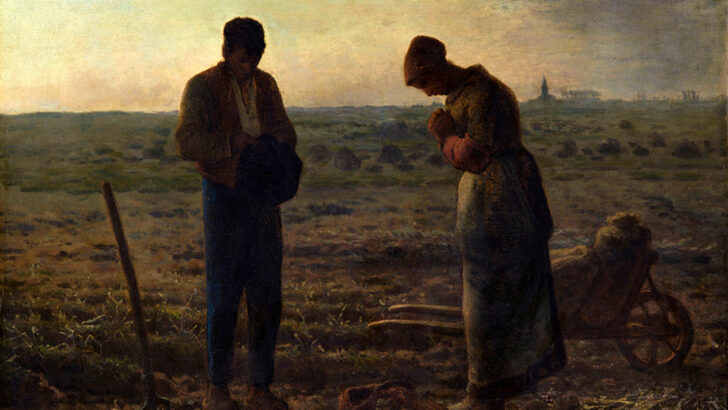
 ‘The Angelus,’ Jean-François Millet, from 1857-1859. Photo: Wikimedia Commons/ Public Domain.
 ‘Prudence is a thoughtful refusal to run with every intimation of fear’ says
Fr Chris Hayden

***
I will give you all of these, if you worship me” – so said Satan to Jesus in the wilderness, while gesturing towards the kingdoms of the world. But what the father of lies actually gives to those who turn from the Father of Light is a crushing sense of responsibility, which he terms independence, or autonomy: “I’ve promised you the whole world. Here it is, then, in all its weight, on your shoulders.”
The way to escape from that burden is to turn, or return, to the Lord, who gives manageable burdens, whose burden is light. But (aside from generally unavoidable matters like illness and loss) how do we discern which burdens God intends for us and which he does not, which burdens we should carry and which we should not? Note well that the question is not, “How can we avoid burdens?” One way or another, we will find burdens and they will find us. As St Thomas à Kempis puts it, in the Imitation of Christ, “If you throw one cross aside you will certainly find another, and possibly one that is heavier to bear.” The task of discernment is not to formulate an evacuation plan, or to seek exemptions from life’s inevitable hardships, but to ascertain what it is the Lord is asking of us.
Without the exercise of prudence, those kindly intentions backfired”
It is the virtue of prudence that makes discernment possible, and I know of no better introduction to that virtue than the story of the Loving Elephant. Strolling along by a river, the Loving Elephant observed an ostrich standing up from its nest and making its way to the river. At the sight of an unprotected ostrich egg, the elephant’s large and loving heart felt a frisson of alarm. What to do? After barely a pause, the Loving Elephant trundled over to the nest and, out of sheer love, sat on the egg, with predictable results.
The elephant ‘meant well.’ Its intention was to protect, to safeguard. But without the exercise of prudence, those kindly intentions backfired. The Loving Elephant saw a need, a threat, and that was commendable. It sought to respond. Likewise, commendable! But it did not stop to reflect, to consider the best way to achieve the desired end; it moved directly from anxiety to action.
Responsibility
In an anxious, crisis-ridden world (a world of ‘permacrisis,’ to repeat a term from the first of these reflections), prudent discernment is more important than ever. Indifference is not an option for Christians, but nobody can carry more than a limited part of humanity’s burden. What can we carry? What is our part? How can we set about doing our bit? Once we’ve discerned this prudentially, and set about doing what we can, then the sane – and sanity-preserving – course is to leave the rest, to entrust it to God and to the good efforts of others. We can, of course, revisit our prudent discernment as necessary; it is not a once-for-all achievement, but an ongoing approach to our circumstances. There is nothing ungenerous about this approach; it is about being able to do our best, rather than being swamped or paralysed.
There will always be loving elephants, undiscerning people who mean well and who imagine that there is something inherently virtuous about carrying the weight of the world on their shoulders and getting others to do the same. That said, our culture as a whole is probably something closer to unlovingly elephantine, with its technology of incessant, steamrolling, anxiety-inducing chatter. Fortunately, as believers we can access resources of resilience and wisdom, which can enable us to engage realistically – and therefore more effectively – with the concerns of the day.
According to the Catechism of the Catholic Church: “Prudence is the virtue that disposes practical reason to discern our true good in every circumstance and to choose the right means of achieving it.” Prudence is, first and foremost, a virtue, a strength. In everyday speech, to describe someone as prudent can be tantamount to saying they are fussy, timid, risk-averse. But prudence is not timidity. In an anxiety-riven world, it is a thoughtful refusal of timidity, a refusal to run with every intimation of fear and anxiety, precisely so that we can stand our ground, and courageously do what we can.
Fear and anxiety are poor advisors. When we feel their cold embrace, or when a myriad voices and images are letting us know what a scary place the world is, let us choose prudence over panic. Let us stand our ground and reflect, in the light of faith and with the assurance of God’s help, on what we can realistically do. It is this way that we can, as the Catechism puts it, “overcome doubts about the good to achieve and the evil to avoid.”
This is the sixth instalment in Fr Chris Hayden’s series, ‘Faith in a time of anxiety’.