

 Peter Costello
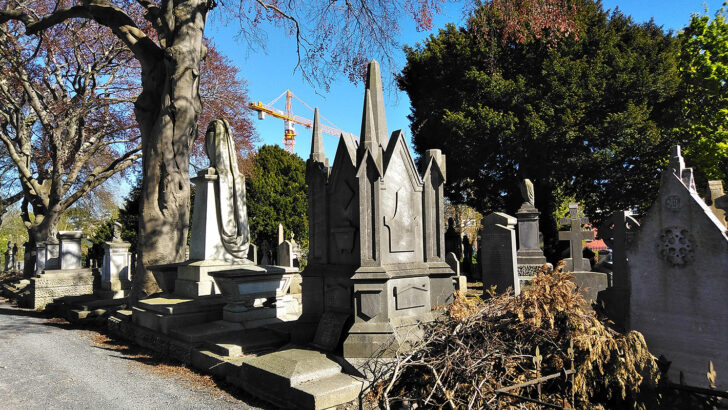 The ‘Long Walk’ in
Mount Jerome Cemetery,
Harold’s Cross. Photo:
Harry Warren
The ‘Long Walk’ in
Mount Jerome Cemetery,
Harold’s Cross. Photo:
Harry Warren Mount Jerome: Dublin’s Victorian Cemetery,
by Maurice Curtis
(The Old Dublin Press, €24.95 / £21.99)
Cemeteries have a peculiar fascination for my imagination. But they have their perils. I can still recall the great difficulty of navigating between the plots to reach the grave of the poet and economist George Russell (“AE”), when a new headstone was being revealed with ceremony a generation ago. It seemed a difficult if not dangerous place to visit, a garden of memorials slowly decaying with neglect.
But that event may well have been a turning point in Mount Jerome’s history. My feelings seem to have been shared by others, for all of this was reversed, when in 1984 the cemetery company, which dates back to 1836, was bought up by Rom Massey senior, the director of Massey Brothers Funeral Directors.
The new management began not only to tidy up the dismal acres, improving access routes and paths, but also opening a Crematorium in 2000, a quarter of a century ago, with a Columbarium and a Garden of Remembrance to follow, and also an “Angels Plot”.
Renewed
Since then many visits to services for departed relatives and friends have renewed a general interest in the place. Today it is worth visiting – though it thankfully does not have the “tourist venue” ambiance of Glasnevin, supposedly of more direct Catholic interest.
Indeed, Mount Jerome was thought of on the south side as a “Protestant” venue. A family story relates that a Protestant ancestor who lived on Merrion Square had several wives. On one occasion a neighbour asked the butler where the funeral was going to. That stolid personality replied, “The master usually buries them in Mount Jerome.”
His Catholic outlook is evidenced in many places, notably in some remarks about Irish Freemasons, many of whom are buried in Mount Jerome”
But a simple calculation suggests that as Catholics have been buried there since 1926, it was only for its first ninety years that the cemetery had few Catholic interments.
Maurice Curtis, a former librarian and bookshop manager, is a person steeped in Dublin lore, as his many previous books have demonstrated. His Catholic outlook is evidenced in many places, notably in some remarks about Irish Freemasons, many of whom are buried in Mount Jerome. But he neglects to note that Daniel O’Connell, the most renowned Catholic person buried in Glasnevin was a Freemason. Irish history is often complicated, and is too easily reduced to a simple Catholic / Protestant, Nationalist / Colonial diagram.
At the end of the book, he provides a roll-call of the notable and the notorious buried up in Harold’s Cross. What a roll call it is. But what is striking in the book and the place is not who is buried there, but how they are buried.
The post-mortem extravagance of that first century of the cemetery is on a global scale, for the place certainly rivals the Campo Santo of France and Italy, or indeed the less well-known Recoleta of Buenos Aires. Today’sw memorials are still often very elaborate, but they lack the classical grandeur of the architectural memorials of the earlier era. Vanity of power and person is on display in its many extraordinary forms.
Extensive
The map provided shows just how extensive the cemetery is. Curtis’s text concentrates on the individuals, leaving to the reader the comparison of the Pérè Lachaise grave where Oscar Wilde is entombed under an elaborate monument by Jacob Epstein, with the small but no less effective memorials to his father and other members of the Wilde family – Sir William Wilde’s grave is indeed one of the prominent things you can see in the immediate vicinity of The Victorian Chapel, where services are held.
Very often these days these are now “humanist” in form; though an examination of any cemetery around Dublin will now reveal gravestones to Irish people of many cultures and faiths – they have become collective rather than particular.
God’s mercy can make even the driest land become a garden, can restore life to dry bones”
Maurice Curtis has put readers in his debt with his excursions among the shades of the city’s past. For Christians, of course, all these interments are made, in the words of the burial service, “in sure and certain hope of the resurrection”.
Or as the late Pope Francis once expressed it, ‘God’s mercy can make even the driest land become a garden, can restore life to dry bones’ – an echo of Ezekiel 37: 1-14. (Easter Orbi et Urbi message, March 2013).
This is because, as Cardinal Vincent Nichol observed later, “the building of hope is about the God-given dignity of every human person and is the core of all truly good human endeavours”.
These are sentiments many will find resolved in a visit to a place dedicated to the memory of the dead such as Mount Jerome.