

 Peter Costello
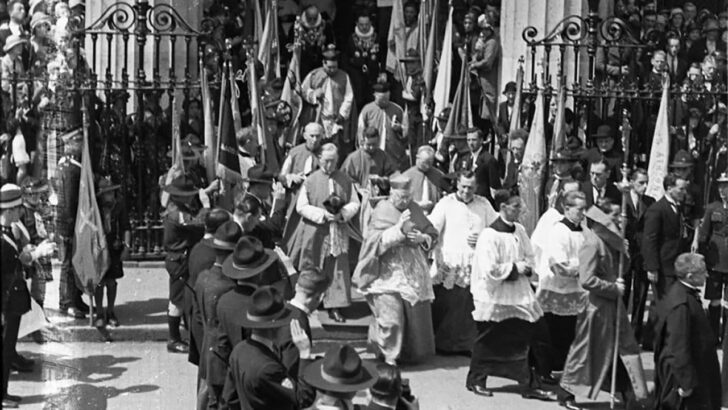 Catholic Ireland’s greatest moment: The 1932 Eucharistic Congress in Dublin. Photo: UCD Folklore Department.
 The Oxford Handbook of Religion in Modern Ireland,

edited by Gladys Daniel and Andrew Holmes
(Oxford University Press, £137.50 / €130.00)
Readers who are not dismayed by the suggested price of this academic book will find that it provides a wider view of Ireland in contrast to the letter box view provided by the Census of 1926.
The book will be an essential reference book for those wishing to explore the changing nature of religious opinion in the Ireland of today, in which to some outside observers the notions of the middle-ages persisted in here until recently in a curious way in this era of “enlightenment”. “Would we could see ourselves as others see us” is an old maxim of wisdom. Well, here is a helpful aid.
Irish studies
Many students taking “Irish studies” courses around the world are not deeply connected with or knowledgeable about this island and its complicated history. So a large part of the audience for this book will be readers living elsewhere.
These tables contrast sharply with that of 1926, more denominations are included among the different traditions in Ireland”
The volume contains some 621 pages with articles by some 32 academic authors. The timeline runs from 1800 down to 2023, that is from the Act of Union down to the European Union in effect. However, the latest statistics on religion and nationality in the Republic alone dates from 2016 – what we might call the centenary of the Revolution.
These tables contrast sharply with that of 1926, more denominations are included among the different traditions in Ireland.
However, the table still leaves out Sikhs, Jews, Baha’i and Mormons (who cannot be classed as Christian in a traditional sense – believing as they do that Christ came back in person to teach in the Americas).
The book is divided into three parts: 1800 to 1922, 1922 to 1968, and 1968-2023 – and these indeed do mark off significant eras in Ireland. The first two parts are in effect a resume of familiar enough scholarship, so it is likely that many readers will focus on the third part, which deals broadly with what one of the editors labels “Ireland after Secularisation”.
Movements
This section finds space for new religious movements, paganism; minority religions brought in by immigrants, and while recognising the interactions of religion and memory in modern Ireland, conclude with fifteen pages on the rise of “No religion”.
A party Presbyterian visitors from Belfast were truly shocked at this manifestation of an easy acceptance by the Dublin elders of ‘loose livers’”
These chapters discuss change, but also significant is surely the continuity of the Church of Ireland in the south, especially in the Dublin region. Then too there is the growing divide between Presbyterians in the south and those in the north.
One of my neighbours, an old fashioned and kindly Presbyterian, explained to me about this in relation to Dublin’s Abbey Church, commonly called “Findlater’s Church”. This congregation had leased part of its premises to a Catholic organisation for young mothers (some unmarried it seems). A party Presbyterian visitors from Belfast were truly shocked at this manifestation of an easy acceptance by the Dublin elders of “loose livers”.
What the overall detail in part three suggests is a growing social and religious complexity, for even Catholicism can now be divided into shades of association or disassociation with Rome.
Nuances
Any readers seeking for serious purposes to understand the nuances of Irish life, tradition, and change will find this book a very rich resource. Whether everyone will take comfort from its pages and the extensive and detailed research that lies behind them, clearly illustrating how things have changed, is another matter.