

 Aubrey Malone
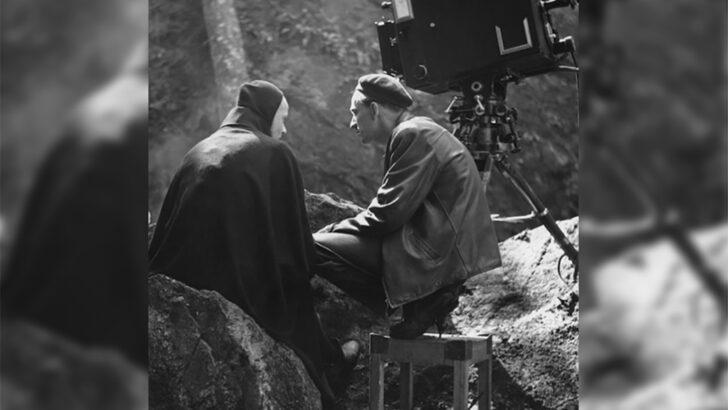 Photograph of actor Bengt Ekerot and director Ingmar Bergman during the principal photography of The
Seventh Seal. Photo: Public Domain.
Photograph of actor Bengt Ekerot and director Ingmar Bergman during the principal photography of The
Seventh Seal. Photo: Public Domain. Woody Allen was 90 recently. The milestone put me in mind of his oft-quoted quip, “It’s not that I’m afraid of dying. I just don’t want to be there when it happens.”
Woody mixes comedy and tragedy often. He sometimes describes himself as a cross between Ingmar Bergman – the gloomy Swedish film director – and Groucho Marx.
Bergman is best known for The Seventh Seal (1957). The story of a 14th-century knight returning from the Crusades to a country devastated by the Black Plague, its most famous scene has the knight (Max Von Sydow) playing chess with Death. His life hangs on the outcome of the game.
It’s a film about religious doubt. There’s a grudging acceptance that God ‘might’ exist.
In one scene, Sydow asks Death, played with crushing starkness by Bengt Ekerot, “Why is God a baffling reality I can’t shake off?” He appears to be suggesting that he doesn’t ‘want’ faith, that God is an inconvenient albatross on his back.
God
The film took its title from the Book of Revelation. This threatened chaos following the opening of a seal “after which there was silence in heaven for half an hour.” A precursor of Beckettian waiting, it holds us in thrall with its sense of existential longing.
Corpses abound on Bergman’s arid landscape as Sydow fights his most daunting enemy of all – himself. This is the dark after-teatime of the soul, the last desperate grasp of a drowning man hanging onto an agnostic cliff-face as the rocks erode before him.
Why, he asks, does God “hide himself in a mist of half-spoken promises and unseen miracles”? “Why can’t I kill the God within me?” he enquires, “Why does he live on in this painful and humiliating way even though I curse him and want to tear him out of my heart?”
“I want knowledge, not faith,” he groans at another point, “I want God to stretch out his hand toward me, to reveal himself and speak to me.”
God, for Bergman, has left his phone off the hook. There’s no hotline to the Pearly Gates. Faith has to be blind adherence within Sydow’s medieval optics. This is difficult when the Black Death has practically decimated everything in sight.
How, Sydow wonders, could a “good” God be responsible for the plague. Here he’s enunciating the age-old problem of evil. God has to have foreseen it. How can he sit by and watch its horrors unfold?
If he wanted mankind to be happy, why didn’t he offer us all eternal bliss from the beginning? The Christian answer to this, of course, is that God doesn’t cause evil; he allows it. And we have to earn our reward in this “vale of tears.”
The most rueful scene in the film is the one where the knight pours his heart out in confession to a man he believes to be a priest. In reality, it’s Death he’s been speaking to all the time.