

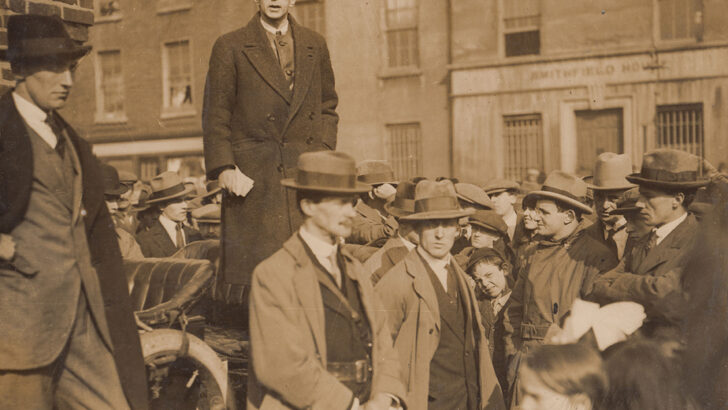
 Rory O’Connor speaking to Republican supporters in Smithfield, Dublin, on April 2, 1922.
 Rory O’Connor: To Defend the Republic,
by Gerard Shannon
(Merrion Press €19.99 / £17.50)
Rory O’Connor was the leading Republican combatant in the Four Courts in the opening stage of the Civil War in April 1922, yet has had to wait for over 100 years to have a proper biography. He was often described by his contemporaries as “enigmatic” and difficult to know so this may explain why historians have shied away from exploring his life.

He is of course best remembered as one of the four Republican prisoners who were executed without trial as a reprisal for the assassination of Sean Hales TD”
Gerard Shannon, author of an earlier book on Liam Lynch, has now taken on the task, and his research has resulted in the definitive version of a somewhat neglected figure in both the War of Independence and the Civil War.
His role as director of engineering was important, but not high profile. He is of course best remembered as one of the four Republican prisoners who were executed without trial as a reprisal for the assassination of Sean Hales TD at a crucial point in the Civil War.
His upper-middle-class Catholic background set him apart from most of his comrades. His father was a senior legal official in Dublin Castle, living in affluent Monkstown. Rory was educated at St Mary’s College and Clongowes, where he would have met Kevin O’Higgins.
Friends
They became good friends while working in secret for the First Dáil and O’Connor was best man at O’Higgins’s wedding. Barely a year later, O’Higgins, as a member of the Free State Cabinet, gave his assent to the reprisal executions.
Why O’Connor took such a hard-line anti-Treaty stance can seem surprising. He was working on Canadian railways when war broke out in 1914, and he returned to Ireland with the intention, according to a friend, of joining the British army. He soon changed his mind and joined the ultra-nationalist IRB while working for Dublin Corporation as an engineer. During the 1916 Rising, he conveyed messages between the various IRA garrisons and was wounded by a sniper.
After the Rising, he became deeply involved in Sinn Féin politics and then in the IRA after the setting up of the First Dáil in 1919. As Director of Engineering, he tried to instruct the IRA Divisions in the use of explosives. He was also appointed as commanding officer of the IRA in Britain.
He was brought to Dublin Castle, where he was tortured before being moved to Kilmainham jail, where he met Ernie O’Malley, who noted the bruises on his face”
This involved organising prison escapes, IRA attacks on infrastructure and recruitment. He became noted by British intelligence and was arrested by the notorious Auxiliaries at his home in Monkstown. He was brought to Dublin Castle, where he was tortured before being moved to Kilmainham jail, where he met Ernie O’Malley, who noted the bruises on his face.
He was later transferred to an internment camp at the Curragh, from where he escaped in March 1921 and resumed his IRA activities until the Truce in July. During the negotiations for the Anglo-Irish Treaty, he became perturbed at the reports of the likely outcome involving the role of the King and Dominion status, while he continued training the IRA for a resumption of the war.
Infuriated
When news of the Treaty terms were confirmed, O’Connor was so infuriated that he asked GHQ for permission to arrest the returning signatories. As he was not a TD, he had no role in the Treaty debates, but he gathered a group of senior IRA officers to discuss how they could sabotage the outcome.
From a virtual unknown outside the IRA, O’Connor suddenly became, with de Valera, one of the most prominent opponents of the Treaty. This was due to his role in summoning an IRA Convention to ensure its independence from the new Provisional Government headed by his former commander-in-chief, Michael Collins, and his readiness to give press interviews to vent his personal views.
This book shows that O’Connor had other critics from inside the Republican ranks; but his nobility of character and devotion to a lost cause are also evident”
At O’Connor’s first press conference at Sinn Féin headquarters, one of the first questions was “Who are you?” After questions probing the future role of the IRA, O’Connor was asked if there was going to be a “military dictatorship”. He fatefully replied: “You can take it that way if you like.” The author describes this as O’Connor’s “dangerous, foolish and undemocratic public utterance.”
This was followed by a series of other interviews to foreign journalists, including one in the beleaguered Four Courts, which reveal a lack of political judgement to say the least. A Republican colleague, Sean O’Hegarty, O/C of the Cork No.1 Brigade, was provoked into writing to newspapers that “It is high time that the pretence of ‘General’ Rory O’Connor to be ‘head of the army’ was burst up.”
This book shows that O’Connor had other critics from inside the Republican ranks; but his nobility of character and devotion to a lost cause are also evident in this long-awaited assessment of one of the tragic figures of Irish independence.