

 Peter Costello
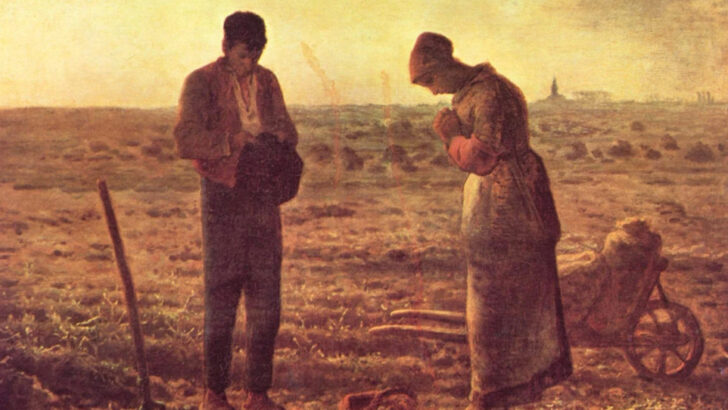 The Angelus by J.F. Millet in
the Quai D’Orsay Museum
The Angelus by J.F. Millet in
the Quai D’Orsay Museum Over the last half-century or so, art history has become one of the most popular subjects to be pursued at universities. This trend has produced large numbers of people to provide new insights both into the lives of artists and how art is conceived and made. This is all to the good.

Yet sometimes there are curious outcomes as well. Recently, a strange claim about a famous painting, The Angelus (1859) by Jean-François Millett (1814-1873), has been revived. Reproductions of this were once a very popular item of domestic piety, to be found in many Irish homes.
The painting itself (now in the Quai D’Orsay Museum in Paris) is still a much-admired work by an important artist. Millet was the eldest son of a Norman farmer and was well acquainted from childhood with all that pertained to rural life in one of the most prosperous rural departments in France.
Last autumn, there was a large exhibition of Millet’s work at the National Gallery in London. The Angelus was one of the items on show. This event revived an almost forgotten theory.
Dali
Ninety years ago, the painting cast a fascination over Salvador Dali, a very different kind of artist. He was inspired by this work to write an analysis of it, The Tragic Myth of The Angelus of Millet. Though written in 1933, this was not published until 1963.
It was Dali’s view that the basket of potatoes that lies on the ground between the man and the woman was in fact the coffin of their dead baby. “Rather than seeing it as a work of spiritual peace,” one recent scholar wrote, “Dalí believed it held messages of repressed sexual aggression.” It was not a celebration of quiet spirituality, it was really a dark revelation of peasant life.
Eventually, the painting was X-rayed. This intervention showed “that the painting contains a painted-over geometric shape strikingly similar to a coffin.” Had Millet had a change of direction as artists often have?
The Angelus was seen as a dignified icon of the life of farming people of his age. A husband and wife stand with their heads bowed. Lit by an almost ethereal, filtered light, they’ve stopped working in the fields to recite the Angelus.
Reading about all this the other day, I recalled that in my postcard collection I have one of an etching by Millet dating from 1863, a version of the same couple in another slightly later Millet painting Going to Work.
The man carries the fork over his shoulder, his wife walking beside him, has the basket for the potatoes over her head like a sun bonnet. In her hand she carries a flagon – presumably filled with cider. Going to Work (which now hangs in the Kelvingrove Art Gallery and Museum in Glasgow, Scotland) dates from 1851 – 1853, the same period as The Angelus. There is no mysterious coffin-shaped object at all.
Dali’s theory was revived in the media in 2025, but it is clearly mistaken and misleading. It is, however, an example of just how psychological interpretations of art and literature, especially coming from influential figures such as Dali can at times undermine the integrity of a work of art.
Those who still have a version of The Angelus hanging in the family home, however, can rest content that their original notion of a young married couple – perhaps indeed wishing for a child – are portrayed not as conducting an illegal burial, but as taking time out for a moment or two of midday prayer.