

 Peter Costello
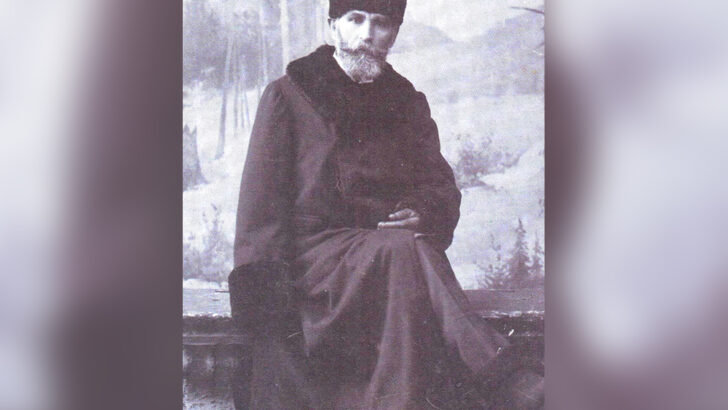 Michael Davitt, reporting from Russia, photographed in Moscow in the summer of 1904. Photo: IE TCD MS 9649/510, image licensed under the terms of CC-BY 4.0, The Board of Trinity College Dublin.
 Exhibition in The Long Room, Trinity College Library, open now, continuing to June 30, 2026.
For details, visit visittrinity.ie/book-of-kells-experience.
Entrance charge. Booking essential; visit tcd.ie/visitors/.
Character is Better than Wealth: The Enduring Legacy of Michael Davitt’ is the broad title of an exhibition currently on display in the Long Room of Trinity College Library. Drawing on the extensive Davitt Papers in the Manuscripts Department of the Library, it has been created by Ciara Daly, the Archivist and Exhibitions curator of the Research Collections.

The materials on display, notes, photographs and all kinds of written items, might once have been called ‘fragments from the life of an Irish felon’, but today they can be seen as the relics of a great man who lived his life for others.
Miss Daly, in the accompanying brochure, explains the intention behind the display: “This exhibition celebrates the life and impact of Michael Davitt, tracing his lifelong efforts to combat poverty, injustice, and oppression wherever he found them. It explores his imprisonment and his subsequent campaign for prison reform; his advocacy for tenants’ rights, for non-denominational education, for women’s education, and pensions for the ‘aged and deserving poor.’”
These papers, of course, have proved to be a treasury of informative gems on 19th-century life in many aspects, social, political and intellectual”
The display also follows, she adds, his international work, from reporting on Russia to journeys through Australia, New Zealand, and South Africa, where he exposed injustices and campaigned for fairer treatment for all.
In 1997, Davitt›s papers were donated to the library by Davitt’s son, Mr Justice Cahir Davitt, a Judge of the Supreme Court, who died in 1986.
These papers, of course, have proved to be a treasury of informative gems on 19th-century life in many aspects, social, political and intellectual. Major biographies were based on them, by T. W. Moody of TCD and by Carla King of DCU. And more recently, by Laurence Marley of Galway University, who presented a more critical view of Davitt’s later years than was common with earlier historians.
So this exhibition will, I suspect, reintroduce to a wide audience an important, if still controversial figure, whose causes still have relevance today in education, women’s rights, the position of workers generally, and above all, social equality.
Going over the five cases of this display of such a variety of items, all at once deeply personal and greatly engaged with the world, I felt that each one could be the subject of a book. This is not a show for an afternoon, but one which visitors will wish to follow up in later reading.
One incident in particular struck me: Davitt’s intervention in the pogrom at Kishineff in 1903. This incident in the history of Russian Jewry is very relevant today.
Davitt was commissioned by the New York American, one of the papers of magnate William Randolph Hearst (the model for Citizen Kane), to go to Russia to get “the absolute truth as to the massacre of Jews at Kishineff”, a town in Moldavia.
Outcome
The outcome of this mission was not just the immediate articles for the Hearst newspapers, but also a much fuller book, Within the Pale, published by The Jewish Publication Society of America, which he finished on July 4, 1903 (US Independence Day) at his family home in Dalkey.
Davitt’s preface to the book concluded with words from Cardinal Henry Edward Manning, the late Archbishop of Westminster in 1891, which seem to be even more relevant now than they were then.
“The public moral sense of all nations is created and sustained by participation in a universal common law; when this is anywhere broken, or wounded, it is not only sympathy, but civilisation, that has the privilege of respectful remonstrance.”
Manning was writing about international affairs, Davitt about the Russian Empire, but the words apply with even greater force to what is happening now to the Palestinians and other ethnic and religious groups in the Middle East.
Davitt was a Zionist, supporting Jewish settlements in Palestine, though not perhaps a Jewish state. What he would have thought of today’s situation is debatable.
Though Within the Pale is not on display, the life and career of Michael Davitt, as outlined in this exhibition, remains as fruitful of thought-provoking, if sometimes surprising insights today as they did in the 19th century.