

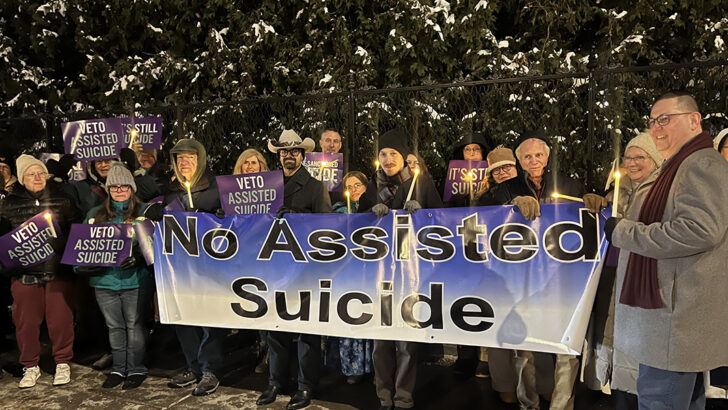
 Opponents of New York state’s assisted suicide bill stand outside the governor’s mansion in Albany December 2025, for a candlelight vigil urging Gov. Kathy Hochul, a Catholic, to veto the bill. Hochul signed the measure into law February 6, 2026. Photo: OSV News photo/Emily Benson, The Evangelist.
 In light of a recent law legalising assisted suicide in New York, Catholic bishops urged Catholics to make end-of-life decisions prayerfully and with guidance from the Church.
The updated pamphlet, “Now and at the Hour of Our Death,” is designed “to simply explain the moral principles of Catholic teaching with regard to end-of-life decision-making and to outline the options that exist in New York state for advance care planning,” according to its introduction.
The guidebook specifically addresses the moral problem of assisted suicide but also goes into detail about other important end-of-life decisions.
Basic lifesaving medical interventions, such as feeding tubes, are generally considered morally obligatory by the Catholic Church, according to the bishops’ guidebook.
The bishops distinguish between these morally required “ordinary” medical interventions and “extraordinary” or morally optional interventions. Determining which is which requires “the weighing of benefits and burdens expected for each individual.”
“This is not just a pragmatic decision of costs and benefits but a moral decision that affects our spiritual health,” the bishops say of end-of-life decisions.
The bishops note that “we must always accept (and others must provide) ordinary medical means of preserving life.”
“Ordinary means are those that offer us a reasonable hope of benefit and would not entail excessive burden on us, our family, or the community,” the bishops continue.
“The immorality of directly intending and bringing about our own death or of assisting in the death of another by intentional action is self-evident,” the bishops state. “Decisions can become much more complex, however, when we contemplate the removal or withholding of medical treatment, such as a ventilator or dialysis.”
“Withholding ordinary care with the intention of causing death is considered passive euthanasia and is always gravely contrary to God’s will,” the bishops continue. “But Catholics are not morally bound to prolong the dying process by using every medical treatment available. Allowing natural death to occur is not the same as killing.”
But the bishops note that “extraordinary treatments” are “considered morally optional.”
“For example, it would be permissible for a cancer patient to forego a particularly aggressive and expensive treatment if the patient judged the survival rate too low and the pain of the treatment too great a burden,” the bishops say.
The bishops emphasise that the distinction can be complex and encourage Catholics to seek guidance in these decisions.
Death of nearly 8000 migrants in 2025 is ‘nothing short of a tragedy’ says bishop
The International Organisation for Migration (IOM) released a report on April 21 that found approximately 7,900 migrants died or went missing in 2025, bringing the total since 2014 to over 80,000 deaths.
“While these figures represent only the lowest boundary of the true number of affected people, they nonetheless underscore the need for urgent action to end migrant deaths and address the complex needs of families left behind,” the UN agency stated in the report.
“2025 was marked by an unprecedented level of aid cuts and restriction of information on dangerous irregular routes, rendering more and more missing migrants invisible,” the report also said.
Bishop Paul McAleenan, Lead Bishop for Refugees and Migrants at the Catholic Bishops’ Conference of England and Wales, told Crux Now that the report’s findings were “nothing short of a tragedy.”
“The fact that almost 8,000 migrants died or went missing on journeys that were undertaken to flee conflict or to search for a better life is nothing short of a tragedy,” McAleenan said.
“As Catholics, we are often reminded that every migrant has a name, a face and a story. When that story comes to an abrupt and tragic end, it is a stark reminder of the dangers people are driven to endure: Unsafe sea crossings, exploitation, hostility, loss of dignity,” he added.
World’s oldest nun turns 113 and reveals secret to long life
A Dominican nun from New York recognised by Guinness World Records as the world’s oldest living nun celebrated her 113th birthday last week
Sr Francis Domenici Piscatella was born on April 20, 1913, on Long Island.
“My whole mind is [on] God. He has kept me going all these years,” she told Fox 5 News. “I’ve given up counting my years. I never really thought I would get to be that age.”
Sr Piscatella, a member of the Sisters of St Dominic of Amityville since 1931, has dedicated 94 years of her life to the service of the Church. “I wanted to be someone important to the sisters,” she remarked.
During the celebration of her 113th birthday, she said: “It’s very kind of everybody who came and made this such a lovely day.” She even received a proclamation from Pope Leo, the 10th pontiff to be elected in her lifetime
In Brief
Lebanese Christians rejoice over new Christ statue brought by Italian soldiers
l Lebanese Christians in Debel are celebrating the gift of a new statue of Jesus on the cross after a recent act of desecration by two Israeli soldiers drew global outrage.
Israel’s military removed two soldiers from combat duty and placed them in military detention for 30 days after they destroyed the town’s crucifix. The social media picture of an Israeli soldier taking the blunt side of an axe to a fallen sculpture of Jesus on the cross drew worldwide condemnation April 20 and apologies from Israeli Prime Minister Benjamin Netanyahu and other officials.
Local pastor Fr Fadi Felefli told OSV News the community is “very happy” to see the statue restored, calling it a sign of resilience amid ongoing conflict. The new crucifix was installed April 22 with support from Italian peacekeepers serving with the United Nations Interim Force in Lebanon, known as UNIFIL.
Canary Islands bishop on migration: ‘We feel powerless’
l The bishops of the dioceses of the Canary archipelago shared their concerns regarding immigration just weeks before Pope Leo XIV’s trip to Spain, a journey that will conclude on the islands.
The situation on the Canary Islands, arising from pressure caused by immigration from Africa, was behind Pope Francis’ desire to visit the islands; this wish will now be fulfilled by his successor, Pope Leo XIV, who will visit the islands in June.
The bishop of Tenerife, Eloy Santiago, acknowledged the fact that the archipelago serves as “Europe’s southern frontier — the point of arrival for immigration coming from the African continent.”
“We lack the human and economic resources to address this dramatic reality. We feel powerless in the face of this deadly Atlantic route,” Santiago explained during a meeting with the press.
Cardinal Koch: May the witness of martyrs inspire unity and peace
l At the Basilica of St Bartholomew on the Tiber Island, an ecumenical celebration for peace gathered Christian faithful on April 23 to commemorate the New Martyrs, with particular remembrance of the Armenian victims of the “Medz Yeghern” on the eve of its anniversary.
In his message for the occasion, Cardinal Kurt Koch, Prefect of the Dicastery for Promoting Christian Unity, said that the witness of martyrs remains central to the life of the Church. Quoting the documents of the Second Vatican Council, he recalled that honouring the testimony of Christians who gave their lives for Christ reveals a “true union in the Holy Spirit” among believers of different traditions.
Reflecting on the Armenian martyrs of the early 20th century, the Cardinal described their sacrifice as part of a “common martyrology” that transcends divisions.
On way back to Rome, Pope Leo condemns state executions in Iran
l On his return flight from Malambo to Rome on Wednesday, Pope Leo XIV condemned the state executions taking place in Iran.
Speaking during his April 23 ITA Airways flight, the pope, when asked about Iran’s execution of opposition members and its bloody crackdown on national protests against its authoritarian regime, which has reportedly resulted in thousands of deaths, said, “I condemn all actions that are unjust.”
“I condemn the taking of peoples’ lives, I condemn capital punishment,” he said.
When a nation or a governing regime makes decisions that “take away the lives of other people unjustly, then that is obviously something that should be condemned,” he said.