

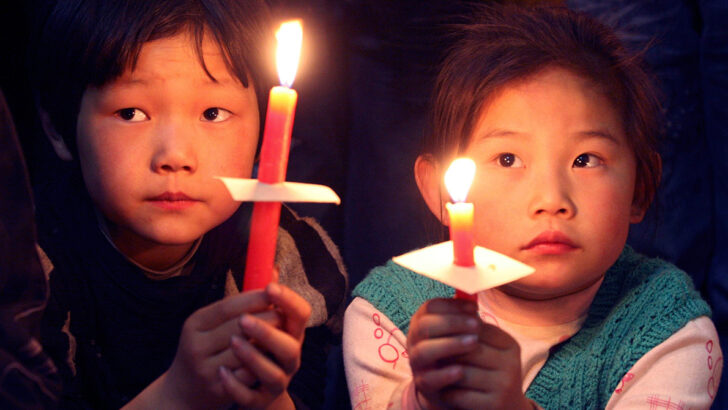
 Children are pictured holding candles during the Easter Vigil Mass at a church in Xiaohan village of Tianjin municipality in China. Children “bear the brunt” of international religious freedom violations, panelists at a hearing of the US Commission on International Religious Freedom said. Photo: OSV News photo/Vincent Du, Reuters.
 Children “bear the brunt” of international religious freedom violations, panelists at an April 30 hearing of the US Commission on International Religious Freedom said.
Vicky Hartzler, chair of USCIRF, an independent, bipartisan US federal government commission that monitors religious freedom around the globe, said the group is “deeply concerned about countries where governments restrict religious education and prevent children from learning or practicing their faith.”
“These policies are designed to erode religious identity by preventing families from passing beliefs on to the next generation,” she said.
Hartzler, a former Republican member of the House from Missouri, said that in China, “authorities have imposed sweeping bans on religious education and practice for Uyghur Muslim and Tibetan Buddhist children, the government has separated tens of thousands of Uyghur and Tibetan children from their families through state-run boarding schools that enforce Mandarin language instruction and prohibit all religious teaching.”
“These policies are intended to sever children from their faith traditions and assimilate them into state-approved ideology, a core element of the Chinese Communist Party’s genocidal strategy targeting Uyghur Muslims and other minorities,” she said.
In Ukraine, she said, “we are also gravely concerned about the ongoing abduction and forced transfer of Ukrainian children by Russian authorities, actions the UN has concluded amount to crimes against humanity.”
“Since Russia’s full-scale invasion, thousands of children have been taken from their families, relocated to Russia or Russian-controlled territories, and subjected to state-run programs that attempt to strip away their Ukrainian culture, including religious identities,” she said. “These policies inflict deep trauma on families and represent a systematic effort to erase the national cultural and religious identity of an entire generation.”
Asif Mahmood, vice chair of USCIRF, added that the group is also concerned about the Taliban’s “tight control” over a growing number of madrasas, or religious schools, in Afghanistan, “which they use to impose a rigid state-mandated interpretation of Islam.”
Across regimes around the globe that USCIRF says conduct violations on freedom of religion or belief, “children are the ones who bear the brunt of religious freedom violations,” Hartzler said.
“Perpetrators target them because they are defenseless, knowing that harming girls and boys can destabilize families and entire faith communities; the consequences are severe,” she said. “Social cohesion deteriorates. Hope for the future fades, and the very survival and identity of these communities are put at risk.”
Indian police arrest Hindu YouTuber over St Francis Xavier ‘terrorist’ jibe
The vociferous protests over a Hindu activist calling St Francis Xavier — patron of the tiny Indian state of Goa, a former Portuguese colony on India’s west coast — a “terrorist” at a Hindu group’s convention subsided after state police traced the absconding insulter to the state of Himachal Pradesh and brought him to Goa on April 26.
“Things are peaceful now and the Church has made its stand clear with our earlier (April 20) statement,” Fr Barry Cardozo, Goa archdiocesan social communications director, told EWTN News on April 28.
Gautam Khattar, a viral Hindu YouTuber and founder of the Hindu group Sanatan Mahasangh, made the controversial remarks about St Francis Xavier on April 18 at an event organised by a Hindu group, Sanatan Dharma Raksha Samiti (Eternal Religion Protection Committee), at Vasco in south Goa in the presence of a state minister and legislator.
“We unequivocally reject and condemn these pernicious statements,” the Catholic Church of Goa articulated its concern in a powerful statement on April 20 as news of the controversial comments spread.
It called upon “authorities to take immediate, strong, and exemplary action against those responsible for this hate speech, in accordance with the laws of the land.”
At the same time, the Church appealed to “all to remain calm and exercise restraint. Let us uphold the peace and unity that have defined us for so long,” it said, calling for the saint’s “spirit of love and fraternity [to] continue to guide us all towards ever greater unity and peace in these troubled times.”
Advanced technology recovers 42 lost pages of ancient New Testament manuscript
An international team of scholars led by Prof. Garrick V. Allen of the University of Glasgow in Scotland has successfully recovered 42 lost pages of one of the most important New Testament manuscripts, known as Codex H.
The university’s College of Arts and Humanities announced April 24 that the codex, a 6th century copy of St Paul’s epistles, had been partially lost after being disassembled in the 13th century at the Great Lavra Monastery, located on Mount Athos in northern Greece.
Thanks to a technique called multispectral imaging, researchers were able to recover texts that no longer physically exist. This allowed them “to retrieve multiple pages of information from every single physical page,” the expert added.
Among the key findings are ancient lists of chapters considered the oldest known for St Paul’s epistles, which differ notably from the current division of these texts.