

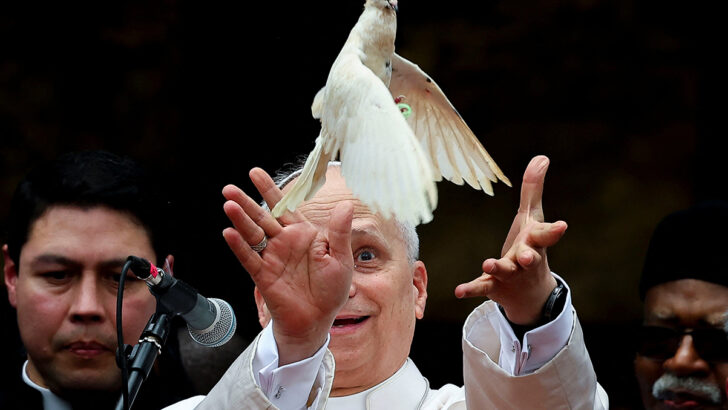
 Pope Leo XIV releases a dove after he attended a Meeting for Peace at St Joseph’s Cathedral in Bamenda, Cameroon, April 16, 2026. Photo: OSV News/Guglielmo Mangiapane, Reuters.
 Cardinal Reinhard Marx, who has served as archbishop of Munich and Freising in Germany since 2008, has instructed the priests and full-time pastoral staff in the archdiocese to introduce the controversial handout “Blessing Gives Strength to Love” as the basis of pastoral care.
Priests who do not want to carry out such blessing celebrations for homosexual marriages or remarried divorced people must refer the couples to the dean or other staff.
A letter from the cardinal indicates that the handout should be “the basis of pastoral care” and beginning in June, various offices within the archdiocese are to offer further training as to the design of the blessing celebrations for all full-time officials in pastoral care.
Marx emphasised that “the blessing is not the celebration of a sacramental marriage.” However, this does not mean that the blessing of a non-sacramental union, which in many cases is already a civil marriage, moves the couple to the margins of the community and the Church.
According to Tagespost, Marx instructed that the “theological meaning” of the text be explained to all those “who still struggle with this blessing.”
The handout “Blessing Gives Strength to Love” is the result of a process that emerged from a vote at the Synodal Way. In March 2023, the fifth synodal meeting adopted the text of the handout with 92% of the votes.
In the Church in Germany, the handout is highly controversial. Official recommendations were issued by the dioceses of Limburg, Osnabrück, Rottenburg-Stuttgart, and Trier. However, the Archdiocese of Cologne and the dioceses of Augsburg, Eichstätt, Passau, and Regensburg all rejected the application and referred to Fiducia Supplicans for justification.
According to Fiducia Supplicans, the Vatican declaration on the pastoral meaning of blessings issued by the Dicastery for the Doctrine of the Faith (formerly the Congregation for the Doctrine of the Faith, or CDF) in December 2023, blessings of connections in irregular situations and of homosexual couples are possible — although the CDF claimed the opposite only two years earlier.
Paragraph 31 of the document states that the form of the blessings may not be “ritually determined by the ecclesiastical authorities … so as not to cause confusion with the blessing of the sacrament of marriage.”
Numerous bishops — including entire bishops’ conferences — have rejected the Vatican approval of blessings for same-sex unions. Thus, there is a struggle for direction in the Church between those who adhere to the Church’s traditional teaching on homosexuality and those who consider blessings of same-sex couples to be possible in principle — whether in the form outlined by the Vatican or in the form that is largely common in Germany.
Pope and Anglican archbishop call for peace and unity
Pope Leo XIV and the head of the Anglican Communion, Sarah Mullally, have called for greater efforts towards world peace and Christian unity. During her visit to the Vatican on Monday, the Archbishop of Canterbury thanked the Pope for his clear words against war and injustice.
She also thanked him for emphasising the theme of hope during his recent trip to Africa. “The world needed this message right now,” said Mullally during the audience at the Apostolic Palace. The Archbishop said she was looking forward to her own trip to Ghana and Cameroon in July.
In their addresses, both emphasised that the proclamation of the Christian message must not be clouded by controversy. “In the face of inhuman violence, deep divisions and rapid social change, we must continue to proclaim a more hopeful message: that every human life has infinite value because we are God’s precious children; that humanity is called to live as sisters and brothers,” said Mullally.
Both referred to the dialogue between Anglicans and Catholics, which officially began with the signing of the Joint Declaration by Pope Paul VI and Archbishop Arthur Michael Ramsey in Rome on 24 March 1966.
It would be “a scandal” if Anglicans and Catholics did not continue to work towards “overcoming our differences, however insurmountable they may seem,” said Pope Leo.
Vatican Roundup
Pope Leo donates $100K to CRS clean water project in El Salvador
l Pope Leo XIV has donated $100,000 to provide access to clean water in El Salvador, supporting a program launched by the papal nuncio to that nation and by Catholic Relief Services, the official humanitarian and development agency of the US Conference of Catholic Bishops.
The gift was announced in an April 20 press release issued by CRS and the apostolic nunciature in El Salvador, with a press conference taking place in Comunidad El Lindero, a remote village in the district of Nueva Concepción in Chalatenango, some 44 miles from the capital of San Salvador.
The funds will help expand the clean water project Agua Segura (“Safe Water”) to four of the eight dioceses in El Salvador.
“Clean water is life,” said CRS president and CEO Sean Callahan, noting he and the agency were “deeply honoured” by Pope Leo’s donation.
An estimated 50,000 living in rural areas are ultimately expected to benefit from the Agua Segura initiative, with about 7,500 directly impacted by the papal contribution.
Vatican automates its telescope in Arizona for remote use
l A new automation system for the telescope at the Holy See’s astronomical observatory in Arizona will allow students from Jesuit universities to use it remotely for scientific research.
Mount Graham in Arizona is home to the Vatican Advanced Technology Telescope (VATT), one of the most important observatories managed by the Vatican Observatory (Specola Vaticana).
Astronomers will now be able to operate the telescope remotely, without the need to be physically present on the mountain. In fact, astronomers from the Vatican observatory at Castel Gandolfo in Italy are already making use of this new feature.
The idea to automate the telescope emerged following a meeting held last January between Kim Bepler; the director of the Vatican Observatory, Fr Richard D’Souza; and the president of the Vatican Observatory Foundation, Bro. Guy Consolmagno.
Pope Leo XIV to prisoners: ‘No one is excluded from God’s love’
l Pope Leo XIV visited Bata prison in Equatorial Guinea April 21, telling inmates that “no one is excluded from God’s love” and urging them to see that even behind bars, there remains the possibility of change, reconciliation, and hope.
At the prison, Leo XIV was welcomed by Justice Minister Reginaldo Biyogo Mba Ndong Anguesomo, the prison director, and the chaplain, Fr Pergentino Esono Mba.
One of the more than 600 inmates thanked the Pope for his visit and support.
“We wish to thank you for your visit and your support,” the prisoner said. “Your presence reminds us of the importance of faith and redemption. We ask for your blessing to keep moving forward and to come out of this as better people. We are grateful for your compassion and for your message of hope.”
The chaplain, meanwhile, thanked the Pope “for his message of mercy and forgiveness.”
Programmes published for Pope Leo’s visit to Naples and Pompeii
l The programmes for Pope Leo XIV’s visit to Naples and Pompeii on May 8, 2026, the first anniversary of his election, have been released. He is scheduled to preside over Mass in Piazza Bartolo Longo in Pompei, participate in the traditional noon supplication to the Virgin of Pompeii, and venerate the relics of San Gennaro in Naples.
The final major event of the day will begin at 5:30 pm, when Pope Leo XIV will meet with the people of Naples in Piazza del Plebiscito and will address the city.
At the conclusion of the gathering, there will be an Act of Entrustment to the Virgin Mary before the venerated image of the Immaculate Conception, which will be brought into the square on the occasion of the bicentenary of its coronation, before Pope Leo imparts his Apostolic Blessing.