

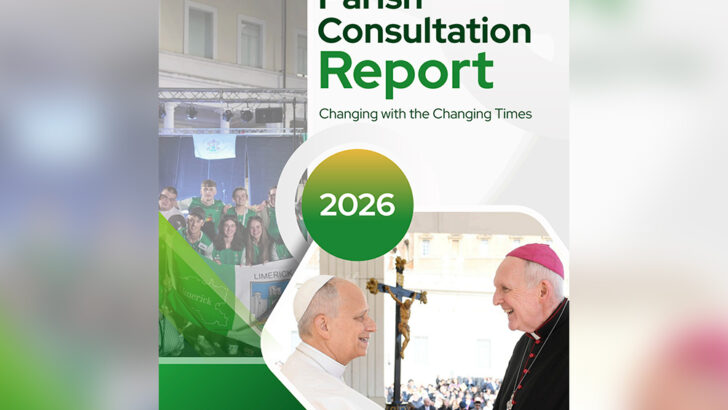
The results of the Limerick diocese’s 2025 consultation released this week tells it again what its own documents have been saying since 2016 and earlier consultations before that, going back to the 1990’s. The deeper question is whether listening, however sincere, has become a substitute for decision-making.
There is a moment near the end of the Diocese of Limerick’s new consultation report, Changing with the Changing Times, where Bishop Brendan Leahy sets out his reading of the past decade almost as a defence exhibit (he is a qualified barrister). He recalls the 2016 Diocesan Synod and the pastoral plan it produced, Moving Forward Together in Hope; the Overview 2023 that took a statistical snapshot of the diocese; and the Diocese of Limerick Mission Report 2024, published in early 2025, that did so again. It reads as a timeline — a paper trail establishing that he has been saying all of this for a long time.
He has. And that is precisely the difficulty.
Striking
Set the 2026 report beside the 2023 Overview and the striking thing is not how much has changed but how little the diagnosis has moved. The 2023 document already carried a section headed ‘Dealing with the Deficit,’ already reported that the Offertory collection had fallen 37% — the identical headline figure cited again in 2026 — and already warned, in Bishop Leahy’s own words, of the need for “courage in the coming years to recognise that certain structures and arrangements, buildings or activities that we’ve had for years may simply be no longer needed or just beyond what we can afford now.” (The diocese was losing 1m annually). Three years on, the new report calls the finances “the elephant in the room” and concedes that one or two parishes are near the point of being unable to keep their doors open. This is not new information being discovered. It is an old warning repeated, louder.
The hard numbers tell the same story of accelerated decline. In mid-2023 the diocese counted 47 diocesan priests under 75 in active ministry; the 2026 report puts the figure at 33. Over the same short interval the number of international priests has risen from nine to seventeen, so that the diocese is increasingly sustained by clergy from Africa, Poland and India. All taking on more and more work. Most telling of all is the volunteer base on which the whole consultation leans: some 2,547 in 2023, “some 2,000” in 2026. The cohort being asked to take on more has shrunk by roughly a fifth in the interval. That is why the bishop’s plea — that the diocese “cannot keep asking the same faithful people to take on more” — rings true, they are exhausted. He is also asking them, and a diminishing pool behind them, to deliver renewal which seems implausible.
When churches close it can be said the people acknowledged it had to happen. That may be pastorally shrewd”
Which forces the question the report cannot quite face: if the recommendations were largely settled in 2016, and the clear diagnosis hadn’t changed by 2023, why consult again at all? The bishop admits that not all the recommendations of 2016 Synod have been implemented so why go back to essentially the same cohort again for ideas?
The generous reading is that the listening is itself the point. Bishop Leahy attended the 2023–24 Synod on Synodality in Rome, and the Limerick exercise is consciously aligned with the Irish Synodal Pathway and the seven priorities heading to October’s National Synodal Assembly. In that frame, consultation is not a means to a plan but a way of being Church. The bishop can fairly say he is doing what Rome has asked, and doing it more diligently than some of his colleagues.
Anxiety
The harder reading is that a consultation which surfaces anxiety about parish amalgamations, lets parishioners themselves name mergers as sometimes necessary, and then urges them to be “proactive in future planning,” looks a great deal like the careful preparation of consent for decisions already foreseen — so that when churches close it can be said the people acknowledged it had to happen. That may be pastorally shrewd. It is not open-ended listening, where parishioners think they are being asked about renewal when really they are being consulted and made aware that the renewal that they want is not on the cards, because there’s not enough people or money to implement it. Essentially, they are being told ‘we love your energy, your ideas, but it’s too late’. The Consultation report admits as much.
But the deepest issue is neither the recycled data nor the management of expectations. It is what the Limerick case reveals about synodality itself — not a failure to practise it, but the limits of what the practice, as the Church currently defines it, can actually be.
Catholic synodality is consultative, not deliberative, by canonical design. A parish pastoral council possesses a consultative voice only (c. 536); the finance council advises (c. 537); the parish priest, and above him the bishop, governs.
The first option is to act now, from relative strength: with 33 priests, 2,000 volunteers and some financial cushion still in hand, to consolidate deliberately into fewer, more viable communities”
The relegation of a church to profane use is the diocesan bishop’s act (c. 1222), as is the deployment of clergy and the ordering of the diocese’s finances. The 2024 Synod’s Final Document pressed hard on transparency, accountability and the evaluation of participatory bodies — but it pointedly declined to give lay councils a deliberative vote.
That is what gives the instinct that something here is unfair. The consultation asks the laity for “co-responsibility” — fill the rotas, carry the administration, take on funeral and baptism ministry, train as catechists — without offering co-governance, any real purchase on the levers that make decisions; which buildings survive, how priests are deployed, how the whole enterprise is financed. It distributes the burden of decline, and by implication the blame for it.
“Unless more people are willing to become actively involved,” the bishop writes, the proposals “will be difficult to realise.” The sentence quietly relocates the cause of failure from a structural crisis decades in the making to the insufficient generosity of the people in the pews. This is responsibilisation without authority, and the laity have had little say in the operational decisions that brought the diocese to this point.
All of which leaves a question – Quo Vadis?, Peter’s question to Christ and it is the question Limerick — and most of the Irish Church — keeps declining to answer. The first option is to act now, from relative strength: with 33 priests, 2,000 volunteers and some financial cushion still in hand, to consolidate deliberately into fewer, more viable communities, and to own that as the bishop’s office requires, accepting the grief and the charge of high-handedness that come with it.
Governance
The second is to share governance in earnest, using instruments canon law already permits but Irish dioceses rarely deploy — lay parish administrators, the entrusting of a share in pastoral care to lay people under a priest moderator (c. 517 §2), finance bodies with genuine weight — so that co-responsibility extends to the hard calls and not merely the chores. The Consultation actually shows a clear call for transparent financial reporting (how is this still an issue?) and a calling for “transparent decision-making and clear lines of responsibility so that they understand who authorises ministries, manages finances and oversees building.” None of these pleas on governance are new, they were there in 2016.
The third is the path the diocese is in fact on: the rhetoric of journeying together, yet the reality of reserved power, poor communications, lack of financial transparency and the pastoral burden devolved to the parishes and the decisions deferred as well as raised hopes and expectations. It is the least fair of the three.
Limerick has now produced numerous instalments of the same diagnosis in ten years. The diagnosis has not changed because the realities beneath it have not changed”
The legitimate question now is whether consultation is being used in good faith as real discernment, or as a pastoral anaesthetic that confers the legitimacy of having listened. The documents clearly show a pastor genuinely loathing to be the man who closed churches. The effect, however, of perpetual consultation is deferral, and deferral has a price, paid disproportionately by the exhausted faithful who remain to absorb it.
Limerick has now produced numerous instalments of the same diagnosis in ten years. The diagnosis has not changed because the realities beneath it have not changed. At some point the difference between a synodal Church and a managed decline is not what a diocese is willing to hear, but what it is finally willing to decide — and who, in a Church that still reserves the deciding to one man, is asked to carry the cost of his not deciding yet.