

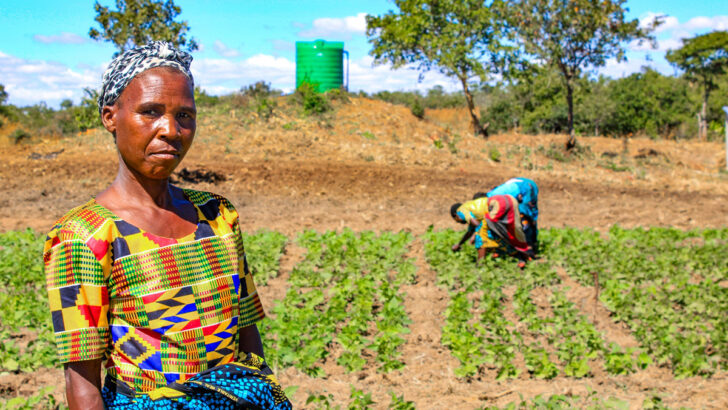
 Veronica at her farm in northern Malawi. With support from St Patrick’s Missionary Society and partner organisation Ungweru, funded by Misean Cara, she now has access to a solar-powered irrigation system which frees her from dependence on increasingly erratic rainfall and enables her to grow food and earn an income year-round. Photo: Ungweru Organisation.
 Shortly after the publication of Misean Cara’s 2025 Impact Report, the organisation’s CEO sat down with The Irish Catholic to discuss the previous year’s highlights and demands, the challenges caused by reductions in global aid budgets, and what the future of Misean Cara’s international development in the global South will look like.

Providing context for the 2025 Impact Report, released on June 24, Misean Cara CEO John Moffett addressed the difficulties that the tumultuous year presented for the communities that the organisation serves. “2025 was a demanding year in development generally but it was also a very meaningful one,” he said.
“The world that we live in grew more uncertain; we saw escalations in conflict, worsening displacement, continuing and disproportionate impact of climate change among the communities, and worst of all we saw significant reductions in global aid budgets.”
Asked about the highlights of the year, Mr Moffett praised the resilience and hard work of Misean Cara’s members: “What struck me during the year is the role that our members played in addressing this kind of increasing crisis…they are ever present, living in the communities that they work for. They know the people, they know the history, they know the pressures and the possibilities in the places that they work, and that long term presence continues to build trust, and that trust makes all the difference in these times of crisis.”
Support
In 2025, Misean Cara supported these members in reaching 1.13 million people across Africa, Asia, Latin America, and the Middle East, providing 13.5 million to support missionary organisations’ projects in 40 countries.
More than 71,000 households in 26 countries improved their livelihood opportunities as a result of these projects, and 84% of households had improved food and nutrition security, stated the Impact Report. In the healthcare sector, more than 980,000 people across 24 countries received improved health services, clean water and better sanitation. In the human rights sector, the 2025 Impact highlights reported that 1.1 million people were supported in claiming their rights with help from Misean Cara’s members, and 900 people were assisted in accessing justice and legal aid. Additionally, 47,000 people in 19 countries received emergency aid following disasters, conflict, and disease outbreaks.
Providing access to education is a ‘vital service in parts of the world that are the poorest and most excluded’”
Mr Moffett said he was particularly proud of the missionary organisations’ impact in the education sector. The NGO assisted in giving 118,000 learners in 33 countries access to quality education, and most importantly, saw a high retention rate. “At the end of the year there were still 98% remaining in schools,” said Mr Moffett. “That’s a really high retention rate through missionary work.”
The Catholic Church is the largest provider of girls’ education in sub-Saharan Africa, shared Mr Moffett. Providing access to education is a “vital service in parts of the world that are the poorest and most excluded, especially for groups like girls or people with disabilities,” the CEO continued.
Commitment
The commitment of Misean Cara’s members, specifically in the education sector, is exemplified in the work of the Loreto Sisters in South Sudan. On a visit to South Sudan in 2025, Mr Moffett said he visited the Loreto Rumbek Primary and Secondary School for girls, founded and led by Loreto Sister Orla Treacy of Co. Wicklow. Mr Moffett described it as “the best girls’ school in South Sudan.” Working in the school and surrounding community in South Sudan for over 20 years, Sr Treacy has demonstrated what many of the Misean Cara’s members and missionaries do: live among the communities they are working with, get to know them and build trust.
The members ‘do the real work’ of supporting and working with disadvantaged groups”
Living and working in South Sudan for a long period of time allows Sr Treacy and other missionaries to “understand the community, the barriers to girls’ education, and how to enter into discussion, dialogue and negotiations with families and local leaders to ensure that girls are able to stay in school until they finish their education rather than being married off.”
The commitment of the members and the missionary work that Mr Moffet said identifies “those that are left on the margins and tries to find ways to include them in development programming”, is a priority for Misean Cara’s next few years, as their 2022-2026 strategy comes to a close in December.
Reflecting on these five years, Mr Moffett said he believes the NGO has delivered very well on their strategy, and noted that the members “do the real work” of supporting and working with disadvantaged groups to improve their livelihoods.
Highlights
A highlight of the last few years for the CEO has been the Children with Disabilities (CWD) programme, a three year initiative investigating how Misean Cara can “ensure missionary organisations are able to provide services at a community level that are able to keep children with disabilities with their families and communities and prevent them from having to move into long term institutional care.”
The project was unusual as it collaborated personnel from charity, government, and development sectors who are responsible for providing care for children, said Mr Moffett.
Identifying a major challenge for the upcoming years, Mr Moffett explained that the reductions in aid budgets, “led by the USA and more stealthily coming through from Europe” is a key concern, as financial sustainability is a priority not just for the Irish NGO, but for the missionary organisations it works with as well. These budget reductions forced many organisations in the international development sector to renavigate a “much harsher landscape to operate in,” said the CEO.
They stay and continue to accompany the communities they work with, even when there are challenging times”
As a result, Mr Moffett said Misean Cara will focus on “financing development aid flows that will support the emerging economies in the global South to maintain and sustain the development gains they’ve made over the last 50 years and prevent them from going backwards.”
Another priority for the organisation moving forward will be, “ensuring that the people closest to the problem have the greatest role in decision making.” The Misean Cara CEO shared that the development sector as a whole is making an effort to move toward this way of thinking, “but it’s moving very slowly.”
The presence of the missionaries in hard to reach places, where they can support disadvantaged communities from the ground up while communicating with them about their needs is the first step towards giving a voice to those closest to the problem. “They embed themselves within communities, and they don’t leave when times get tough,” said Mr Moffett, praising the work of those missionaries like Sr Treacy. “They stay and continue to accompany the communities they work with, even when there are challenging times.”