

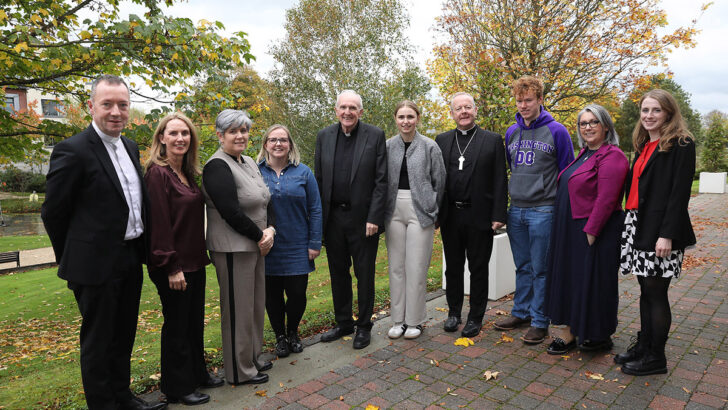
 The Pre-Synodal Assembly, held in Kilkenny in October 2025, brought together over 230 delegates from across the island of Ireland. During this day-long gathering, the National Synodal Team presented seven priorities for discussion and discernment among participants. This photograph captures a cross-section of the delegates who attended the Assembly, reflecting the diversity and broad representation engaged in the synodal journey. The National Synodal Assembly will take place this October in Co. Meath. See www.synod.ie
 As a parishioner, I had always thought of the Church in terms of structures. I had thought of clergy, parishes, and committees as part of the physical buildings themselves. I had thought of churches built of stone and mortar, institutions that had stood for generations and carried the faith through centuries.

But being part of the synodal pathway has changed how I see, and live the Church.
I have been given the opportunity to look into the heart of the Church, and what I see is not structures, systems or buildings. I see people. I see passion. I see hard work. I see commitment and sacrifice. I see people who care deeply about faith and about bringing others closer to God.
The structures of stone and mortar remain, but now I see more clearly the people upon whom the Church stands.
The Church is not simply sustained by buildings or offices; it is sustained by people who give of themselves quietly every day. People who pray. People who listen. People who accompany others. People who continue to show up, even when it is difficult. The synodal process has allowed me to witness that reality in a very real and personal way.
Concerns
For some people, however, the synodal pathway brings fear.
There is fear of change. Fear that we are giving something up. Fear that we are moving away from prayer, tradition, and the foundations of our faith.
Those concerns should not be dismissed lightly. Change can be unsettling, especially when faith is something so precious and deeply rooted in our lives. Tradition matters. Prayer matters. The treasures of our faith matter.
But I would offer this reassurance: this process has been grounded in prayer from the beginning and, in a special way, guided by the Holy Spirit.
The Synodal Pathway is not about abandoning the faith. It is not about moving away from God. Rather, it is about listening – listening to one another and listening to what God is asking of His Church today.
Those who, in the pace and demands of modern life, have struggled to prioritise faith and their relationship
with God”
I understand why some people are anxious. I understand why it can feel uncertain. But for me, this process shows something beautiful: it shows that the Church is listening.
And in listening, the Church is bringing people along on a journey. That means all people.
It means people who have felt left behind. Young people, women and men, who, for one reason or another, have turned away from their faith. People who carry hurt, disappointment or even apathy. People who may still believe but no longer feel they belong.
It also means those who, in the pace and demands of modern life, have struggled to prioritise faith and their relationship with God. Not because they rejected faith, but because life became busy, complicated, and overwhelming.
These people matter. Their voices matter. Their place within the Church matters.
Frustration
Some people have become frustrated with the synodal process. Perhaps it has moved too slowly for some. Others may feel uncomfortable moving away from certain systems or structures that have long been familiar.
That frustration is understandable. While the path ahead exists, it is up to all of us to clear the way on our journey forward, together.
Yet perhaps the most important thing is not the speed of the journey, but the direction.
If we keep at the centre of this process the question: What does God want from the Church in Ireland today? then surely we must continue listening.
Can we not be patient? Can we not remain open? Can we not create space for all people to find their place in our Church?
Because we are all people of God.
The synodal pathway reminds us that the Church is not something separate from us. We are the Church. And if that is true, then we should always be asking ourselves: how can we bring others on this journey with us?
At its core, this is a lifelong journey – a journey of deepening our relationship with God.
We already understand this when it comes to our children. We invest extraordinary energy into helping them encounter faith. We prepare them for the sacraments, accompany them through catechesis, encourage them in prayer and support their spiritual growth. And rightly so.
But can we not do the same for everyone? Can we not accompany adults searching for meaning? Welcome those returning after years away? Walk with those who are uncertain? Support those whose faith is fragile?
The call to deepen our relationship with God is lifelong. For me, that is what the synodal pathway has revealed.
I began by seeing structures. I now see people, open to the Spirit, open to journeying together.
I hear a Church that listens, on a path of renewal. A Church seeking to fulfil her mission today while asking what God is calling it to become for the good of future generations.
And perhaps that is where hope lies – not in the stones and mortar, but in the people who continue, together, to build the Church every day.
Crysta Gunn is a communications officer for the Irish Catholic Bishops Conference communications office.