

 Martina Purdy
What do you do when a convent dies? It is a question for our times, sadly, with the death of vocations and, frankly, a lack of appreciation for religious sisters, past and present. I was intrigued when Co. Down businessman Ciaran Fitzpatrick contacted me about the old Mercy Convent in Downpatrick, which had been officially opened on All Saints Day 1871 – though the sisters’ first arrived in the town this month in 1855.

The convent closed in 2011 – and was then subject to a painful kind of ‘pass the parcel’ as it moved between owners trying to find new life for a listed building that was physically attached to the parish church of St Patrick’s.
The Mercy convent was built for £4,000 thanks to a generous benefactor – and brought many blessings: not just the education of generations of schoolchildren, but service of the poor and the sick at a time when Ireland was ravaged by famine.
Indeed it was exactly 150 years ago this week, on June 3, 1876, that the Mercy Sisters opened their schools. The Convent of Mercy Nursery School on Folly Lane is still thriving – a legacy of the sisters who were first invited to Downpatrick by parish priest Fr Bernard McAuley. He had met their foundress, now Venerable Catherine McAuley, in Dublin in 1828.
Columbarium
The nuns lived initially in a small house in Irish Street in the town named for St Patrick – whose Christian mission in Ireland began in Downpatrick in 432AD. A silver statue of St Patrick shimmered from the convent wall, overlooking the Mountains of Mourne, as I greeted Mr Fitzpatrick who is both an undertaker and an estate agent – the irony of his position was not lost on me. His family’s estate agency has been operating in Downpatrick since 1890 – almost as long as the convent.
Mr Fitzpatrick said he had acquired the old convent about three years ago and has invested around £500,000. The property has been divided into three sections two of which are in the process of being sold off.
However, he has retained the sister’s former chapel and created Ireland’s first privately-owned columbarium. “The word ‘columbarium’, he tells me, originates from the Latin ‘columba’ meaning ‘dove’. “Because,” he adds, “the wall niches in a columbarium resemble a dovecote”.
Mr Fitzpatrick said cremation is increasingly an alternative to burial in Ireland”
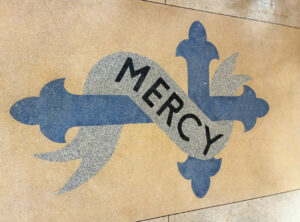
The convent chapel, now Trinity Columbarium, has been restored, and repainted in blue and gold – with stunning original features such as the domed ceiling. Mr Fitzpatrick was intrigued when a dusty old carpet was lifted to reveal a terrazzo floor with a stunning motif of a cross and the word, “Mercy”. The old altar has been removed – and now the main focus as you enter the chapel is a wall – behind which urns are kept. Trinity Columbarium has places for up to 6,000 urns. “It’s all made in America and imported. It is made of bronze.” These weighty decorative bronze plates were made in Buffalo, New York.
Recently the ashes of the late John Byrne, of Downpatrick, who died in December 2024, became the first to be “inurned” in Trinity Columbarium. Mr Fitzpatrick said already fourteen people have reserved a place. The cost on average is around £1300.
Mr Fitzpatrick said cremation is increasingly an alternative to burial in Ireland – driven by the rising costs and scarcity of traditional burial plots, particularly in urban centres. “Cremations are getting more and more popular, because they’re a lot cheaper for a start,” he said. “Yes, the council cemetery here is still relatively cheap, but in Belfast the cost of a grave can be up to £3,500 and then you have your burial costs, and your headstone costs. An inurnment – as opposed to interment – is a fraction of that.”
Mr Fitzpatrick said he took a calculated risk – noting that cremations now account for 20% of his rural-based business compared to just 3% fifteen years ago. “There is no rush,” he said. “There’s no bank finance or anything like that involved. So there’s no pressure. It’ll build momentum.”
Sentiment
For Mr Fitzpatrick, a Catholic, this has been a labour of love as well as a financial prospect. He spent three years preparing for the redevelopment including obtaining planning permission for Trinity Columbarium. He and three sons, Joseph (12), Conor (10) and Declan (9), personally spent many hours cleaning up the property which had deteriorated, having lain idle for some time. The Fitzpatrick family helped removed tumbleweed and pigeon faeces from the old courtyard repainting a grotto in honour of Our Lady of Lourdes. The courtyard is shared with St Patrick’s Church and is now a lovely green space where First Communion children flock to have their picture taken.
Mr Fitzpatrick is marketing Trinity Columbarium at home and abroad – to the Irish in Britain and America. “I am reaching out to the Irish diaspora, people who would like their ashes to be in the town where St Patrick is buried.”
Ashes can be easily shipped from North America as Northern Ireland is no longer subject to European restrictions”
“Do you know that the boulder is on St Patrick’s grave up there? Because when people were going to America, they were taking the soil, putting it in their suitcase. So, around 1900, they placed the big boulder there to protect the grave.”
He recently discovered that ashes can be easily shipped from North America as Northern Ireland is no longer subject to European restrictions. He also said there were tens of thousands of ashes in urns, unclaimed in funeral homes or left in inappropriate places across the UK and Ireland – and the Church requires a suitable place for ashes to be “inurned.”
Ownership
When the last of the Mercy Sisters left the convent, ownership had initially passed to a Kerry-born member of the congregation, Sr Consilio Fitzgerald, who in 1966 set up Cuan Mhuire, Ireland’s largest voluntary provider of addiction treatment.
Sr Consilio opened a refuge in the former convent for people who were leaving treatment but had nowhere to go. But the cost of maintaining the old property was burdensome.
The property was offered to Downpatrick parish, for a peppercorn fee; and there were hopes that the former convent might be developed as a parish centre. But the Diocese of Down and Connor, concerned about the financial risks of a multi-million-pound project, declined the offer. Still, there has been ongoing concern that the former convent will be used inappropriately – nobody wants a nightclub attached to the church for example.
A section of the convent, backing onto Stream Street, will be sold for apartments”
Ultimately, Sr Consilio received the proceeds of £185,000 from the sale. “Sr Consilio at least got some money in the end,” said Mr Fitzpatrick.
Mr Fitzpatrick is optimistic that a section of the convent, backing onto Stream Street, will be sold for apartments – for those aged over 55, and reveals that he is in negotiations to sell the third section. He remains hopeful that it will be put to good use – with rooms that could yet be leased by the parish. “It is an issue across the world, disused churches and old buildings – what do you do with them? A lot of them are left to rack and ruin. Here in Down and Connor, this is a way of restoring this old building.”
**
A student from Our Lady and St Patrick’s College, Knock, designed the cover for the Down and Connor Sacred Heart Novena 2026. This is the third year of the Novena, initiated by Bishop Alan McGuckian. The Novena booklet is beautifully adorned with original art from young people. The Novena runs from June 4 to the 11, and I have no doubt, through the Heart of Jesus, it is bearing fruit.
**
Congratulations to Co. Antrim priest, Fr Paddy Delargey, on his new book, Listening to People who Listen to God. The book – being launched at All Saints Parish, Ballymena on June 5 – features a series of reflections on The Benedictus. It contains my own thoughts on the line “Blessed be the Lord the God of Israel, He has visited his people and redeemed them…”