

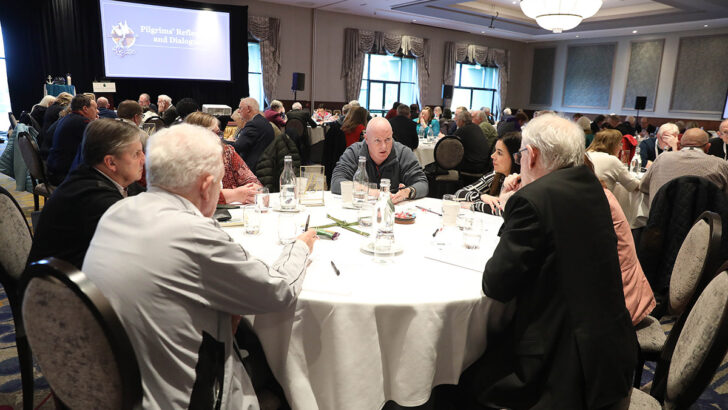
 Pre-Synodal Assembly. Photo: John McElroy.
 An editorial in this newspaper, last week, reflected on the issue of engagement with the Synodal Pathway. Ultimately it posed the fairly fundamental question of ‘who exactly is this process for?’ It raised, in its analysis, the apparent “disengagement” of Irish priests. It implied an absence from the process on the part of The Irish Catholic readers, while the paper has previously noted the impression that conservative lay Catholics have not engaged. To further explore the background to these perceptions, it may be worth recalling the origins of the current Pathway, and retrace something of its early steps.

Our bishops decided on a Synodal Pathway for Ireland at their 2020 winter meeting. It was announced the following March. An obvious backdrop had been the growing awareness of synods in the course of the Francis pontificate. A measure of consultation, for example, had preceded Synods on the Family, and on Young People, in more recent years. The Pope had described “synodality”, meanwhile, as the path which “God expects of the Church of the third millennium”. Whatever it might involve, synodality was a term routinely cited from February 2020 onwards. A synod on the topic had been announced by Rome, that month, scheduled for 2022. Given all this, our Hierarchy’s decision to embark on a ‘Synodal Pathway’ may have seemed understandable.
The timing was less understandable, however. 2020 had been a year quite unlike any other, with Covid-19 bringing upheaval in unprecedented ways. Much effort had been put into adapting church life, negotiating lockdowns and complying with the various measures imposed. Many communal restrictions were still in place when the Bishops’ Conference made its Synodal announcement. It would be a further two months, in fact, before in-person worship was restored south of the border.
An episcopal sub-group, it was explained, had been exploring the concept for some time. The Conference had had online engagement, meantime, with the Synod of Bishops’ Secretariat. For the wider Church in Ireland, nonetheless, the announcement was largely unforeseen – and seemed even a bit precipitous. The process had been agreed during meetings of the bishops via video-link, as restrictions had prevented conventional gatherings. While this medium was the only real option in the circumstances, one wondered if it had afforded the kind of debate and reflection the decision merited.
Priests were more than aware of previous renewal projects of various kinds. However sincere, these had a tendency to fade and leave little of lasting worth”
Similar restrictions had prevented bishops and clergy from conferencing, in a traditional way, for the whole of the previous year. While caring and attentive to priests’ well-being all throughout the pandemic, bishops, it was felt, had little chance to read where clergy – as a body – were at, in its immediate aftermath. How might the proposed synodal process sit with them? In the minds of many clergy, meanwhile – whatever the Pathway’s possible merits, it didn’t seem the right moment for a major renewal initiative. Parishes were occupied with negotiating their way out of restrictions. They were conscious that Covid had changed a lot, and there was anxiety as to how things would work out. It was anticipated that congregations would be reduced, and financial contributions similarly. The talk in the wider community was of a ‘new normal’ – but nothing very concrete about what this might look like.
Moreover, priests were more than aware of previous renewal projects of various kinds. However sincere, these had a tendency to fade and leave little of lasting worth. The decade just past, indeed, had witnessed one such significant initiative. The Hierarchy had introduced a National Directory for Catechesis in 2011. According to Cardinal Brady, at its launch, “It addressed in a unified, coherent and co-ordinated manner many of the issues that are very pressing for the Church in Ireland today.” The Cardinal concluded that “what we are launching today will be a decade of renewed evangelisation and catechesis in Ireland.” It didn’t turn out that way, however, and the project was quietly parked – two years afterwards – due, apparently, to resourcing difficulties. Archbishop Diarmuid Martin later told The Irish Times: “It was assigned to a working group of different commissions of the Bishop’s Conference, and it never really took off.”
Journey
The best intended of ventures could easily have come apart in what was a very challenging and often volatile environment. This particular collapse, however, needed to be closely analysed – and careful plans laid for any further big initiatives. It didn’t help early impressions of the Synodal Pathway, it might be said, when it appeared somewhat knocked off-course soon after it was first announced. The Holy See gave notice of a global synodal consultation, which seemed to cut across Ireland’s published plans for something similar. The outcomes from this global initiative would be fed – it was subsequently said – into the Irish process. This appeared to satisfactorily untangle the crossed wires, though the impression was given that we had been blind-sided by Rome on an important matter. It reinforced a suspicion, moreover, that synodal processes had been, perhaps, not well thought through. Given this – and given the post-Covid challenges still at hand – it was not difficult for many clergy to persuade themselves to remain at a distance from the project. This newspaper is broadly correct in its perceptions in this regard.
The news that the ‘Synod on Synodality’ would begin at local level – and work its way through parish and diocesan stages – was, however, encouraging. While ‘synodality’ as a concept remained vague, we were repeatedly informed that ‘synod’ had its origins in the notion of ‘journeying together’. Given this, one expected that a process exploring ‘synodality’ would review our mechanisms for communal discernment at various levels of Church. If so, it seemed a timely initiative. Key forums for planning and reflection – such as Parish Pastoral and Finance Councils – had been operating for decades without much evaluation. Moreover, the advent of ‘priestless’ parishes – and of pastors with more than one charge – had considerably impacted parochial dynamics. These had, at times, had adverse consequences for collaboration with parishioners and decision-making processes.
This appeared to happen largely as a result of how the global consultation was designed and in how it was initially pitched”
Much the same could be said at the level of diocese too. The workings of Colleges of Consultors, Councils of Priests and other key diocesan bodies were, surely, ripe for review. Meanwhile, just as with parishes, the ongoing pairing of dioceses appeared to point up new ‘synodal’ challenges. Could a bishop, for example, be expected to sustain meaningful collaborative practice across two dioceses? Or was a drift towards autocracy an inevitable temptation in such circumstances? These seemed pressing questions, if our collective ‘journeying’- and the models which enabled that – was the principal concern of this synod.
While the Synod of Synodality could conceivably have addressed such matters in depth – with fruitful outcomes for the cause of ‘co-responsibility’- its focus would end up elsewhere. This appeared to happen largely as a result of how the global consultation was designed and in how it was initially pitched. Whatever about the theory of what was being attempted, it became popularly perceived to be a plebiscite – and the chance to ‘have your say’ about the Catholic Church. Posters memorably depicted Pope Francis straining to hear what the public had to tell him. Meanwhile, the views of those on the peripheries, those disaffected from the Church – even those who had never been part of it – were said to be especially sought.
Discourse
While there was something undeniably humble and outward-looking about this, for many committed to the Church in Ireland the prospect was not that appealing. Disaffected and peripheral Catholics here seemed to have had privileged access to the airwaves, for many years now, and there was not much sense that their voices had been missing from discourse concerning the Church. Far from it, indeed! One had only to go back to Pope Francis’s own visit to Ireland to be forcefully reminded of this. The World Meeting of Families, which he had attended in 2018, had become the occasion for a chorus of attacks on Catholic teaching. Former President Mary McAleese had led the way, dismissing the World Meeting as “essentially a right-wing rally”. The Loyola Professor of ‘Catholic’ Theology at Trinity College – Siobhan Garrigan – labelled it “a jingoistic propaganda machine for some very outdated ideas”. And there were so many others.
Veteran political journalist, Stephen Collins, captured the scenario well: “Imagine a panel for a major sporting event composed of people who despise the game in question, and you get some idea of the general tone of the commentary”. Indeed, the whole episode had seemed, in the end, to serve more as a platform for ‘liberal’ Ireland than for the upbuilding or renewal of family life. While there is something mildly amusing about Collins’s summation of it all, there is something very telling as well: When certain forces and agendas become sufficiently powerful within a society, they have little difficulty turning any initiative towards the furtherance of their own ends. The Synodal Pathway here – at least in its initial phases – seemed especially vulnerable in this regard.
Moreover – moving beyond the context of Ireland, or the realm of the Catholic Church – popular surveys are renowned for more readily engaging those exercised about change, than those broadly accepting of prevailing realities. While this doesn’t at all render them unworthy undertakings, it can make what they yield seem like wish-lists and litanies of complaint. For others, this can be off-putting. It probably goes some way towards explaining this newspaper’s perception – reported a fortnight ago – that conservative lay Catholics here “sat out the synodal process” in its early stages. This had created the impression – the report explained – that the process was “a project of the Church’s more progressive wing.” The principal documents which would emerge from our Synodal Pathway – in due course – appeared, to a considerable extent, to confirm this.