

 Mary Kenny
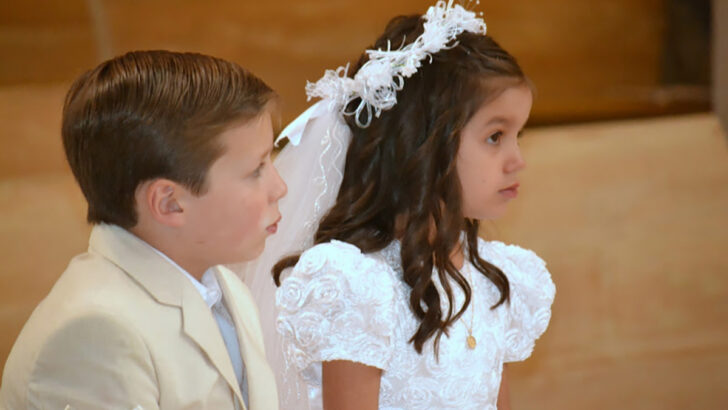 First Holy Communion. Photo: Wikimedia Commons / Mathisfield.
 Some years ago, I was attending a Sunday Mass in Co. Galway, when I came to realise that it was also the occasion for First Holy Communions. Well, that’s a lovely ceremony to behold, and adds extra grace to a summer morning. Didn’t Napoleon say that everyone remembers their First Communion for the rest of their lives?

But seeing the children, and especially the young girls, from a closer range, it did strike me that their appearance seemed a little overdone. Their dresses were so elaborate – some so ballgown-shaped that it was awkward for the child to get into her waiting limousine. Some girls wore mini-tiaras. Some children evidently had facial cosmetics applied.
As I observed events after the ceremony – the photographs and family gatherings – I also realised that many of the families came from Traveller Communities. Everyone was splendidly, maybe even showily, dressed, and there was plenty of jewellery on display too, especially among the dads and uncles.
Each year, during First Communion season, there are complaints about how ostentatious and materialistic the sacramental ceremony has become. And that’s not what it’s supposed to be about. Agreed.
Reactions
And yet, how judgemental should we be about the way that parents and families choose to mark this special day for their child?
I felt distinctly mixed reactions at that Galway church. Obviously, little girls shouldn’t be dolled up to the nines for a spiritual event. But if this is how families in certain communities express their commitment to the occasion, then, who are we to condemn them?
Critics say that the church should rein in over-elaborate costumes, jewellery and general presentation. And I’m sure most priests and religious education teachers do make the point that this is a solemn sacramental event, and not a fashion parade. But the pastor’s duty is often to “meet people where they are”, and that may mean taking account of background culture and traditions.
There’s an entire industry built on wedding planning, constantly pushing for ever more expensive three-day parties”
Some critics, moreover, would like to do away with the First Communion practice altogether, especially in schools.
Everything gets commercialised in a capitalist society. There’s an entire industry built on wedding planning, constantly pushing for ever more expensive three-day parties. That doesn’t invalidate the sacrament of matrimony.
And back in the distant past when I made my First Holy Communion in a much simpler society – yes, choosing the special white dress, accessories and veil underlined the enduring memory of the occasion.
And guess what – even in 1951, I insisted on having, beneath that white veil, a head-dress in the shape of a tiara!
**
Much heartless mockery greeted reports about the shopping sprees of Nicola Sturgeon’s estranged husband, Peter Morrell.
Mr Morrell, who was chief executive of the Scottish Nationalist Party, spent £400,000 of party funds on luxuries great and small. There was a Jaguar car (£57,500), a motor home (£124,550), two Bremont watches (£4,500 each), a Lalique salt and pepper set (£2,618), a silver wine coaster (£3,500), a coffee-machine (£3,232), plus much more, including luxury toilet seats and seven Dyson vacuum cleaners.
He has pleaded guilty to embezzlement and Ms Sturgeon has pleaded that she knew nothing about all this illicit spending. The mockery has targeted her spousal incuriosity as well as his yearning for posh stuff.
But I’d suggest the chap may have a problem – spending sprees are often associated with bipolar disorders.
And there’s another scenario. Nicola Sturgeon, as Scotland’s leader, was a big political celebrity. Not every man can handle being outshone by his wife. And not every wife probes into the spending habits of her husband, especially if it’s all about compensating for her dominance in the public sphere.
**

There’s a special exhibition on at EPIC (the Irish Emigration Museum in Dublin’s Docklands) focusing on emigrants who went to England in the 1940s, 50s, and onwards. It is very professionally done (and well-attended).
Those who found the emigrant’s experience tough, like Bartley Duggan who left Connemara in 1970, are quoted: “Us Irish never got any recognition for the hard work we did in this country, and we worked very hard”. As is Kerrywoman Mollie Kissane who enjoyed her life in England, including wartime experiences: “They were great years. I would have done it all again.” Good times as well as hard times occurred.
Yet there’s also a contradiction in platforming posters alleging job discrimination against the Irish (“No Irish Need Apply”), with the actual evidence that British employers deliberately recruited from Ireland, and were glad to get Irish staff, too. There’s a fine book, Irish Nurses in the NHS, which tracks that successful recruiting policy.
As is usual now, there’s little mention of religious faith in EPIC’s exhibition, although it played such a supportive role in the emigrants’ lot. More than 500 Catholic chaplains served the Irish community over those emigrant years, but their contribution is unacknowledged. Sad