

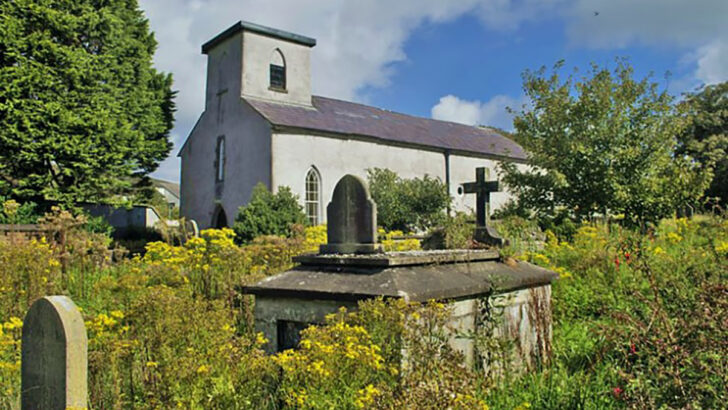
 St James’s Church in Dingle, Co. Kerry
 There are many contested happenings in Irish history – invasion, the conflicts over land, religious hegemony, secularism, the liberal ethic.
One that still raises passions and evokes strong opinions is the nature and place of conversionism, or proselytism, in the Irish story. It hits at the heart of who today’s Irish think they are. It captures stories of compulsion and of resistance to alien religion; but also of sincerity in change of belief and how that sincerity can be accommodated in a pluralistic society.
Karina Wendling is a French scholar, currently an associate professor at the University of Lorraine. Her work attempts to analyse viewpoints without “taking sides”. This book is a tightly argued study of Protestant mission activity in nineteenth century Ireland that significantly complicates the familiar “souperism” narrative.
Rather than treating Protestant proselytism as a simple story of British cultural aggression, her book shows how language, Bible translation, schooling, and conversion intertwined in ways that were both locally rooted and politically charged.
Dr Wendling writes from the outside, and this gives the book a valuable and timely perspective. We are very good at navel-gazing, but it sometimes takes someone who can step back to see the wider and broader picture. This is especially needed in the debate about “colonialism”, and whether Ireland was a simple case of invader and indigenous, ruler and ruled, oppressor and oppressed.
Volatile
The book is set in the Ireland of the first half of the nineteenth century, a particularly volatile era. Catholic society was on the move, both economically and politically. High-level political emancipation was finally achieved in 1829. Catholic economic progress was becoming obvious, especially in the towns and cities.
Yet, as Edward Norman wrote “educated Protestants regarded Catholicism as inimical to the proper conduct of civil affairs and national prosperity alike.” Thus as Catholics came to be accepted – reluctantly and gradually – as part of the notion of “citizenry”, it was imperative to civilise the natives.
All this converges in Wendling’s discussion of souperism, and “the question of the religious nation at the intersection of politics, religion and education.” She does this through the example of the (Protestant) Irish Society for Promoting the Education of the Native Irish through the Medium of Their Own Language, and she argues that the Society cannot just be reduced to a crude vehicle of imperial domination.
The book’s chronological and thematic reach makes it valuable beyond the history of missions alone”
The Society certainly aimed at conversion, but it also worked through Irish-language education and biblical dissemination, which gave its project a more complex and paradoxical character. That complexity matters because it unsettles two long-standing assumptions: first, that Protestant missions simply imposed Englishness; and secondly, that the Irish language belonged naturally and exclusively to Catholic or nationalist politics.
The book’s chronological and thematic reach makes it valuable beyond the history of missions alone. By moving from education to language to “colonial” politics, Wendling places religious competition within broader struggles over identity, authority, and belonging in modern Ireland. The result is a study that speaks to historians of religion, education, nationalism, and colonial discourse at once.
The book argues that language was not merely a neutral medium of instruction. Wendling shows that the Protestant mission’s use of Irish was strategic but also ideologically revealing, because it depended on vernacular access to scripture while claiming loyalty to a British Protestant framework.
Paradox
This produces a striking paradox: a movement often read as an agent of anglicisation was also, in practice, one of the early institutional advocates of Irish in educational and devotional settings.
That paradox gives the book a real interpretive force. It invites readers to see Irish-language activism in a wider, more conflicted field, where religious motives, social care, and imperial power overlapped rather than neatly separated. Catholicism’s devotional language, after all, was Latin, not Irish or English.
Voices are difficult to locate outside the elite in the early nineteenth century. A revealing and thoughtful case-study examines the Irish Society’s “colony” of converts in Dingle in the 1830s and 1840s. Wendling has unearthed some of these forgotten people, memorably one labourer, John Sullivan (although he could write). This section of the book brings conversionism from an abstract “-ism” into a dark and difficult real world.
All that points to a larger truth – the essentially surreal nature of the Protestant project in Ireland”
Ultimately these missions failed. The few converts the missions managed to make soon discovered you couldn’t be a Catholic convert and remain in your home parish – later, virtually all the descendants of the “soupers” were living abroad.
All that points to a larger truth – the essentially surreal nature of the Protestant project in Ireland. It is to Wendling’s credit, though, that she hasn’t succumbed to Irish Protestant Gothic, and she has kept her scholarly feet on the ground.
This is a book that is not only insightful and important for those of us struggling to understand the curiosities of Irish Protestantism, but also a genuine pleasure to read.
Dr d’Alton is a Visiting Research Fellow at the Centre for Contemporary Irish History, TC