

 Peter Costello
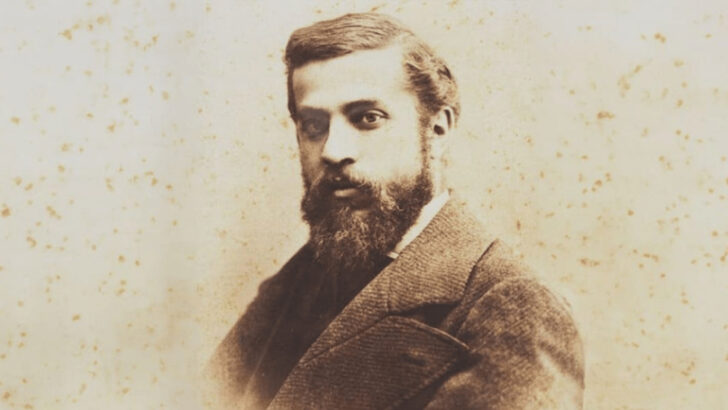 Antoni Gaudi as a young man
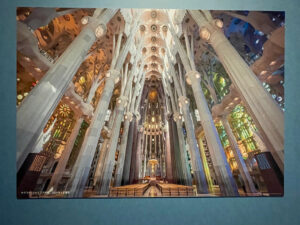
 The completion and inauguration of a cathedral is a rare event in modern Europe. Yesterday the Pope was in Barcelona to inaugurate the cathedral of the Holy Family on the centenary of the death of its architect Antoni Gaudi.

These two books provide two contrasting biographies for readers. Peter Stanford, a well known British Catholic author, has written for the centenary, as well as the first stages towards Gaudi’s possible canonisation, a biography which is concerned on the religious drive behind Gaudi’s work on the Cathedral which is now completed.
On the other hand Grijs van Hensbergen, a Dutch born art historian and Hispanist, who has also written about Picasso, provides a detailed account of Gaudi’s overall career from that perspective. Copies of his earlier work from 2018, The Sagrada Familia: Gaudí’s Heaven on Earth (2018) are still widely available on the internet.
Remarkable
Between them these books would seem to compose a complete picture of a very remarkable man, fervent Catholic, and patriotic Catalan – a person who even dared to speak Catalan in an audience with the king of Spain, a “not done thing” these days with the strong feeling that Catalonia has about its own identity, as well a desire of many there for an independent state of their own.
But Gaudi, born in June 1852, is unfoundedly a special case. Great and remarkable as his religious achievement is as an artist, we have also to keep in mind that he was a working architect, and was responsible for many interesting buildings and structures, across the city of Barcelona.
In his younger days Gaudi was very much a man about town, and the Grill Room Bar Thonet is a charming reminder of this era”
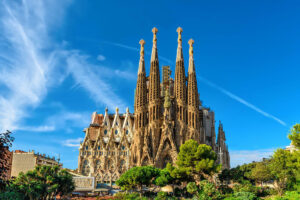
A recent photograph of Barcelona taken from the surrounding hill shows the pinnacles of the Cathedral towering quite literally above the earlier houses and the modern city, but they are unchallenged by examples of modern brutalism such as are to be found in so many cities today from Dublin to Dubai, soulless examples of the Lego-like “buildings systems” approach to modern city planning.
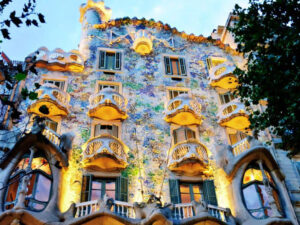
Gaudi was a trained architect; those who gave him his qualification recognised that he was either a genius or a madman, “only time would tell”. He was in fact a little of both. The city is filled with his creations, the Portal Miralles, the Casa Battló – which is now a museum, the Casa Vicens…he has left his mark everywhere. In his younger days Gaudi was very much a man about town, and the Grill Room Bar Thonet is a charming reminder of this era.
Yet the really great work of his life was still to come. The first stone of the proposed cathedral was laid in 1882, and like the cathedrals we admire and worship in across Europe, it took a long time to complete: it was consecrated by Pope Benedict in 2010. But its completion now is due not so much to carrying out a plan as materialising a personal vision.
Changed
Gaudi’s way of life changed after the death of his father in 1909. He became intensely religious, careless of his dress appearance, and often of his behaviour. He lived an almost monastic life as a layman. But he was, it has to be said, well supported by a team of others, architects and craftsmen, as dedicated to his vision as he was. This collectivity is again very medieval. The nature of his work also reflected the era when the painted cathedrals of Europe were a riot of colour.
From the shattered fragments of a broken past, so to speak, he created something wholly new and complete”
It is significant that his work was everywhere marked by the use of trencadis – the use of broken coloured stones and tiles as tesserae. Thus from the shattered fragments of a broken past, so to speak, he created something wholly new and complete. It was an essential part of Gaudi’s moral vision as an architect.
Mention of his moral vision brings to an important aspect of this year’s celebrations in Catalonia – the move under way to have Gaudi canonised. There would usually be a requirement of miracles leading to both his beatification and eventual canonisation. But surely a miracle does not just have to be a medical cure, as is usual. One feels that the heroic application of a prayerful life to the completion of the Sagrada Familia might, for many people, and especially for Catalans, be miraculous enough.