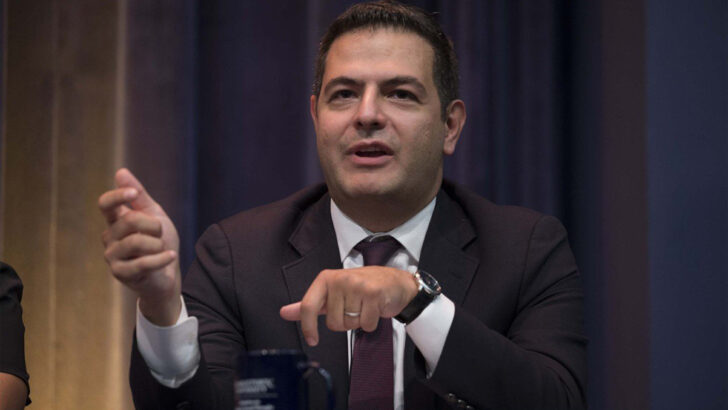
 Sohrab Ahmari speaks at a panel at Georgetown University in Washington, September 11, 2024. Mr Ahmari is US editor of
UnHerd and a contributing editor at Compact magazine. Photo: OSV News / Georgetown University, Leslie E. Kossoff.
Sohrab Ahmari speaks at a panel at Georgetown University in Washington, September 11, 2024. Mr Ahmari is US editor of
UnHerd and a contributing editor at Compact magazine. Photo: OSV News / Georgetown University, Leslie E. Kossoff. Seven years after From Fire, by Water first appeared, Mr Ahmari is not especially interested in retelling his conversion story. The memoir, which traces his journey from post-revolutionary Iran through atheism and into the Catholic Church, is now being released in a UK edition with a new preface. But speaking to The Irish Catholic, Mr Ahmari returned less to the details of his conversion than to the country of his childhood.

“I think the book speaks for itself,” he says. “I’ve done a ton of interviews.” What interests him more now is Iran, and the ways in which it continues to be misunderstood.
Iran
Part of the picture, he says, is familiar. “It’s an authoritarian regime motivated by a particular interpretation of Shiite Islam.” But that is only part of the story. Even at the height of its revolutionary zeal, there was more room for private life than outsiders might expect.
“My parents always drank alcohol. There were always Western movies in our house,” he says. These films were contraband at the time, but widely consumed behind closed doors. The result was a kind of double life. “There was the world inside our house,” he says, “and then there was the world outside.”
Iranians, he adds, are not passive subjects of ideology. “They’re very sarcastic, funny… they defy it a lot too.” That tension, between public conformity and private resistance, remains a defining feature of Iranian life.
At the same time, he cautions against a simple picture of widespread opposition. Recent events, he says, have been a reminder that support for the regime is not purely transactional. “We used to think that the only people who support the regime must do it because they get material benefits,” he says. “But part of it is also belief.”
Growing up within that system shaped his early understanding of religion. It was not something he encountered as a living faith, but as something imposed and often hypocritical. “I just decided that God is this sort of public hypocrisy or charade,” he says. In the circles he moved in, religion was seen as something for the uneducated. “If you were educated, if you were urban, if you were intelligent, you couldn’t possibly take it seriously.”
Conversion
That instinct of rebellion carried over into his life in the United States, where his family settled when he was a teenager. The memoir follows what he describes as an intellectual journey through the dominant ideas of modernity, moving through Nietzsche, existentialism, Marxism and postmodern thought in search of meaning.
Looking back now, he is conscious that the book captures only one stage of that process. “A memoir is a strange sort of book,” he says. “It’s like amber. It preserves a snapshot in time.” The difficulty is that the person who wrote it continues to change.
Their partial truths can help us discern the cruciform shape of the world and spur us to cling more tightly to the cross”
One of the shortcomings he now sees in From Fire, by Water is what he calls its “renunciatory” tone. “It was very much, ‘this is wrong, that is wrong, everything is wrong,’” he says. With distance, that approach now seems incomplete.
Christianity, he insists, contains the fullness of truth. But that does not mean other traditions are without value. “Christians can and should be in dialogue with worldly traditions,” he says. “Their partial truths can help us discern the cruciform shape of the world and spur us to cling more tightly to the cross.”
That shift reflects a deeper confidence in the tradition he has entered. Rather than rejecting everything that came before, he now sees the possibility of engagement. Figures such as St Augustine and St Thomas Aquinas, he notes, did not simply discard non-Christian thought, but engaged with it critically, recognising what was true while also realising its limits.
Ideology
That same suspicion of total rejection informs his reading of contemporary Iran. Among some critics of the regime, particularly in the diaspora, there is a tendency to treat Islam itself as something to be removed from Iranian identity. Mr Ahmari sees this as a mistake.
“Islam is so deeply interwoven” into Iranian life, he says. Attempts to imagine a future that excludes it risk alienating large parts of the population. “If you say that we’re going to tear everything down, why would people defect?” he asks.
This complexity becomes especially important in the context of the current conflict. Western discussions, he suggests, often flatten the distinction between regime and people, or assume a unified desire for change that does not exist in reality.
If a society says we don’t have a worldview… that itself is a metaphysical claim”
His own experience of growing up in an overtly ideological state has also shaped how he sees the West. In Iran, ideology is visible like in the movie They Live. “It’s like you always have your glasses on,” he says. “You always see the ideology.”
In Western societies, by contrast, ideology is less explicit, but no less real. “If a society says we don’t have a worldview… that itself is a metaphysical claim,” he says.
These reflections form part of a broader reassessment that is also evident in the new preface to his memoir. There, he points to the pressures of contemporary Western life and the ways in which economic and cultural conditions can make the transmission of faith more difficult.
War
Yet it is the present crisis that brings these themes into sharpest focus. Having once supported a more interventionist foreign policy, Mr Ahmari now speaks with caution about the use of force.
“I used to be a very true-believing neoconservative,” he says. The experience of the post-9/11 wars has changed that outlook. “It all went to hell.”
The lesson he draws is a modest one. In a region as volatile as the Middle East, the goal should not be ambitious projects of transformation, but the prevention of further collapse. “If we can just… prevent it from descending into chaos, that’s good enough,” he says.
He is particularly critical of what he calls the “fantasies of liberation through bombs.” The idea that external force can remake a society, he argues, has repeatedly failed. “This is a kind of opening the gates of hell,” he says. “I think it’s a mistake.”
If there is a hope to be found, it lies not in sweeping change, but in restraint. “If we can just restore calm and responsibility and mutual respect,” he says, “that’s good enough for me.”
For Mr Ahmari, the republication of From Fire, by Water comes at a moment that underscores how much has changed since it was first written. The book remains a record of a particular journey, preserved, as he puts it, “like amber.” But the reflections that accompany it now point toward something more measured.
People do not stop changing, he suggests. They continue to think, to grow, to argue even with themselves. And in that ongoing process, both faith and politics may require a certain humility.