

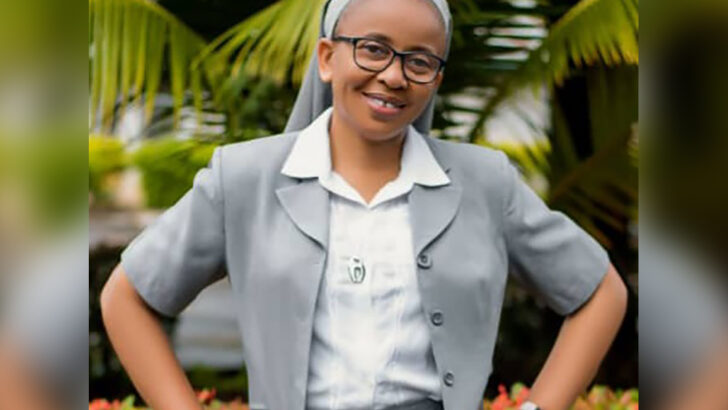
 Sr Ekaete Ekop, a Medical Missionary of Mary and
obstetrician-gynaecologist working in Nigeria. Photos:
Courtesy of Sr Ekaete Ekop
Sr Ekaete Ekop, a Medical Missionary of Mary and
obstetrician-gynaecologist working in Nigeria. Photos:
Courtesy of Sr Ekaete Ekop I said to her, what’s the problem? You don’t want to have a caesarean section. And she said, ‘Why are you so bent on the caesarean section? You haven’t even checked to see whether I can have a baby.’”
The woman had already undergone two previous caesarean sections. Medically, a third was necessary. Attempting a natural birth carried serious risks for both mother and child. But each time she came to the hospital, she left again, unwilling to consent.
“I could feel my irritation. Why are you taking a risk? But then I remembered, she’s not taking a risk. I need to find out what the issue is.
“So I took her into the labour room and I did a full examination. After I had done the exam, I said, you know, I don’t think you’ll be able to make it because of this, because of that.
“And as I turned round to take off my gloves, when I turned back, she was standing… and she said, ‘So where is the theatre?’
“It was like magic. All I had done was not condemn her, was meet her halfway.”
For Sr Ekaete Ekop, a Medical Missionary of Mary (MMM) and obstetrician-gynaecologist working in Abakaliki in southeastern Nigeria, moments like this have come to define what healing means to her.
Professed
Sr Ekaete has been professed as a sister for 27 years, having joined the congregation in 1995 after training in medicine and surgery. Coming from a medical family, her father a surgeon and her mother a senior nurse, she had always imagined a life of service, though not originally in religious life.
“Truly, when I was young, I never thought of being a religious. It wasn’t part of my dreams. I wanted to have many children, like eight. But somewhere along the line… I think Jeremiah says it well when he says, ‘You have seduced me away.’ Somehow I found myself beginning to think about being a religious, and I had to find out what it was all about. So after medical school, after my internship and national service, I joined.”
We started off trying to bring medical services and liturgy to the missions. But over time the whole concept of healing has expanded”
From 2015 to 2022, she also spent time in Dublin as part of the congregation’s leadership team.
While the charism of the MMMs was originally rooted in healthcare, Sr Ekaete says the understanding of healing has widened significantly over time.
“The name Medical Missionaries of Mary is kind of historical. We started off trying to bring medical services and liturgy to the missions. But over time the whole concept of healing has expanded. So we will do anything to promote the health and wholeness of peoples and the environment. In the MMM constitutions, we say: when you go into any place, study the people’s understanding of health, of sickness, of death, of life. And then you’re working with them. You’re not imposing your own understanding on them.”
Central
That approach has become central to her work, particularly with women and mothers.
“A lot of the problems the women are presenting with have other drivers – social, cultural, religious, economic. So just staying in the hospital alone will not solve the problem. You watch them come in bad, you help them, but if you could go back into the society and meet these people long before the problem happens, then together they could make different kinds of decisions.”
As she continued in the work, it began to change her understandings too. In a country with one of the highest maternal mortality rates in the world, she says it also led her to look beyond the immediate medical causes of illness and death.
“Why are women dying? If you go to the WHO website, they will tell you they’re dying of haemorrhage, of eclampsia – those medical conditions. Yes, those are the things we see kill them in the hospital. But if you look beyond that… why will a woman who bleeds have a higher chance of dying in Nigeria than in another country?
If we don’t address these things, it’s not going to go down, no matter how well equipped our hospitals are”
“You begin to see other things. Her understanding of life, of pregnancy, the high premium put on childbearing. If you’re not producing children, you suffer psychological torture… you’re not seen as a full woman. And then there is poverty, the ability to take decisions for yourself, the need to wait for someone to permit you to go to hospital, the fear of caesarean section.
“If we don’t address these things, it’s not going to go down, no matter how well equipped our hospitals are.”
Asked what this shift meant in practice, she points first to a change in herself.
“The first change I would notice is the one that happened in me. I became less judgmental, I became less irritable, and I started listening more to the women and saying, what can we do together? Where is our meeting point?
“They’re not just being stubborn. They’re protecting something we don’t understand. She’s not coming for the eighth pregnancy because she is stupid. We need to find out what is making her go for that. And when we meet them halfway, their acceptance of medical care is better, because they feel, okay, you’re on our side now… so we trust you.”
Hope
She has seen that trust lead to moments of unexpected hope. Recalling one particularly difficult case, she speaks of a woman who had lost a previous baby and was carrying a high-risk pregnancy: “I said to her, you are carrying a very risky pregnancy and you are too far away from the hospital. Could you come and stay around the hospital? She said she couldn’t afford it. But the staff were beautiful. They helped her, some gave her food, some allowed her to stay with them. We were seeing her almost twice every week.”
When the time came for surgery, the outcome was uncertain: “As soon as I brought out the baby and she heard the child cry, her first exclamation was, ‘Oh, thank God, I’m definitely going to have another baby.’
“She had gone through the whole pregnancy afraid she might die… and now suddenly there was this big smile on her face. For me, that was a story of hope… God doing what God does best. It was a privilege to be part of that story.”
For Sr Ekaete, these encounters are inseparable from her faith.
“God speaks to me through these women. They have taught me about life, about love, about compassion, about empathy, about God. We live Benedictine spirituality, and Benedict says, treat the farm utensils with the same reverence you treat the sacred vessels on the altar. So there is no sacred and secular. Everything is sacred. My time in the chapel is as crucial in the work of salvation as listening to these women. In fact, one feeds the other.”
That same perspective shapes how she accompanies women in moments of fear.
“In our hospital, before surgery, we ask the woman to pray. And sometimes she says, ‘No, sister, you pray.’ And I say, no, you are the mother of this baby, you speak.
“You have the power here. I’m only an instrument. And when they pray, sometimes they begin by naming everything they don’t want to happen. And I say, no, don’t put those things in your mind. Tell God what you want to happen. Speak life.”
“It’s not magic,” she says. “It’s to help her trust that God is on her side.”
“This work is not so much of a sacrifice. I see it more as a privilege. It’s almost like having a front seat in the arena of what God is doing in people’s lives.”