

 Peter Costello
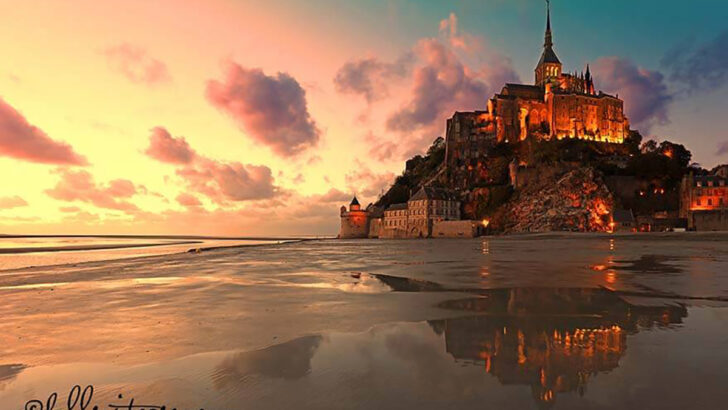 Mont St Michel at sunset
 Notre-Dame de Paris,
by Victor Hugo, newly translated from the French with an introduction by John Sturrock
(Penguin Classics, €13.99)
After its formal reopening at the end of last year, Notre Dame cathedral in Paris this summer returned, after those dark years of closure, to its place as the most popular tourist attraction in France, certainly in Paris.
But it is now having to deal with a new attitude across Europe from Spain to Greece over “surtourisme” and its baleful effects on local communities across the continent.
Once, say in 1950s Spain, tourism was seen as an essential source of revenues and “economic development”. Now many communities see that their own particular ways of life, which the tourists presumably come to see, is being seriously damaged. Here we are well aware of this, especially in Dublin and the problem of Temple Bar. A reaction has begun to set in against over dependence on tourists.
In Paris those wishing to visit Notre Dame will now have to book online for a set window of time to make their visit, the length of which is carefully limited.
Controls
Such controls are needed. Certainly when a year or two ago we visited Venice, our experience of St Mark’s was a bleak and disappointing affair, from which neither culture nor religion benefited. Rereading Ruskin’s Stones of Venice (1851-1853) was a direct way back to the medieval spirit.
So too, reading Victor Hugo’s classic novel in this careful modern translation might be a better way for some to engage with medieval Paris, in which despite the vulgar Victorian title usually used, the misfortunate Hunchback plays only a limited role. The book provides a vision of the middle ages which further reading will only enrich.
In the rest of what the French call “the Hexagon”, the leading attraction is Mont St Michel in Normandy. This is indeed a strange experience, for it too gets millions of visitors.
Passing through the main gate one is on the rising main street which at first is devoted to restaurants, shops and other attractions. Only by stages does one actually reach the Abbey itself. As one ascends the steep hill the numbers lessen; certainly a good few reach the main building, but go no further.
It was reported last week that over a third of the priests now active in France are born outside the Hexagon, mainly in Africa”
If one continues you eventually come out on the roof with a wide view over the Channel which is indeed quite astonishing. But you may well find that there are only a couple of other people there; the vast horde crowded through the main gate have fallen by the wayside.
Some would say if you want to see faith in action avoid such places and go to Lourdes, as so many do. Or, if one wants a quieter, more traditional pilgrimage, the celebrations at Sainte-Anne – d’Auray, on 26 July, with their traditional Breton features are still a very real expression of faith.
Signs
Yet there are signs that all is not well in the Church in France. It was reported last week that over a third of the priests now active in France are born outside the Hexagon, mainly in Africa.
In France one can see wherever one goes the monuments of the Church’s past. But there are also hints of the Church’s future. But there is an aspect of the local l churches in France which could be copied here.
Everywhere one goes one will find that the parishes are prepared for the tourist, they offer not only a place for a few moments of peace and reflection, but also a history of the place one is sitting in, but also pamphlets on the meaning of Christianity for those who are not Chrstians.
The tourist boom may play an unsuspected role in evangelisation, as indeed may a reading of what exactly Victor Hugo wrote about medieval Paris in Notre-Dame-de-Paris for those drawn to visit it again.