

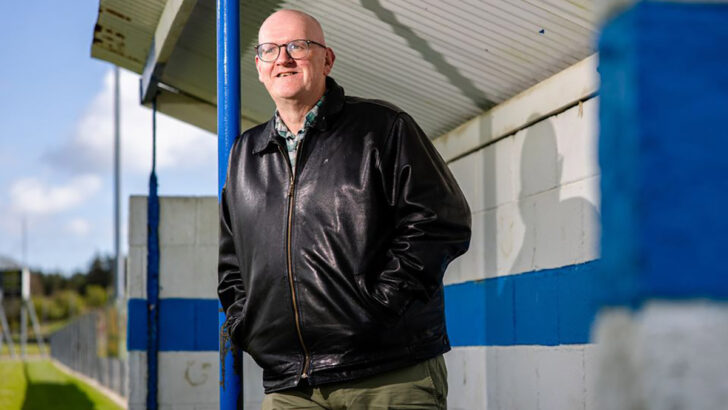
 Author Eamonn Sweeney takes a stand. Photo: courtesy Hachette Ireland
 The Last Ditch: How one GAA Championship gave a Sports Writer back his Life,
by Eamonn Sweeney
(Hachette Books, €20.00 / £16.99)
The author is a sportswriter and in the first two chapters reveals the challenges – phobias – which he has to overcome in plying his trade.

In the rest of the book Eamonn Sweeney in a way no other writer has done captures the ambience, culture and traditions which enshrine Gaelic games: football and hurling. He attended Gaelic football and hurling matches across Ireland during the Senior Football and Hurling Championships of 2024. He describes the ‘build-up’ and aftermath of matches, the fans of the various teams and the exchanges he had with them.
The first fixture he attends is the Munster Senior Football final between Cork and Kerry. He begins by commenting on the unique scenic location of Fitzgerald Stadium. Then he acknowledges that support for the fixture has declined in recent years, owing to the dominance of some exceptional Kerry teams. However, in the event the match in 2024 was closely contested.
Sweeney is greatly impressed by the football skills of David Clifford. He notes that the Fossa man was already well-known for his heroics in the under-18 and under-20 competitions.
Kingston was hurling’s ‘little girl with the curl in the middle of her forehead’. When he was good he was really, really good, but when he was bad he was horrid”
On advancing to the senior level of football he did not disappoint. Crowds flooded to see him play, and at the end of games hundreds of children flocked around him seeking his autograph and being received with great courtesy and patience. Sweeney even claims that a legendary aura similar to the one that once surrounded Christy Ring and Mick O’Connell already hovers over him.
Sweeney next attends a crucial match in the All-Ireland Hurling Championship between Cork and Limerick. He applauds the upsurge in Limerick hurling, John Kiely and his remarkable team.
In the case of Cork, he welcomes them to the later stages of the championship. For decades they and the county’s footballers had been in the doldrums, owing to intractable disputes between the Cork County Board and their senior county players. In the event, Cork won the match because of a penalty won by Shane Kingston who had come on as a substitute.
Sweeny concludes his account of the match with a delightful pen picture of Kingston: “Kingston was hurling’s ‘little girl with the curl in the middle of her forehead’. When he was good he was really, really good, but when he was bad he was horrid”.
Commentary
Sweeney’s next match was Galway versus Kilkenny in the All-Ireland Leinster hurling championship at Salthill. It ended in a draw and prompted him to comment on the unsurpassed success of Brian Cody as Kilkenny’s manager. Remaining in the West, he attends the Connacht Senior Football final between Galway and Mayo.
He discusses the differing managerial styles of Kevin McStay and Pádraic Joyce, the footballing skills of Damien Comer and Shane Walsh and the penchant Mayo football teams have for losing finals.
Sweeney’s next call is O’Moore Park in Portlaoise for a pedestrian encounter between Laois and Offaly in the Leinster Co. Championship. Offaly won the match to advance to next meet the all-conquering Dublin footballers.
Sweeney bemoans the static lateral football of the Armagh-Galway final of 2024, which made a change in the rules of the football game imperative. He welcomes the new rules introduced by Jim Gavin and his committee.
He congratulates the GAA for their practical concern for players struggling with addictions and mental health difficulties”
However, there are some alarming omissions in Sweeney’s narrative. He seems to be oblivious to the excellent football teams in Ulster who have added an “edge” and sparkle to the championship. He does not even refer to the unfortunate re-scheduling of the championships, having them conclude at the end of July and leaving the TV screens totally to their historic competitors: rugby and soccer, for the rest of the year.
Before signing off Sweeney warmly welcomes the remarkable upsurge and interest in the GAA women’s games of camogie and ladies’ Gaelic football. He congratulates the GAA for their practical concern for players struggling with addictions and mental health difficulties.
While reporting on matches Eamon Sweeney tells the reader much about himself and his family, all of which reveal him to be not only a fairly typical GAA follower, but also an admirable person.