

 Peter Costello
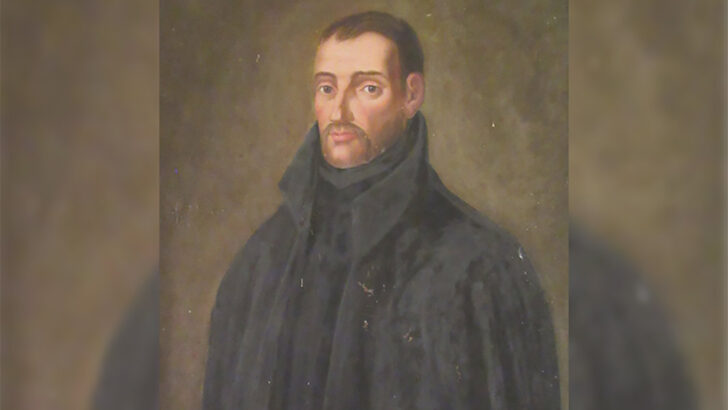 Portrait of St Pierre Favre in the chapel dedicated to him in Le Villaret
By Way of the Heart: Pierre Favre SJ, the First Jesuit Companion,
by Brendan Comerford SJ
(Messenger Publications, €12.95 / £10.95)
In any great enterprise the initiating leader needs associates to make the new initiative a success. Among the Jesuits the names of Ignatius Loyola himself and Francis Xavier are well known. Less well known, one might almost say quite forgotten by many, was the quiet, less dramatic character of Pierre Favre.

It fills up what was indeed a strangely empty space in the early history of the Jesuits, when as mentioned in passing a travelling party of three Jesuits had to share, turn and turn about, a single mule.
To older readers he may be better known as Peter Faber – the result of inter-linguistic confusion, as his birth name was indeed Pierre Favre and is not established as the more usual version of his name.
Career
In this new biography Brendan Comerford, currently co-ordinator of St Francis Xavier Church in Gardiner Street, Dublin, aims to set this right. Despite his contemporary fame Pierre Favre passed into the shadows. In his own time he was well recognised. He was the first of the early companions of Loyola to be ordained.
He died from a fever in Rome on his way to assist the Council of Trent in 1546. The move towards his beatification began a mere 80 years after his death. But then it stalled so that he was only beatified in 1872.
He was canonised by Pope Francis on December 17, 2013, through the canonical process known as ‘equivalent canonisation,’ which allows a saint to be declared without the typical requirement of proving that miracles were owed to his intercession.
When his long suppressed writings came to be published during the 19th century, it was this intense local devotion that opened up the way to his eventual canonisation”
Asked about this, Pope Francis spoke about Pierre Favre’s “dialogue with all, even the most remote and even with his opponents; his simple piety, a certain naïveté perhaps; his being available straight away; his careful interior discernment; the fact that he was a man capable of great and strong decisions but also capable of being so gentle and loving.”
In his career he seems to have travelled constantly. He was a seemingly rootless person, except in one place, his native Savoy. It was there, where many Savoyards called him popularly “blessed” and “saint”, that a local devotion to him sprang up. When his long suppressed writings came to be published during the 19th century, it was this intense local devotion that opened up the way to his eventual canonisation.
Parts
Fr Comerford’s book is divided into two parts. The first part deals with the course of the saint’s life, much of which was devoted to journeys to and fro across Europe to what one might call perhaps the front lines of religious debate and conflict in the opening days of the Reformation that culminated in the Council of Trent.
The book concludes with some pages devoted to the prayers and spiritual counsels of Pierre Favre, set out to inspire the further reflections of the reader.
Following this biographical outline, the second part is devoted to an analysis of the saint’s heart, through which he worked for those he encountered in six chapters devoted to the qualities of character that made him the man he was in life. His sense of prayer, his compassion and empathy for others, his sensitive nature, his discerning insight, all combined in a gentle obedient yet personable soul. He was very much “a man of his own time”, yet personally diffident and timid at times.
He was indeed not only a man for all men, but now for all times. St Pierre Favre’s exhortation is one which will strike many as worthy of daily recollection in these days of deep division around the world: “Take care, take care, never to close your heart to anyone.”